# Get Your Free Copy

### **Get Smart on the $100 Trillion Opportunity in Web3**

Web3 can be confusing – the space is rapidly evolving and there are a ton of different “buzzwords” such as cryptocurrencies, DeFi, NFTs, DAOs, Layer 1s, Layer 2s, the Metaverse, etc…

*Digital Nations* will show you how all these pieces will tie together to create **the world’s first truly "borderless" economies**.&#x20;

<figure><img src="/files/17TeyUHRQscU4dA4L4jZ" alt=""><figcaption></figcaption></figure>

Download your free copy of *Digital Nations* here:

{% file src="/files/wCwwffJit0CxQM9AYI7Q" %}

In this book you'll learn: &#x20;

* How Web3 is going to create the first digital nations
* Why our current economic system is flawed and how Web3 will fix it
* Easy to understand descriptions of how decentralized economic systems work – in particular how technologies such as blockchains, digital key cryptography, consensus mining and smart contracts combine to form decentralized “world computers”&#x20;
* A deep understanding of cryptocurrencies, DeFi, NFTs, DAOs, smart contract platforms and the metaverse, and how all of these concepts will combine to form the world’s first truly autonomous digital nations
* The technical architecture of the Web3 ecosystem and the key “picks and shovels” protocols that support the network (such as wallets, decentralized ISPs, node providers, decentralized storage, oracles and virtual worlds)
* The often-overlooked challenges that plague Web3 and how we are working to fix them
* Why Web3 could easily be a $100+ trillion investment opportunity&#x20;

You can also check out this website for: 1) a deeper dive into much of the material in the book, 2) free research reports on important protocols and 3) a free “Web3 University” section that highlights the best resources I’ve come across for learning more about the space (e.g. books, articles, videos, podcasts, twitter accounts, etc…)

\
I hope that you find the site helpful and, if you like it, please don’t hesitate to share and follow me on [Twitter](https://twitter.com/mtorygreen?lang=en) for updates on developing trends!

&#x20;                                                                                                                                       \- Tory Green&#x20;

*Note: This content is for informational purposes only, you should not construe any such information or other material as legal, tax, investment, financial, or other advice.*


# What is Web3?

A comprehensive overview of the trends, technologies, important sectors, key players, problems and potential of Web3.

<figure><img src="/files/PdBXGzToI5dDmB7iczqi" alt=""><figcaption><p>Photo <a href="https://www.dreamstime.com/cubes-logo-cryptocurrency-bitcoin-ethereum-tether-usd-coin-bnb-xrp-solana-avalanche-crypto-money-concept-image251459943">251459943</a> © <a href="https://www.dreamstime.com/photogranary_info">Simon Lehmann</a> | <a href="https://www.dreamstime.com/photos-images/avalanche-polygon-solana.html">Dreamstime.com</a></p></figcaption></figure>

Few people truly understand the potential of Web3.&#x20;

It’s not – as most people think – simply the “next version of the internet”.  Instead, it’s creating the world’s **first autonomous** **digital nations**.&#x20;

Seemingly disparate verticals such as cryptocurrencies, DeFi, NFTs, smart contract platforms and DAOs will combine to form the building blocks of “borderless” economies that **operate outside of the purview of the existing financial, legal and political ecosystem.**   These new organizations can eliminate many of the costs, restrictions and regulations that hamper us today, and may also help overturn centuries of inequality and economic oppression.    &#x20;

To understand why this is so relevant now, consider the fact that we are becoming a digital species.  Over 5 billion people use the internet and **the average American spends more than 8 hours online everyday** (over 50% of our waking hours!).  The technology has revolutionized information sharing, communication and connectivity, becoming arguably the most efficient system for organizing people that has ever existed.&#x20;

&#x20;              **5+ Billion People Use the Internet, Spending an Average of 8 Hours Online per Day**

<figure><img src="/files/UTIe1RNgsbesz4CMYHVm" alt=""><figcaption><p>Source: Hootsuite and Statista</p></figcaption></figure>

Despite all this, the internet is still a vassal to legacy economic systems.  It is almost entirely controlled by third parties – we make transactions in national currencies such as the US Dollar, digital goods are created and controlled by companies such as Google, Amazon, Facebook and Apple and the space is subject to a patchwork of local laws and regulations – such as the European Union’s GDPR or China’s Great Firewall.&#x20;

The technology behind Web3 changes all of this, and allows us – for the first time in history – to create  fully sovereign, self-sufficient online economies with their own:

* **Money**:  Cryptocurrencies will replace national, fiat currencies as the new nation’s money
* **Financial System**:  DeFi will replace banks as the native financial system
* **Native Goods**:  NFTs – assets which are entirely created, used and owned online – will become the native goods of this new economy
* **Laws**:  Smart Contract Platforms will replace local administrations and legacy legal systems as the governing law
* **Corporations**:  DAOs will replace corporations as the primary economic entities

The potential for this shift is massive, as liberating the trillions in value created by the internet into its own sovereign entities could change the world in ways we can’t even imagine.


# The Problem with Centralized Economies

Our current political-legal-economic infrastructure is highly centralized and still relatively autocratic.&#x20;

National governments are the only entity with the power to create laws and issue currencies, banks control the money supply and flow of capital and large corporations have a near monopoly on the production and sale of most goods and services.&#x20;

&#x20;              **Governments, Banks and Corporations Have a Monopoly on the Economy**

<figure><img src="/files/MbS7xe5C8CP0xOrEg9e9" alt=""><figcaption></figcaption></figure>

Unlike many in the crypto space, I don’t hate this system.  In fact, I think that it has served us remarkably well and has undoubtedly been a key driver of prosperity over the few centuries.  Governments provide security and help establish trust through laws and regulation, the international financial sector facilitates growth via trade and the international flow of investment capital and corporations help coordinate the production and distribution of goods and services.&#x20;

But, like any centralized system, our current infrastructure has its issues.  It’s bloated, byzantine and  draconian and – worst of all – it consolidates power in the hands of the few.  This leads to numerous problems including:&#x20;

* **Expensive and Inefficient:**  Governments, banks and large corporations are highly inefficient.  Hierarchical layers slow communication and new ideas must often pass-through multiple rounds of approval before being implemented.  To make matters worse, armies of bankers, lawyers, accountants, executives and bureaucrats are required to maintain the system, costing an estimated $7 trillion a year in the US ([or 35% of GDP](https://papers.ssrn.com/sol3/papers.cfm?abstract_id=3218761))
* **Potential for Corruption**:  Even the best centralized economies are notoriously opaque.  We aren’t privy to many of the internal decisions of our government, corporations are only required to share certain types of information on an intermittent basis and – as the financial crisis of 2008 proved – even the banks and regulators had little idea what was sitting on the balance sheets of our largest financial institutions.  At best, this opacity is a recipe for negligence, at worst, it is a breeding ground for corruption&#x20;
* **Seizure:**  In our current system, it’s debatable whether you really own your assets.  Many governments can arbitrarily revoke citizenship, corporations can take your digital goods and banks can freeze and even seize your assets at will.  While this may seem far-fetched, consider that in 2013, the Government of Cyprus seized 47.5% of all bank accounts over €100,000 to bail-out its failing banking system  &#x20;
* **Limited Access**:  The economic agents of nation-states are the ultimate gatekeepers.  Gaining citizenship to many countries is often impossible and banks can decide whether they want you as a customer.  While the latter is generally not a problem in the developed world, this is a huge issue in growing economies.  Today, nearly 1.7 billion people remain unbanked simply because they aren’t profitable enough to be considered by global financial institutions
* **Limited Privacy:**  Our current system offers citizens very little privacy.  Governments require extensive documentation, banks must collect detailed personal information to adhere to KYC, AML and CFT regulations and companies such as Facebook own all the data you post.  While in some cases this produces comical effects (such as a man learning from Facebook that he was going to be a father before his wife told him), it has also produced dystopian ones (such as Facebook illegally sharing user vast amounts of private user data with third parties in the Cambridge Analytica scandal)&#x20;
* **Censorship:**  While many modern democracies have codified freedom of speech, this unfortunately doesn’t always apply to private institutions.   Companies such as Twitter have full discretion over who can access its site and whom they can ban.  To date, they have banned hundreds of thousands of people, including several high-profile users.  This problem also isn’t limited to social media, as Apple recently banned Epic Games, the creator of the multi-billion dollar game Fortnite, from its App Store after a revenue dispute
* **Hidden Taxes:**  In addition to the taxes we pay to the federal government, citizens of many developed nation states are also subject to a variety of “hidden taxes”.  For instance, banks often charge enormous fees on credit card transactions and international money transfers, and “Big Tech” often takes a large cut of revenues earned by artists and entrepreneurs.  For instance, Spotify garners 30% of the revenues from a song, and Apple often charges a 30% “tax” on every sale made through their App Store&#x20;
* **Lack of Interoperability**:  Many players in the economic ecosystem of modern nation-states operate as “walled gardens”, limiting the interoperability between financial institutions and technology companies (i.e. an app built for Apple’s App Store will rarely work on Google).  This makes it difficult to even transfer assets between entities let alone share and collaborate on new technologies and products

Together, these concerns represent a major problem.  Not only do they limit growth, but they also continue to drive inequality.

So why do we tolerate these inefficiencies?  Well, we don’t really have a choice due to what is known as the Byzantine General’s Problem.  While I’m oversimplifying a bit, this concept basically states that large groups of humans can’t trust one another or coordinate across vast distances without using centralized third parties (such as governments, banks or corporations) to establish trust.  For example, when a stranger sends you money online, you must rely on your bank to ensure that 1) they are whom they say they are and 2) they have the money they say they have and 3) they actually send it.


# The Benefits of Decentralized Economies

This all changed in 2009 when Satoshi Nakamoto invented Bitcoin, solving the Byzantine General’s Problem and setting off a chain of events which made the concept of “decentralization” possible.

While the mechanics of this invention will be discussed more below, the key thing to remember is that he (or she) combined three technologies - blockchains, public and private key cryptography and consensus mining – to create a system that could autonomously authenticate economic actors, verify their funds and guarantee the completion of a transaction.

In effect, for the first time in history, Satoshi made it possible to create **an economy that doesn’t** **rely on** **third parties such as corporations, banks, governments or courts to function**.&#x20;

&#x20;     **Web3 Economies don’t Require Banks, Governments, Courts or Corporations to Function**

<figure><img src="/files/UT62LJsE6TV7pQr0qygr" alt=""><figcaption></figcaption></figure>

The effect of this cannot be overstated and requires a bit of *tabula rasa* thinking.  Imagine for a bit, how you would design an economy if you no longer needed intermediaries:&#x20;

* After all, what’s the point of relying on central banks and treasury departments if you can issue your own money and control the supply?
* What’s the point of banks if you can safely hold your own assets, raise your own funds and orchestrate your own lending and borrowing protocols?
* Why do we need Big Tech if we can create and own our own digital goods?&#x20;
* Why do we need to rely on local governments and courts if we can enforce our own laws through smart contracts?

If you’re like me, you’re probably envisioning something much simpler and more elegant than what we have today…

In short, an economy without unnecessary middlemen.&#x20;

This, my friends, is Web3.  And it may allow us to reap all the benefits of a traditional economy – namely trust, security and growth – while removing most of the downsides.  Indeed, Web3 is:

* **Fast and Efficient**:  Web3 operates almost entirely via computer programs which automate the execution of all transactions.  As such, there’s no need for intermediaries such as bankers, regulators, lawyers, accountants, executives or government bureaucrats – making the system much faster and cheaper
* **Transparency**:  Every transaction in Web3 is broadcast to the public allowing for real-time monitoring and maximum transparency.  In addition, protocols are built with open-source code allowing any user to audit them, greatly reducing the threat of corruption and serving as a safeguard against negligence&#x20;
* **Seizure-Proof**:  In Web3, you control your assets.  Instead of relying on banks, governments and corporations, you hold your funds, identity and digital goods in your own digital wallet.  As such, there’s no one to seize your assets, limit withdrawals or tell you where you can and can’t spend your money
* **Permission-Less**:   No one can stop you from accessing Web3.  Anyone with an internet connection can participate in markets that are open 24 hours a day, 7 days a week and 365 days a year
* **Borderless:**  Web3 has no borders.  Users can store millions (or more) on a thumb drive or online wallet (not recommended) and go anywhere they please.  They can send money to relatives living abroad, perform cross-border transactions and invest in foreign companies without having to pay outrageous fees or navigate a labyrinth of international laws
* **Private**:  Web3 is designed so that users have complete ownership of their data – in fact, it’s completely possible (and often preferred) to navigate Web3 in a completely anonymous fashion
* **Eliminates Censorship**:  No one in Web3 can censor you.  Anyone is free to upload any content, no matter how controversial, to any platform they so choose
* **Permanence**:  Because a decentralized internet is hosted on thousands of devices across the world, it’s very resistant to failures and almost impossible to shut down (unlike traditional nations, digital states can’t be conquered with tanks, bombs or guns)
* **More Money for Artists:**  Artists, musicians, game developers and entrepreneurs could increase their profits by an order of magnitude when we remove the current gatekeepers of the web.  In fact, we are already seeing this take shape, as some Web3 services such as Audius (a decentralized version of Spotify) increase a musician’s share from 12% to 90%!
* **More Money for Consumers**:  Users will be able to choose whether they want to be paid for creating content or sharing their data and they will also have the right to sell the virtual goods that they earn online.  We already saw this happen last year in the Philippines, where many citizens made more money selling the digital assets they earned playing the blockchain-based game Axie Infinity than they would have from working full-time as a teacher, construction workers or office assistant&#x20;
* **Interoperability**:  Web3 protocols are built to be composable, that is, they can be programmed to work with one another allowing users to build increasingly complex and novel products

I know this is a lot to take in.  Crypto is so unique, so transformative, so unintuitive that I’ve been studying it for over six years now and sometimes I feel like I only partially get it.

But to help you understand more about how Web3 can transform the world, let’s go a bit deeper down the rabbit hole and learn how it works on a technical level…


# How do Decentralized Economies Work?

As discussed, centralized systems exist because of the need to create trust.  We trust banks to hold and transfer our money, governments to enforce contracts and laws and corporations to establish the legitimacy and ownership of digital goods.&#x20;

Decentralized systems are so innovative because they allow us to do all of these functions without the aforementioned “middlemen”.&#x20;

&#x20;              **Decentralized Systems Provide the Money, Goods and Law of a Digital Nation**

<figure><img src="/files/QPqiZlvR3jjISFWFInny" alt=""><figcaption></figcaption></figure>

They do this by combining three separate innovations – decentralized ledgers, smart contracts and NFTs:

* **Decentralized Ledgers:**  Decentralized ledgers, often referred to as “blockchains”, serve as the “bank” of a decentralized economy.  They are responsible for creating, storing and transferring money&#x20;
* **Smart Contracts:**  Smart contracts codify and enforce the “laws” of a digital nation.  They are digital agreements that execute automatically when pre-determined conditions are met.  Smart contracts operate on decentralized computers known as smart contract platforms (or “Layer 1 protocols”)
* **NFTs:**  Non-fungible tokens are the “goods” of a decentralized economy.  They can represent  digital assets (e.g. virtual land, digital art, music, games, videos, software), physical assets (e.g. gold, oil or real-estate) or intangible assets (e.g. voting rights, ownership stakes, membership privileges)

Let’s see how all of these tie together…


# Decentralized Ledgers

As discussed, decentralized ledgers serve as the “bank” of a digital nation.  Bitcoin is the original decentralized ledger, invented in 2008 by a person or persons using the pseudonym Satoshi Nakamoto.&#x20;

While often colloquially referred to as “blockchains”, these structures actually combine three different innovations – blockchains, digital key cryptography and consensus mining – to allow users to create, store and transfer assets.

To understand how this works in practice, imagine that Alice wants to buy a few bananas from Bob’s grocery store.  She would historically rely on her bank to: 1) store her funds in a secure bank account, 2) provide her with a debit card to access these funds and 3) use auditors and accountants to ensure the transaction is legitimate and transfer the funds to Bob’s account. &#x20;

Using decentralized ledger technology, she can perform all of these actions without relying on a bank:

* **Blockchains:**  Blockchains serve as the “bank account”.  They are the distributed, immutable databases that store Alice’s assets
* **Digital Key Cryptography:**  Digital keys are the “debit cards”.  They are cryptographic instruments that allow Alice to access her assets and send them to Bob
* **Consensus Mining:**  Miners are the “auditors” and “accountants”.  They are random individuals that are chosen to ensure that the transaction is legitimate and update Alice and Bob’s accounts with the new balances

While often described as “trustless”, decentralized ledgers don’t eliminate the need for trust.  Instead,   they simply transfer that that responsibility from one, “centralized” party to hundreds or thousands of “decentralized” parties.  This democratizes power – shifting it from the hands of the few to hands of the many.&#x20;

<figure><img src="/files/407az7GJXP4xWxxItspW" alt=""><figcaption></figcaption></figure>

Let’s take a deeper look into how blockchains, digital key cryptography and consensus mining work… :point\_right:


# Blockchains

In many ways, a blockchain is similar to an online bank account.  It is an electronic database that stores digital assets (such as cryptocurrencies or NFTs) along with a record of who owns them.  For example, the Ethereum blockchain may have a record that says that account “0xb794f5ea0ba39494ce839613fffba74279579268” owns 10 Ethereum tokens and one Mutant Ape NFT.&#x20;

&#x20;                                         **Database of Actual Balances on the Bitcoin Blockchain**

<figure><img src="/files/mBF0ZG51vIoNUvI365Or" alt=""><figcaption><p>Source:  <a href="https://www.blockchain.com/explorer/assets/btc">Bitcoin Block Explorer</a>.  Addresses were selected at random.  Data as of 9.7.22.</p></figcaption></figure>

Unlike a traditional bank account, however, blockchains are distributed and decentralized:&#x20;

1. **Distributed:**  Instead of being hosted in a single location, they are hosted across thousands of individual computers located all over the globe
2. **Decentralized:**  Blockchains are not controlled by any one party

Let’s take a look at each of these concepts…

## **How is a Blockchain Distributed?**

Unlike traditional databases that live in a geographically centralized “server farms” (such as the ones owned by Amazon or Google), decentralized ledgers are hosted across thousands of individual computers located all over the globe.

These computers are called “nodes”, and they each contain an identical copy of the account balances and transaction history of a blockchain’s database.

&#x20;          **Decentralized Ledgers are Distributed Across Thousands of Individual Computers**

<figure><img src="/files/VSwwacqbxjBhg5BIZ5vT" alt=""><figcaption></figcaption></figure>

This distribution is very important because it means that: 1) it’s almost impossible for a third party to turn them off, 2) they are extremely resilient to hardware failures and 3) practically speaking, a distributed architecture is needed to design a decentralized system.&#x20;

## **How is a Blockchain Decentralized?**

Traditional banks have always been trusted to protect consumer’s assets.&#x20;

In the old world they did this by storing money in secure vaults and defending it with armed guards.  In the information age – where over 92% of money exists only in digital form – they do this with an army of accountants, auditors and cybersecurity experts.  These professionals monitor accounts, check for fraud and assure that no one hacks the system and manipulates account balances.&#x20;

Unlike traditional bank accounts, blockchains can’t rely on an in-house staff to safeguard a user’s assets and assure that no one tampers with the balances.  Instead, they rely on a process known as “hashing” to protect the books.&#x20;

To initiate the hashing process, blockchains organize all incoming transactions into groups known as “blocks”.  These blocks have a limited storage capacity, so when they become full, they are locked and linked to the previous block with a “hash”.  This forms a chain – hence the name, blockchain.

<figure><img src="/files/wISM8z9DCDXetSDVpTKN" alt=""><figcaption><p>Source: ig.com</p></figcaption></figure>

These hashes are extremely important because they make blockchains immutable – that is, data (such as your Bitcoin or Ethereum balance) can’t be deleted, tampered with or changed once it is locked into the chain.  &#x20;

This is due to the unique properties of hashing, a cryptographic process that takes a given set of information and converts it into a unique code.  For example, the word “fox” could be hashed as DFTY786DCFJ894SUSH865AAHJAI978 and the sentence “the quick brown fox jumps over the lazy dog” could be hashed as SOIAUYA7865ASLUAN098A5489USYAN.  There are three important things to note about hashes:

* Virtually anything can be hashed (i.e. you can hash a word, a sentence or the entirety of War and Peace)
* Hashes are always unique (i.e. if you changed a single letter in War and Peace you would get a completely different hash)
* It’s impossible to guess the original data from looking at the hash (i.e. you wouldn’t know that DFTY786DCFJ894SUSH865AAHJAI9785 was “fox”)

Because all new blocks are required to store the hash of the previous block, it’s easy to see if the blockchain has been tampered with.  If the hash contained in the new block matches the old, you know that the data is secure.  If they are different, everyone will know that the block has been manipulated.


# Digital Key Cryptography

Digital keys are the “debit cards” of the blockchain ecosystem in that they allow a user to prove ownership, access their account and control their assets.&#x20;

In reality, digital keys are nothing more than long strings of numbers (256 bits long for Bitcoin) that always come in pairs – a public key and a private key:

* **Public Key**:  A public key is similar to a bank account number as it serves as your address on a cryptocurrency network.  For example, instead of recording that “Alice owns 2 BTCs”, the Bitcoin blockchain would record that “1BvBMSEYstWetqTFn5Au4m4GFg7xJaNVN2 owns 2 BTCs”
* **Private Key**:  A private key is similar to a secret PIN code that allows users to access and control this account

Every public key has only one private key, and – like a key and a lock – they are linked through cryptography.  The important thing to note about this link is that it only flows one way.  Although one can always access a public key with a private key, it’s mathematically impossible to do the reverse.

&#x20;                              **It’s Impossible to Decipher a Private Key from a Public Key**

<figure><img src="/files/olobpAQ0ul8zShmTsQu8" alt=""><figcaption><p>Source: Ledger</p></figcaption></figure>

This one-way logic forms the basis of cryptocurrency transactions.  For example:

* **To Receive Funds**:  In order to receive funds, a user would share his public key with the sender, who would deposit the money in that address.  Because it’s impossible to decrypt a private key from the public key, this is completely safe (and necessary).
* **To Send Funds**:  In order to send funds, a user would use her private key to “unlock” her public key on the blockchain to authorize the transfer of the money.  Again, because it’s mathematically impossible for anyone but the holder of the private key to do this, the blockchain can be sure that this person owns the funds.

In practice, users rarely see either their keys, as they are often stored inside digital wallets and managed by software (i.e. you just click buttons that say “send” and “sign” on a wallet such as Metamask and the application does the rest for you).


# Consensus Mining

Centralized networks, such as banks, have a small army of bookkeepers, accountants and auditors to process transactions.

While decentralized networks can’t rely on an in-house staff, they can leverage a distributed group of users known as “miners” for a similar purpose.

Miners are the de facto auditors of decentralized platforms.  They are responsible for processing the output of transactions, confirming asset ownership, ensuring there is no fraud and updating the blockchain with the new results.  Unlike auditors at a traditional bank, almost anyone can be a miner – there’s no hiring process, no location requirements and miners don’t even have to disclose their identity (in fact, most miners are completely anonymous).

As such, most decentralized platforms have thousands of miners located all over the world that can validate transactions.

While this seems like an elegant solution to the problem of centralization, it raises a few concerns.  In particular:  how can we trust the miners?  How do we know that they won’t abuse their power and send a bunch of money to themselves or their friends?

The answer is surprisingly simple – we use economic incentives to reward good behavior and punish bad behavior.

While there are several incentive schemes, the most popular– used by both Bitcoin and Ethereum – is known as “Proof of Work”.

&#x20;                                                                   **Overview of Proof of Work Mining**

<figure><img src="/files/GJy2Tv02IxYHfGHJdGdj" alt=""><figcaption><p>Source: Bitpanda</p></figcaption></figure>

Proof of Work requires miners to solve an extremely difficult math problem to earn the right to validate new blocks.  This problem is so difficult that it can only be solved by random guessing.  As such, miners often employ dozens to hundreds to thousands of computers to make millions of guesses, hoping that one of them gets the correct answer.

This uses a lot of electricity, and therefore effectively costs miners a lot of money to “bid” on the right to validate transactions (it’s not uncommon for a miner to spend tens to hundreds of thousands on electricity costs before successfully mining a block).

Once a miner solves the puzzle, she will then update the blockchain with the new transactions and send it to the other miners on the network for approval.&#x20;

* If she did everything correctly, the network will accept the new block and she will receive a reward (the current rewards are \~$4K for mining an Ethereum block and \~$180K for mining a Bitcoin block).
* If, however, she tries to cheat the system, it would be painfully obvious to everyone – the aforementioned hash would be broken and the new block wouldn’t connect to the old one.  As such, the network will reject the new block, causing the miner to not only lose out on the rewards, but also waste money on electricity costs.

So, at the end of the day, the network is secured by economic incentives and game theory – a miner who acts appropriately could receive hundreds of thousands of dollars in rewards, while one who attempts to cheat the system will almost certainly be left with nothing but a huge electricity bill.

*Note:  Ethereum is switching to a different consensus mechanism – known as Proof-of-Stake – in mid-September 2022.  You can learn more about Proof-of-Stake in the article:*  [*“The Complete Beginner's Guide to Smart Contract Platforms”*](https://torygreen.substack.com/p/the-complete-beginners-guide-to-smart)*.*


# How to Read a Decentralized Ledger

As discussed, one of the cool things about decentralized ledgers is that everyone can view every single transaction in real time.  For instance, if you go to the [Blockchain.com Bitcoin explorer](https://www.blockchain.com/btc/unconfirmed-transactions), you will see all of the given transactions at any moment.&#x20;

&#x20;               **Transactions on the Bitcoin Network at 10:58PM on September 7th, 2022**

<figure><img src="/files/SADfU1OpCo17AJZrCgOV" alt=""><figcaption><p>Source: Bitcoin Explorer as of 9.7.22 10:58PM ET</p></figcaption></figure>

If you click into any of these transactions, you will see details on who is sending the funds, how much they are sending and who is getting paid.  [Ledger](https://www.ledger.com/academy/how-to-read-a-blockchains-transaction-history) provides a great graphic and writeup explaining this:&#x20;

&#x20;                                                     **Details of a Specific Bitcoin Transaction**

<figure><img src="/files/3bHoAIELO6TEIvonOv4K" alt=""><figcaption><p>Source:  <a href="https://www.ledger.com/academy/how-to-read-a-blockchains-transaction-history">Ledger</a></p></figcaption></figure>

Let’s dig into each:

1. **Transaction ID:**  The “hash” represents the unique ID of each transaction.  You can always save this number to look up the specific details later
2. **Sender:**  This shows the public address of the person sending the BTC and how much they are sending
3. **Fees:**  Shows the fees associated with the transaction
4. **Receipient:**  This shows the public address of the person or persons receiving the BTC and how much they are receiving.  Note that there is a particular technical quirk of Bitcoin that requires them to send all of your Bitcoin everytime you make a transaction and then send the unused amount back to you.  So if Alice had 10 BTC and wanted to send 1 BTC to Bob, she would actually send all 10 BTC out, 1 BTC would go to Bob and the remaining 9 BTC would go back to her.&#x20;
5. **Transaction Status:**  Transactions often take several minutes to clear, so this section will often read “unconfirmed” until the transfer goes through

While all blockchains have slightly different formats, virtually every one has a public “block explorer” where you can view the transaction history (e.g. Ethereum’s is at etherscan.io).&#x20;

Again, the ability for anyone to do this is groundbreaking in that it allows us to create highly transparent organizations that greatly reduce corruption and fraud.  Imagine, for instance, if we could see where every dollar our government spent went today!&#x20;

Even today, authorites are using these public block explorers to track (and often recover) stolen funds from cryptocurrency hacks.&#x20;


# Smart Contracts

Smart contracts codify and enforce the “laws” of a decentralized economy. &#x20;

Introduced with the launch of Ethereum in 2015, they represent a significant advancement in decentralized ledger technology.&#x20;

The first blockchains – such as Bitcoin – required users to manually perform all transactions.  For instance, if Alice made a loan to Bob in Bitcoin, Bob would still have to manually access his wallet each month to send Alice the interest payments.&#x20;

Smart contracts – **digital agreements that execute automatically when pre-determined conditions are met** – expand on the original idea of Bitcoin by creating a form of “programmable” money.   &#x20;

For example, one could program a smart contract to make recurring interest payments on outstanding debt, pay an employee each time she launched a new product or feature or honor a farmer’s drought insurance claim if the temperature exceeded a certain threshold.  &#x20;

Unlike traditional contracts, smart contracts don’t rely on corporations, banks, lawyers, courts or local laws to guarantee their enforcement.  Instead, users **trust the technology** and its pre-programmed code to automatically execute when they’ve upheld their end of the deal.&#x20;

&#x20;           **Smart Contracts Don’t Need Lawyers, Brokers, Banks, Courts or Governments**

<figure><img src="/files/Mx5ZuklS0NmBQgEZhO1T" alt=""><figcaption><p>Source:  <a href="https://medium.com/techskill-brew/smart-contracts-on-blockchain-part-9-blockchain-basics-c49b667cb3c5">Techskill Brew via Medium</a></p></figcaption></figure>

Despite the fancy name, smart contracts are just software programs – snippets of code that execute a series of programmed instructions.  As such, they aren’t limited to financial transactions or even “contracts” in the traditional sense.&#x20;

As such, when combined with decentralized ledgers, smart contacts can form fully functional, decentralized computers known as “smart contract platforms” (or “Layer 1 protocols”).&#x20;

These computers serve as the foundation of Web3.  They set the rules for the ecosystem and allow users to create, store and trade cryptocurrencies and digital assets such as NFTs.  Much like a traditional computer can host apps such as Airbnb, Uber, Facebook, Tinder and Netflix, smart contract platforms such as Ethereum can host a variety of decentralized applications such as Uniswap (cryptocurrency trading), Aave (lending), LooksRare (NFT creation and trading), Axie Infinity (a blockchain-based game)  and can even be used to run entire decentralized businesses known as DAOs.&#x20;

&#x20; **Smart Contract Platforms are Computers That Can Run a Variety of Decentralized Applications**

<figure><img src="/files/vb3mduf4efrXDPFspdb8" alt=""><figcaption></figcaption></figure>

Unlike conventional computer networks – which are run by centralized third-parties such as Facebook, Microsoft or Google – these platforms retain the same benefits of Bitcoin in that they are 1) distributed (i.e. simultaneously hosted by thousands of different computers all over the world) and 2) decentralized (i.e. not controlled by a single entity).

This gives smart contract platforms several unique benefits, including the fact that they are:&#x20;

* **Democratic:**  No single party can control the network and tell users what they can and cannot do
* **Open to Everyone:**  You don’t need permission to use smart contracts and you can’t be blocked – anyone with an internet connection can access them at any time and from any location
* **Permanent**:  Because they are hosted on thousands of nodes scattered across the globe, no one can ever turn them off or shut them down
* **Immutable:**  Data recorded on a smart contract platform is permanent, and can never be changed or manipulated
* **Transparent:**  Everyone can see every transaction on a smart contract platform and easily audit things when necessary
* **Secure:**  Information is stored on a decentralized and distributed blockchain, meaning that no one can manipulate the data and there is no risk of information loss

Perhaps most importantly, smart contract platforms give us the ability to create truly ***autonomous*** digital nations.&#x20;

Because they use decentralized ledger technology to store their own funds and smart contracts to enforce their own laws, smart contract platforms don’t need to rely on traditional intermediaries such as banks or courts.  As such, they can largely **operate outside of the purview of the existing financial and legal ecosystem**, allowing them to eliminate many of the costs, restrictions and regulations imposed on conventional networks.

Indeed, as they like to say in cryptoland – “code is law”.&#x20;


# NFTs

Non-fungible tokens function as the goods of a decentralized economy.&#x20;

While the term can sound confusing, one of the easiest ways to visualize an NFT is as a digital “record of ownership”.  In many ways it’s like the deed to a house, a car’s title or an artwork’s certificate of authenticity.

Instead of a physical piece of paper you can hold, however, this “certificate” is recorded on a blockchain, where it is linked to your digital address.  This not only guarantees the legitimacy of the asset, but also proves that you own it.

Like real-world assets, NFTs can be bought, sold, traded and consumed via smart contract platforms.&#x20;

&#x20;     **An NFT is a Digital Certificate of Ownership for an Asset that is Secured by a Blockchain**

<figure><img src="/files/zJByDwzQe2GfCdklCjyn" alt=""><figcaption><p>Source:  <a href="https://news.bloomberglaw.com/ip-law/the-trendy-hot-nft-market-has-a-new-entrant-patents">Bloomberg Law</a></p></figcaption></figure>

NFTs can represent digital assets such as virtual land, music, digital art, games or software; tangible assets such as oil, real-estate or gold; or intangible assets such as ownership stakes, voting rights, content licensing or membership privileges.  In fact, virtually any asset can be represented as an NFT as long as it is ownable and has value.&#x20;

Each and every NFT is unique – in fact, the term “non-fungible” is just a fancy way of saying “unique” – and they run on the same underlying technology that powers traditional tokens such as Bitcoin and Ethereum.  This gives them three important properties:&#x20;

* **Proof of Authenticity:**  NFTs use cryptography to prove their authenticity.  As such, they cannot be counterfeited and it is relatively simple to spot a fake NFT
* **Record of Ownership:** They maintain a record of ownership on a blockchain, which cannot be altered, destroyed, removed or confiscated
* **Inalienable Rights:**  Owners can often do anything they want with their NFT – they can sell it, rent it, license it and / or create derivatives works

While the idea of digital goods is not new, NFTs are transformative because they completely change the underlying economic foundation of the internet.

Historically, most digital goods have been owned by centralized third parties such as Apple, Amazon, Facebook, Google and Microsoft and “rented“ to consumers.

For example, if you bought an in-game asset (such as the ultra-rare, $16,000, Dragon Slaying Sabre in the game Age of Wulin), you would need permission from the developer to sell it and you likely wouldn’t be able to transfer it to other games.  In addition, the gaming studio could easily choose to arbitrarily restrict access to your items and / or decide to charge you enormous fees.

NFTs change the game because – **for the first time in history** – they allow consumers to truly own their digital goods.  This eliminates the need for centralized third-parties and provides substantial benefits to all stakeholders.


# The Web3 Ecosystem

Web3 uses blockchain technology to create fully autonomous digital nations that can operate outside of the purview of the existing financial, legal and even political ecosystems.

Each of these nations have their own:&#x20;

* **Money:**  Cryptocurrencies are the native currency of a digital nation.  To paraphrase Abraham Lincoln, they are the money “of the people, by the people and for the people” as they can’t be seized, restricted or regulated by the government. &#x20;
* **Financial Systems:**  DeFi forms the financial system of a digital nation.  Decentralized banks can’t appropriate your assets, restrict or regulate your transactions, block you from becoming a customer, force you to share private data or charge outrageous fees. &#x20;
* **Goods:**  NFTs are the native goods of a digital nation.  They are the first and only virtual asset that can be truly owned by a consumer.  Big Tech can’t confiscate your NFTs, dictate how you use them or charge you exorbitant prices for selling them. &#x20;
* **Laws:**  Smart contract platforms create and enforce the laws of a digital nation.  They are decentralized computers that aren’t controlled by governments, banks or corporations.  Anyone can use them for any purpose and they can never be shut down or turned off.&#x20;
* **Corporations:**  DAOs are the “corporations” of a digital nation.  Unlike a traditional corporation, no single person or group owns or controls a DAO and they largely operate outside of the purview of the existing financial and legal ecosystem. &#x20;

Keep reading to learn more about each of these building blocks... :point\_right:


# Cryptocurrencies

How cryptocurrencies work, why they’re better than traditional money, how they can improve and where they might be going. (Note:  All data in this section updated as of March 30th, 2022)

<figure><img src="/files/pwJJxmJ3tTLecE5ttsdb" alt=""><figcaption><p>Photo Credit: © <a href="https://www.dreamstime.com/bbbirdzshop_info">Karin Chantanaprayura</a> | <a href="https://www.dreamstime.com/photos-images/dogecoin-ethereum-money.html">Dreamstime.com</a></p></figcaption></figure>

This article is intended to provide a somewhat thorough introduction to the use of cryptocurrencies ***as a replacement for traditional money***.  As such, it will **not** cover their use in emerging fields such as DeFi, NFTs, Web3, the Metaverse, DAOs etc…(all of those are covered in separate articles).&#x20;

This piece is over 8K words (a 30 minute read) and is organized into 8 parts, which are summarized below for the tl;dr crowd:

1. **What is a Cryptocurrency?**  A cryptocurrency is a form of money that is created, distributed and owned directly by the public (as opposed to the government).  The total market capitalization of all cryptocurrencies is over $2 trillion as of late March 2022&#x20;
2. **What is Money?**  Money has evolved from direct bartering to precious metals to currencies fully controlled and backed by the government and banking system (known as “fiat money”)&#x20;
3. **What are the Problems with Centralized Money?**  Government-controlled money represents several problems, most notably the fact that the State has the power to seize your funds, restrict access to your accounts or impose limitations on usage any time they see fit
4. **What are the Benefits of Decentralized Money?**  Cryptocurrencies remove the need for governments and banks and give consumers full control over their funds – allowing them to store their own assets without fear of seizure, transact directly with other users without regulation, and freely move their funds anywhere in the world&#x20;
5. **How do Cryptocurrencies Work?** Cryptocurrencies operate using three technologies – blockchains, digital keys and consensus mining
6. **Who are the Key Players?** Bitcoin and Ethereum comprise over 60% of the market while another asset class known as stablecoins (cryptocurrencies backed by fiat currencies such as the US dollar) make up an additional 10%&#x20;
7. **What are the Problems with Cryptocurrencies?** Cryptocurrencies suffer from numerous problems including high fees, volatility, environmental concerns, criminal activity and MEV
8. **What is the Long-Term Potential of Cryptocurrencies?**  Some analysts believe that by 2035 a single Bitcoin will be worth $1 million and a single Ether will be worth nearly $200K.&#x20;


# What is a Cryptocurrency?

Note:  All data in this section updated as of March 30th, 2022

To paraphrase Abraham Lincoln, a cryptocurrency is the money “of the people, by the people and for the people.”&#x20;

Contrary to popular belief, you don’t really own your money.  Traditional currencies – such as the U.S. Dollar, Euro or RMB – are ***owned and controlled*** by the government and ***leased*** to the public to use as payments for goods and services.  While this model has its benefits, it also gives the State the power to seize your funds, restrict access to your accounts or impose limitations on usage any time they see fit.&#x20;

Cryptocurrencies, on the other hand, are created, distributed and, most importantly, ***owned directly by the people***.  This removes the need for governments and banks and gives consumers full control over their funds – allowing them to store their own assets without fear of seizure, transact directly with other users without regulation, and freely move their funds anywhere in the world.&#x20;

<figure><img src="/files/I7g9hH5iuBW9XpxOL2XN" alt=""><figcaption></figcaption></figure>

Proponents assert that cryptocurrencies are superior to traditional government-backed (or “fiat”) currencies because they retain all the benefits of conventional money with the added benefits of being cheaper, faster, less restrictive, more accessible and highly transparent.   Critics argue that they represent an existential threat to the global financial system, a serious danger to the community and must be regulated at all costs. &#x20;

Whatever side of the argument one falls on, the popularity of cryptocurrencies is undeniable.  The market has grown nearly 15x in the last three years to a total value of over $2 trillion.&#x20;

&#x20;                                     **The Total Market Cap of Cryptocurrencies is Over $2 Trillion**

<figure><img src="/files/egYMKm7WwReyTGX2qz7q" alt=""><figcaption><p>Source:  <a href="https://coinmarketcap.com/charts/">Coinmarketcap.com</a> as of 3.30.22</p></figcaption></figure>

What is driving this popularity?  Let’s dig a little deeper…


# What is Money?

To understand the importance of cryptocurrencies, we first need to understand money.&#x20;

The history of money is, in many ways, the history of civilization itself.  For thousands of years, human beings have utilized various forms of currency to build economies and facilitate trade.&#x20;

Indeed, money serves three important functions in our economy.  It is used as a:

* **Store of value**:  Money can be saved and used for later
* **Unit of account**:   It serves as a common base for prices
* **Medium of exchange**:  Currency is used to buy goods and services

Ideally, money is durable, portable, divisible, uniform, accepted everywhere and has a limited supply.

&#x20;                                                                **The Ideal Properties of Money**

<figure><img src="/files/0kW0Q61j7Hhp4Azn3lBQ" alt=""><figcaption><p>Source: <a href="https://www.stlouisfed.org/education/economic-lowdown-podcast-series/episode-9-functions-of-money"> St. Louis Federal Reserve</a></p></figcaption></figure>

Money has taken many forms over the years – it started with the barter of goods, progressed to trinkets such as seashells then to precious metals, and finally to paper money, plastic cards and electric money.&#x20;

Today, over 90% of currency is electronic, meaning that it has no physical backing and exists only in computers owned by large banks.&#x20;


# The Problems with Centralized Money

While the earliest forms of money – such as seashells, precious metals and gold – were owned and controlled by individuals, money today is controlled almost exclusively by governments and banks. &#x20;

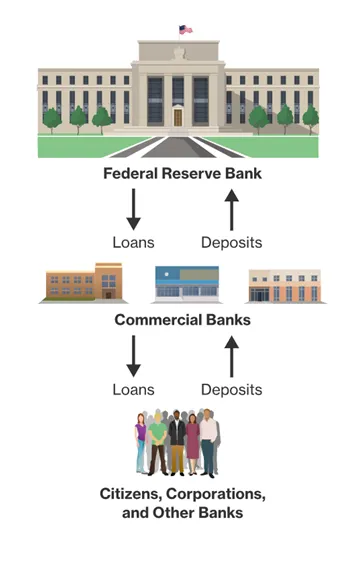
In the United States, the system is dominated by three entities:

* **Treasury:**  The Department of the Treasury is responsible for printing physical currency (i.e. notes and coins) and distributing it to Federal Reserve banks and branches
* **Federal Reserve:**  The Fed is the “banks’ bank” – it controls the overall money supply and distributes money to commercial banks
* **Commercial Banks:**  Institutions such as Bank of America, Chase and Wells Fargo put currency into circulation by lending directly to consumers

&#x20;                                                      **The Federal Reserve and Banking System**

<figure><img src="/files/B5ZiRazRCa2rHgg1XH90" alt=""><figcaption><p>Source:  <a href="https://www.coursehero.com/sg/introduction-to-finance/federal-reserve-system/">Coursehero.com</a></p></figcaption></figure>

This centralized ownership presents five major problems:

* **Third-Party Custody**:  In the current financial system, you don’t really hold your funds – the banks do.  This means that they can freeze and even seize your assets at will.  While this may seem far-fetched, consider that in 2013, the Government of Cyprus seized 47.5% of all bank accounts over €100,000 to bail-out its failing banking system.    <br>
* **Limited Access:**  Banks can decide whether they want you as a customer.  While generally not a problem in the developed world, this is a huge issue in growing economies.  Today, nearly 1.7  billion people remain unbanked simply because they aren’t profitable enough to be considered by global financial institutions<br>
* **No Privacy**:  Banks must collect detailed personal information to adhere to KYC, AML and CFT regulations and transactions<br>
* **Expensive and Inefficient:**  The current financial system is rife with inefficiencies and unnecessary expenses.  Payment networks charge up to 3% on credit card fees, cross-border remittance payments can take up to a week and cost 10%, and even in developed nations, users are faced with long transfer times and bloated fees.   <br>
* **Restrictions of Transfer:**  Several countries restrict or even ban the transfer of large amounts of cash internationally

So why do we tolerate these inefficiencies?  Well, we don’t really have a choice due to what is known as the Byzantine General’s Problem.  While I’m oversimplifying a bit, this concept basically states that large groups of humans can’t trust one another or coordinate across vast distances without using third parties (such as banks) to establish trust.  For example, when a stranger sends you money online, you must rely on your bank to ensure that 1) they are whom they say they are and 2) they have the money they say they have and 3) they actually send it.&#x20;

In short, while some may call the banking system “evil”, up until now it has been a “necessary evil”.&#x20;


# The Benefits of Decentralized Money

This all changed in 2009 when a person (or persons) using the name “Satoshi Nakamoto” invented Bitcoin, solving the Byzantine General’s Problem and setting off a chain of events which made the concept of “decentralization” possible.&#x20;

For the first time in history, Bitcoin made it possible to perform **direct, peer-to-peer transactions without relying on third parties to establish trust**.&#x20;

The effect of this cannot be overstated and requires a bit of “tabla rasa” thinking.  Imagine for a bit, how you would design a financial system if you no longer needed intermediaries.  After all, what’s the point of banks if you can safely hold your own assets?  What’s the point of a federal reserve if you control the money supply?  What’s the point of a Treasury Department if you can issue your own money?&#x20;

If you’re like me, you’re probably envisioning a form of money that is much simpler and more elegant than what we have today…

&#x20;                                                        **Evolution of Money:  From Cows to Crypto**

<figure><img src="/files/BjrpA5KkDsbPNs63cFod" alt=""><figcaption><p>Source:  <a href="https://www.shutterstock.com/image-vector/stages-money-evolution-vector-flat-style-1317245552">Shutterstock</a></p></figcaption></figure>

That’s the promise of cryptocurrencies, and they may allow us to reap all the benefits of traditional money – namely trust, security and growth – while removing most of the downsides.  Indeed, cryptocurrencies are:

* **Seizure-Proof:**  Instead of relying on a bank to hold your assets, you control all of your funds with your own wallet.  As such, there’s no one to seize your assets, limit withdrawals or tell you where you can and can’t spend your money&#x20;
* **Permission-Less**:   Users don’t need permission from a bank to access their funds.  Anyone with money and an internet connection can buy any cryptocurrency in markets that are open 24 hours a day, 7 days a week and 365 days a year
* **Private:** Users can choose to (and often do) remain anonymous&#x20;
* **Borderless:**  Cryptocurrencies have no borders.  Users can store millions (or more) on a thumbdrive or online wallet (not recommended) and go anywhere they please.  They can send money home to relatives without anyone ever knowing&#x20;
* **Cheap:**  Although fees for many cryptocurrencies are high now they’re “fixed” (vs. variable) which makes them ideal for sending larger amounts of cash.  In addition, as fees continue to decline, it’s likely that transactions will be cheaper than traditional credit cards or wire transfers
* **Transparency:**  While many claim cryptocurrencies will be a haven for criminals and tax cheats, they’re actually much more transparent than traditional currencies as every transaction is permanently recorded on a blockchain

I know this is a lot to take in.  Crypto is so unique, so transformative, so unintuitive that I’ve been studying it for almost five years now and sometimes I feel like I only partially get it.&#x20;

But to help you understand more about how it can transform the world, let’s go a bit deeper down the rabbit hole…


# How do Cryptocurrencies Work?

Cryptocurrencies are a form of money that lives online in distributed, decentralized databases.&#x20;

* **Database:**  Nearly all money today (92%) exists only online and is stored in databases – cryptocurrencies are no exception
* **Distributed:**  Identical copies of these databases are shared over thousands of computers located all over the world
* **Decentralized:**  Cryptocurrencies rely on a combination of blockchains, digital key cryptography and consensus mining to ensure decentralization

I know this might all seem a bit confusing, so let’s dive into each of these a bit deeper in the next sections.


# What are Databases?

Most of the world’s data exists in database servers – giant computers that are built with the express purpose of hosting large amounts of information.  Many of these servers are hosted in hyperscale data centers – multi-hectare facilities that can host thousands of computers.&#x20;

&#x20;                                    **Map of Microsoft, Amazon and Google’s Data Centers**

<figure><img src="/files/h7B0dMAkwTX0tsle49R6" alt=""><figcaption><p>Source:  <a href="https://www.atomia.com/2016/11/24/comparing-the-geographical-coverage-of-aws-azure-and-google-cloud/">Atomia</a>.  Note:  Shown data center does not represent Brazil location.</p></figcaption></figure>

Given that our modern economy runs off of data, that makes them some of the most important -- if not *the* most important – assets in the world.&#x20;

While they are generally little more than glorified excel spreadsheets with a few columns, databases form the backbone of our modern digital economy because they store our health records, mortgage deeds, insurance records, virtually all the content we consume online and – perhaps most importantly –over 90% of our money.

<figure><img src="/files/ANfcbdQK0rlkBt6S8lqG" alt=""><figcaption></figcaption></figure>

&#x20;☝️ Your money is little more than a collection of 1s and 0s in a database owned by Bank of America (or whomever you bank with)

Today, we access the internet through what is known as a client-server-database architecture.&#x20;

**The Client – Server – Database Architecture**

<figure><img src="/files/i8fSDxnyQOkwBcPLSpM5" alt=""><figcaption><p>Source: <a href="https://www.researchgate.net/figure/Client-server-architecture-of-information-system-services-at-the-village-level_fig1_317627309">Researchgate</a></p></figcaption></figure>

As the name suggests, there are three major components to this structure:

1. **Clients:**  Your PC or laptop is known as a “client”, when you visit websites on a browser such a Google Chrome, it makes requests to servers
2. **Servers**:  Servers are responsible for routing your request to the correct database and then sending the information from the database back to you
3. **Databases**:  Almost all of the information that you find on the internet is stored somewhere in a database

So when you open your iPhone to check your balance at Bank of America, your phone sends a request to one of Bank of America’s servers, which then sends a request to one of Bank of America’s databases that then tells you that you have $X in your account.&#x20;

As stated previously, the vast majority of these databases are owned by centralized companies.  For instance, Microsoft, Google and Amazon own over 50% of the world’s largest data centers.&#x20;

Cryptocurrencies simply swap the existing, centralized, storage layer with decentralized and distributed databases.  These new databases contain both the current balance of everyone’s cryptocurrency as well as the entire transaction history. &#x20;


# How are Cryptocurrencies Distributed?

Cryptocurrencies are distributed because, instead of living in centralized “server farms” as they often do at Microsoft or Facebook, they are hosted across thousands of individual computers located all over the globe.&#x20;

These computers are called “nodes”, and they each contain an identical copy of the account balances and transaction history of the cryptocurrency’s database.

<figure><img src="/files/Zw5QtL21mGffVIZZrwhL" alt=""><figcaption></figcaption></figure>

This distribution is very important because it means that: 1) it’s almost impossible for a third party to turn them off and 2) they are extremely resilient to hardware failures.&#x20;


# How are Cryptocurrencies Decentralized?

It’s been said that “innovation is what happens when ideas have sex”. When Satoshi Nakamoto created Bitcoin, they combined three synergistic technologies into a single invention that made economic decentralization possible.&#x20;

As mentioned previously, governments and banks have historically controlled the creation and distribution of money.  This is because it’s almost impossible to create a currency without a trusted, centralized authority.  For example, when a stranger sends you money online, you must rely on your bank to ensure that 1) they have the money they say they have, 2) the money isn’t counterfeit and 3) they actually send it.&#x20;

Bitcoin removed this long-standing limitation by replacing the traditional functions of banks with technology, transferring control of the money supply back to the people.

In particular, it used a combination of three interactive tools:&#x20;

* **Blockchains:**  Immutable databases that record who owns what and that the currency in question is not counterfeit
* **Digital Keys:**  Verify that users own their funds
* **Consensus Mining:**  Ensures that transactions are legitimate and transfers the funds

<figure><img src="/files/FhrVsZEIXcPRBzKbFL4K" alt=""><figcaption></figcaption></figure>

So if Alice wanted to send Bob two Bitcoin, the process would look something like this:&#x20;

1. The Bitcoin blockchain stores Alice and Bob’s original account balances (i.e. Alice has 2BTC and Bob has none)
2. Alice desires to send 2 BTC to Bob
3. She creates a transaction and signs it with her digital key, verifying that it is indeed her requesting the transfer
4. This transaction is broadcast to a network of miners
5. Miners receive the transaction and verify that i) it is actually Alice requesting the transaction (via her private key signature) and ii) that she has the required funds
6. Miners would then update the Bitcoin blockchain with the new balances – (i.e. Alice now has 0 Bitcoins and Bob now has 2 Bitcoins)

Let’s explore each of these concepts in more detail.&#x20;


# What are Blockchains?

Cryptocurrency balances store their data on a blockchain.  At its core, a blockchain is little more than an electronic database – i.e. a collection of information –  that is shared across many different computers.&#x20;

Unlike a traditional database, blockchains organize data into groups known as blocks.  These blocks have limited storage capacity, so when they become full they are locked and linked to the previous block with a “hash”.  This forms a chain – hence the name, blockchain.&#x20;

<figure><img src="/files/xYv3hJzeyfB31cJg0uul" alt=""><figcaption><p>Source:  <a href="https://www.ig.com/en/trading-strategies/what-is-blockchain-technology--200710">ig.com</a></p></figcaption></figure>

These hashes are extremely important because they make blockchains immutable, that is, data (such as your Bitcoin or Ethereum balance) can’t be deleted, tampered with or changed once it is locked into the chain.   &#x20;

Hashes are created through a cryptographic process (known as hashing) that takes a given set of information and converts it into a unique code (which is basically a long string of characters).  For example, the word “fox” could be hashed as DFTY786DCFJ894SUSH865AAHJAI978 and the sentence “the quick brown fox jumps over the lazy dog” could be hashed as SOIAUYA7865ASLUAN098A5489USYAN.  There are three important things to note about hashes:&#x20;

* Virtually anything can be hashed (i.e. you can hash a word, a sentence or the entirety of War and Peace)
* Hashes are always unique (i.e. if you changed a single letter in War and Peace you would get a completely different hash)
* It’s impossible to guess the original data from looking at the hash (i.e. you wouldn’t know that DFTY786DCFJ894SUSH865AAHJAI9785 was “fox”)&#x20;

Because all new blocks are required to store the hash of the previous block, it’s easy to see if the blockchain has been tampered with.  If the hash contained in the new block matches the old, you know that the data is secure.  If they are different, everyone will know that the block has been tampered with.&#x20;


# What is Digital Key Cryptography?

Digital keys are nothing more than long strings of numbers (256 bits long for Bitcoin) and come in pairs – a public key and a private key.&#x20;

* **Public Key:**  A public key is similar to a bank account number as it serves as your address on a cryptocurrency network.  For example, instead of recording that “Alice owns 2 BTCs, the Bitcoin blockchain would record that “ 1BvBMSEYstWetqTFn5Au4m4GFg7xJaNVN2 owns 2 BTCs”
* **Private Key:**  A private key is similar to a secret PIN code that allows users to access and control their account.&#x20;

Every public key has only one private key, and – like a key and a lock – they are linked through cryptography.  The important thing to note about this link is that it only flows one way.  Although one can always access a public key with a private key, **it’s mathematically impossible to do the reverse**.&#x20;

&#x20;                                  **It’s Impossible to Decipher a Private Key from a Public Key**

<figure><img src="/files/mixht7zpObYPeUS6vnxm" alt=""><figcaption></figcaption></figure>

This one-way logic forms the basis of cryptocurrency transactions.  For example:

* **To Receive Funds:**  In order to receive funds, a user would share his public key with the sender, who would deposit the money in that address.  Because it’s impossible to decrypt a private key from the public key, this is completely safe (and necessary).&#x20;
* **To Send Funds:**  In order to send funds, a user would user her private key to “unlock” her public key on the blockchain to authorize the transfer of the money.  Again, because it’s mathematically impossible for anyone but the holder of the private key to do this, the blockchain can be sure that this person owns the funds.&#x20;

In practice, users rarely see either their keys, as they are often stored inside digital wallets and managed by software (i.e. you just click buttons that say “send” and “sign” on a wallet such as Metamask and the application does the rest for you).


# What is Consensus Mining?

Centralized networks, such as banks, have a small army of bookkeepers, accountants and auditors to verify that transactions are legitimate.&#x20;

While blockchains can’t rely on an in-house staff, they can leverage a distributed group of users known as miners for a similar purpose.&#x20;

Miners are the defacto auditors of a cryptocurrency.  They compete to earn the right to process the output of transactions, confirm account balances, ensure there is no fraud and update the blockchain with the new results.  They are, in turn, rewarded with cryptocurrency for their efforts.&#x20;

While this seems like an elegant solution to the problem of centralization, there are a few major problems.  Specifically:  1) miners are often anonymous and 2) as the defacto auditors of the blockchain, they have a lot of power.  So how do we know that they won’t abuse this position and manipulate the results to send a bunch of money to themselves?&#x20;

Cryptocurrencies employ two safeguards to prevent this:

* Because of the properties of hashing discussed above, if anyone tried to manipulate the data it wouldn’t connect to the previous block, and this would be very obvious to everyone on the network.&#x20;
* They institute systems known as consensus mining protocols to punish bad actors and prevent fraud

The most popular consensus mining protocol today is known as Proof of Work.  Proof of Work requires miners to solve a very difficult math problem to earn the right to validate new blocks.  This problem is so difficult that it can only be solved by random guessing.  As such, miners often employ dozens to hundreds to thousands of computers to make millions of guesses, hoping that one of them gets the correct answer.&#x20;

This uses a lot of electricity, and therefore costs a lot of money.  So if a miner is lucky enough to get the right answer, she is not going to risk manipulating the data and having her update thrown out, especially given that it would be so easy to get caught.&#x20;


# Key Players

Note:  All data in this section updated as of March 30th, 2022

Although there are many different types of cryptocurrencies, the market is dominated by three:  Bitcoin, Ether and stablecoins.

<figure><img src="/files/2FvvlfV9QlIK20IVmFmD" alt=""><figcaption><p>Source: Coinmarketcap as of 3.30.22. Respective market caps divided by total market cap.</p></figcaption></figure>

* **Bitcoin**:  Bitcoin is the world’s first and largest pure cryptocurrency
* **Ether**:  Ether is the native token of the smart contract platform Ethereum.  It can be thought of as a form of “programmable money” (e.g. it can be coded to perform functions such as automatically repay loans, hold funds in escrow, automatically execute contracts, etc…)
* **Stablecoins**:  Stablecoins are cryptocurrencies pegged to the value of fiat currencies such as the Dollar, Euro, Renminbi or Yen

We’ll dive into each of these in the next sections...


# Bitcoin

Note:  All data in this section updated as of March 30th, 2022

## **What is Bitcoin?**

Bitcoin (“BTC”)  is the grandfather of all cryptocurrencies.  It was created in 2008 by an unknown person or group of people using the alias Satoshi Nakamoto and currently has the largest market capitalization of any asset in the space.

&#x20;                                                       **Bitcoin’s Market Cap is Nearly $1 Trillion**

<figure><img src="/files/nqh28N7NwKs9vwdC0Ib6" alt=""><figcaption><p>Source: Coinmarketcap as of 3.30.22</p></figcaption></figure>

Satoshi created the currency to combat what they saw as the perils of unchecked spending by the government.  As such, Bitcoin famously limits its supply to 21 million coins, and often earns the moniker “digital gold” as a result.&#x20;

A few local and national governments are officially using Bitcoin in some capacity, with one country, El Salvador, adopting it as a legal tender.

## **What are the Benefits of Bitcoin?**

Bitcoin proponents believe that the currency is unique among its peers.  The most extreme of them, often called “maxis”, argue that anything else is a “shitcoin”.&#x20;

While that may be a bit extreme, the currency does have its strong points, including:&#x20;

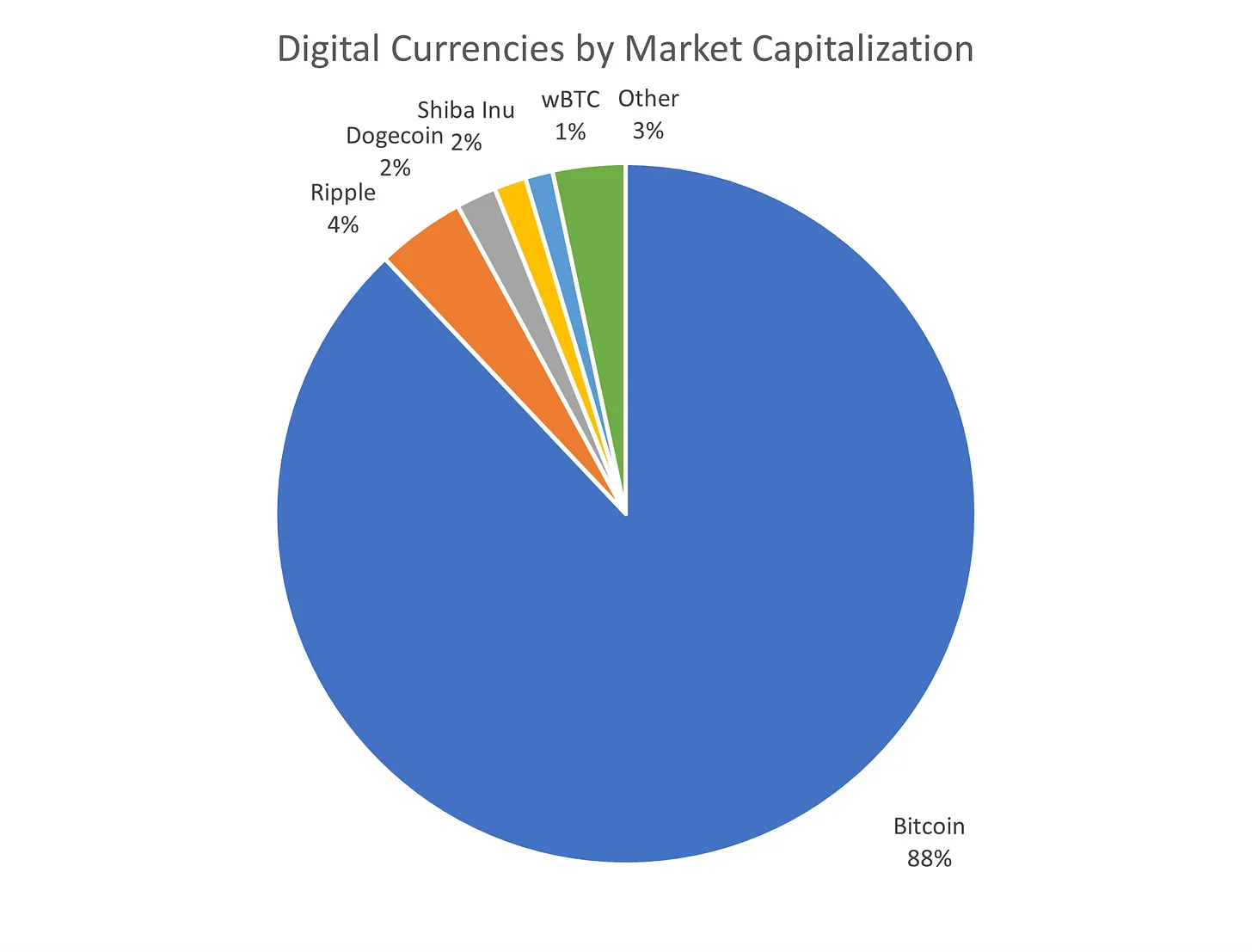
1. **Network effect**:  Bitcoin is by far and away the market leader with over 40% share of all cryptocurrencies and almost 90% share of digital currencies.  Although this percentage has been steadily declining, it will likely serve as one of the dominant forces in the spaces for years to come.
2. **Decentralization**:  While most cryptocurrencies are migrating to a Proof-of-Stake system to lower transaction costs, Bitcoin will continue to use proof of work.  While this means that the currency might be more expensive and less environmentally friendly, proponents argue that it’s the most secure and most decentralized method, as it would be extremely difficult for anyone to monopolize the supply of electricity.&#x20;
3. **Inflation resistance**:  Many Bitcoin enthusiasts believe its strongest benefit is lies in inflation resistance .  In his book The Bitcoin Standard, Saifedean Ammous argues that fiat currencies have been “unsound money” since they went off the gold standard in the 70s.  According to Ammous, unsound money leads to recessions and debt, hyper-inflation and even war!  By limiting its supply to 21 million BTC, the currency reduces the threat of inflation and therefore (hopefully) mitigates these downsides. &#x20;

Although Bitcoin is by far the largest digital currency, there are a few other players in the space.&#x20;

## **Who are the Other Players in the Space?**

<figure><img src="/files/QQmnwXiW7hKzWyOhcPqD" alt=""><figcaption><p>Source: Coinmarketcap as of 3.30.22</p></figcaption></figure>

Bitcoin dominates the digital currency market holding almost 90% market share.  In addition to Bitcoin, other notable projects that can be considered pure “digital currencies” (as opposed to smart contract platforms, stablecoins or tokens designed to run a specific protocol) are Ripple, Dogecoin, Shiba Inu and Wrapped Bitcoin.&#x20;

<div align="center"><figure><img src="/files/4sM7HBMjQ4l9QeRsaEue" alt=""><figcaption><p>Source: Coinmarketcap as of 3.30.22</p></figcaption></figure></div>


# Ether

Note:  All data in this section updated as of March 30th, 2022

## **What is Ether?**

Ether is a form of “programmable” money.  It was conceived in 2013 by Vitalik Buterin, launched in 2015 and is currently the second largest cryptocurrency with a market capitalization of $406 Billion.&#x20;

&#x20;                                                 **Ethereum’s Market Cap is Nearly $500 Billion**

<figure><img src="/files/JPOO1J27OpYzSlumCKXH" alt=""><figcaption><p>Source: Coinmarketcap.com as of 3.30.22</p></figcaption></figure>

Unlike Bitcoin – which functions very similar to traditional forms of money such as the USD or gold – Ether can be programmed to act in a certain way if predetermined criteria are met.  &#x20;

This has several important applications including (but not limited to):&#x20;

* **Recurring Payments:**  Ethereum can be programmed to make automatic payments at predetermined times.  This has an almost unlimited number of use cases including loan repayments, stock divided payments, automated payroll, etc…&#x20;
* **Escrow:**  Large transactions often require escrow services to hold funds while a sale takes place.  Currencies like Ethereum eliminate the need for this as they can be programmed to automatically release the funds once the deal is consummated
* **Contracts:**  Ethereum can also be programmed to settle more complex transactions.  For instance, one could write an insurance contract that automatically pays policy holders if certain criteria are met (i.e. it could pay drought insurance funds to a farmer if the temperature averages over 90 degrees for any given month)

This functionality is supported by a decentralized “cloud” computer known as the Ethereum Virtual Machine (“EVM”).  Like any computer, it can run a variety of programs – not only the ones listed above, but also a host of decentralized applications such as cryptocurrency exchanges, play-to-earn games, lending and borrowing protocols, music streaming services, etc… (to learn more check out the article on Smart Contract Platforms).&#x20;

In addition to serving as a currency to buy goods and services, Ether is also needed to i) pay for the computing power required for transactions on the EVM and ii) serve as the platform’s primary consensus mining mechanism.&#x20;

This trifecta of uses makes the coin unique among assets.&#x20;

## **What are the Benefits of ETH?**

Perhaps the most interesting take I’ve heard on the potential of Ether as money comes from David Hoffman of Bankless in his article [“Ether:  The Triple Point Asset”.](https://newsletter.banklesshq.com/p/ether-a-new-model-for-money?s=r)

Hoffman references an argument by economist Robert Greer that assets have historically served one of three functions.  They are either:&#x20;

* **Capital Assets:**  Capital assets generate cash flows for the owner.  Examples include stocks that pay dividends, bonds or rentable real estate.
* **Consumable Assets:** Consumable assets generate value when they are used.  Oil, coffee and electricity all fall in this category.  outcome that is economically beneficial. Think about the gold plating in electronics, the gasoline in a car, or the coffee beans in a coffee machine.
* **Store-of-Value Assets**;  Store of assets can’t be consumed nor do they provide cashflows, but they nonetheless have value.  Examples include gold, traditional currencies, real estate, art, or Bitcoins.

Although real estate and gold come close, no single asset has satisfied all three functions.&#x20;

**No existing asset simultaneously produces cash flow, stores value and is consumable**

<figure><img src="/files/HDDAEPtGstq6s3wsgWND" alt=""><figcaption><p>Source: Placeholder VC via <a href="https://newsletter.banklesshq.com/p/ether-a-new-model-for-money?s=r">Bankless</a> </p></figcaption></figure>

Ether, however, does.  A token on the Ethereum network has what Hoffman calls an “economic trifecta” because it acts as a:

* **Capital Asset:**  Ether produces passive income through staking
* **Consumable Assets:**  It is needed to pay gas fees on the Ethereum Virtual Machine
* **Store-of-Value Asset:**  Ether is the most used form of collateral to be “locked” in DeFi

So in a sense, owning an Ethereum token is like a dollar bill, blue chip stock and barrel of oil all rolled into one!

## **Who are the Other Players in the Space?**

<figure><img src="/files/rJoWABukWiYgQ3rlAb29" alt=""><figcaption><p>Source: Coinmarketcap.com as of 3.30.22</p></figcaption></figure>

The smart contract market is highly consolidated, with Ether holding over 50% of market share and the second six players – Binance, Terra Luna, Cardano, Solana, Avalanche and Polkadot garnering an additional 31%.&#x20;

<figure><img src="/files/gghAMk77xck8q8lpdKgw" alt=""><figcaption><p>Market share data from 3.30.22</p></figcaption></figure>


# Stablecoins

Note:  All data in this section updated as of March 30th, 2022

## **What are Stablecoins?**

While both Bitcoin and Ethereum have their benefits, one thing limiting their development is price volatility.  After all, how can we use cryptocurrencies as a medium of exchange if the value is so unpredictable?  What good are double-digit interest rates if the value of the underlying assets can decrease by 50% overnight?

Stablecoins help mitigate this volatility.  In a sense, a stablecoin is nothing more than a cryptocurrency pegged to a (relatively) secure asset such as the US Dollar.  They can be used to buy things, lend and borrow, collect interest and even hold as a store of value.  In effect, anything you can do with cash you can do with a stablecoin.&#x20;

&#x20;                                                                        **Total Stablecoin Supply**

<figure><img src="/files/9MOHy6jSE1JDXQuA86VB" alt=""><figcaption><p>Source:  <a href="https://www.theblockcrypto.com/data/decentralized-finance/stablecoins">The Block</a></p></figcaption></figure>

The stablecoin market has grown more than 500% in the past year alone, and currently stands at $181B.&#x20;

## **How do Stablecoins Work?**

While on the surface stablecoins might seem very similar to the digital money we use today, under the hood they are very different animals.  Perhaps the most glaring distinction is in the ownership and control of the assets.  The dollar is owned by the United States government – the Fed sets the rules and controls the supply, commercial banks distribute the funds through fractional reserve banking and depositors receive interest.&#x20;

Stablecoins on the other hand, are a form of private money.  They either are governed by a corporation or a DAO (to keep things simple you can think of this as a collective), users create and distribute the funds by depositing collateral and token owners claim the interest.&#x20;

Today, there are three main types of stablecoins:

1. **Fiat-Collateralized**:  Fiat-collateralized stablecoins such as Tether and USDC are (or at least claim to be) fully backed by cash.  That is, for each $1 of Tether, there should be $1 sitting in a bank account somewhere.\
   \
   The problem with these coins is that, by definition, they are still centralized, relying on banks and other third-parties to keep custody of the collateral.  This goes against the decentralized ethos of DeFi, as any centralized point in the chain makes the entire system vulnerable and serves as a magnet for regulators. <br>
2. **Crypto-Collateralized**:  Crypto-collateralized stablecoins such as Dai are, as the name suggest, backed by a basked of cryptocurrencies and use autonomous protocols to maintain the peg.\
   \
   While promising, crypto-collateralized stablecoins are currently very inefficient, requiring huge amounts of overcollateralization. That’s why the holy grail of DeFi has long been the creation of an Algorithmic Stablecoin. <br>
3. **Algorithmic**:  Algorithmic stablecoins are decentralized and do not require collateral.  The peg is maintained through a complicated incentive program.  In essence, when the price goes above $1, more coins are issued, diluting the supply and lowering the price.  When it goes below $1, coins are bought back to raise the price.&#x20;

While algorithmic stablecoins are great in theory, they may not be possible in practice.  Economists are quick to point out that they violate the “impossible trinity”, which states that you can’t have a free capital flow, sovereign monetary policy and a fixed exchange rate at the same time.&#x20;

Indeed, virtually every experiment in this space has failed because incentives stop working if people don’t believe there’s inherent value in the currency.  Once trust is loss, everyone sells contributing to a “death spiral” that quickly reduces the value of the coin to zero.&#x20;

## **What are the Benefits of Stablecoins?**

Whether or not this problem is solved by the current batch of market participants, stablecoins will likely continue to play a major role in the economy as they offer several core benefits:

* **Permissionless**:  Anyone can access stablecoins and use them to freely move assets across international borders
* **Cheaper:**  Although Ethereum is currently experiencing a significant fee problem, many competing networks offer near-zero fees for using stablecoins (much less than the 2-3% charged by Visa and Mastercard)
* **Faster:**  Stablecoin transactions and transfers are near instant and can be performed at any time
* **Programmable:**  It’s helpful to remember that stablecoins are software and, as such, can be easily programmed into smart contracts, creating a variety of potential use cases
* **Transparent:**  Anyone can view the underlying code and all transactions are easily discoverable on blockchain explorers

## **Who are the Key Players in the Stablecoin Market?**

<figure><img src="/files/XMkGvHY4rte8Jx1egzRa" alt=""><figcaption><p>Source:  <a href="https://coinmarketcap.com/view/stablecoin/">Coinmarketcap.com</a> as of 3.30.22</p></figcaption></figure>

The market for stablecoins is currently dominated by the fiat-collateralized model, with Tether, USDC and BUSD holding a combined 83% market share.&#x20;

<figure><img src="/files/1qTOUKMbamOWKOdqNFw9" alt=""><figcaption><p>Market share as of 3.30.22</p></figcaption></figure>


# Other

This report focuses on cryptocurrencies that are primarily used as a form of payment or, in the case of smart contract platforms, to run a payment network.&#x20;

That said, while virtually all cryptocurrencies can be used as a form of money, many were designed primarily for other means, including tokens that are used to:

* Run DeFi protocols (e.g. Uniswap and Aave)
* Power decentralized oracle networks (e.g. Chainlink)
* Serve as gaming tokens (e.g. Axie Infinity)
* Provide currency for virtual worlds (e.g. Decentraland and Sandboxx)
* Assist with DAO governance (e.g. ApeCoin)
* Enable key web3 infrastructure (e.g. Arweave, Filecoin, Helium, Pocket Network, The Graph)&#x20;
* Assist with interoperability (e.g. Thorchain)

Since there are tens of thousands of cryptocurrencies, we won’t focus on these here, but they will be covered in detail in other reports.&#x20;


# Problems with Cryptocurrencies

Although cryptocurrencies definitely have their benefits, they also come with their share of downsides.  Among the most notable of these are:

* High Fees
* Volatility
* Environmental Concerns
* Tax Cheats & Criminals
* MEV

Let’s take a deeper look into each concern :point\_right:.


# High Fees

Note:  All data in this section updated as of March 30th, 2022

Both Bitcoin and Ethereum suffer from high fees.  As of March 2022, the mean transaction fee was $1.56 for BTC and $8.20 for ETH (and these are actually historical lows, as ETH fees averaged $50 to $75 several times in 2021).&#x20;

This makes them impractical for daily use – after all, imagine having to pay $2 to $8 (or even $75) dollars in fees for a cup of coffee!

&#x20;                                                  **Average Transaction Fees Bitcoin and Ethereum**

<figure><img src="/files/A48FA1NRFB2ZWXVeXOMW" alt=""><figcaption><p>Source:  <a href="https://news.cryptorank.io/bitcoin-and-ethereum-average-transaction-fees-decline-by-roughly-90/">Cryptorank</a></p></figcaption></figure>

While this seems like an insurmountable problem, there are several mitigating factors to consider:

1. Unlike traditional finance, fees are independent of the transaction amount (i.e. it costs the same to send $1 or $1 million), so while this may be a problem for daily use, it’s actually much cheaper than standard costs for bank wires and remittances and also cheaper than a credit card for larger purchases
2. Projects like Ethereum are working very hard on lowering fees, and some estimate the transactions may cost less than a penny when the upgrade to ETH 2.0 is finally complete (although that is likely years away)
3. We have recently seen the creation of alternative blockchains – such as Avalanche, Solana, Cardano, Polkadot, Binance Smart Chain and Terra – that offer significantly lower feeds and transaction times.&#x20;


# Volatility

Cryptocurrencies are notoriously volatile – Bitcoin alone recorded swings greater than 2 standard deviations an average of almost 20x per year over the past 5 years.  &#x20;

&#x20;                       **Bitcoin has swung more than 2 SDs almost 20 times a year since 2017**

<figure><img src="/files/Yz5EtwIkmiv7AQRfl7r0" alt=""><figcaption><p>Source: <a href="https://www.bloomberg.com/graphics/2021-bitcoin-volitility/">Bloomberg</a></p></figcaption></figure>

Many critics argue that this volatility will be their ultimate downfall.  After all, something can’t function as a medium of exchange if its value fluctuates wildly from one day to the next.  Imagine waking up not knowing whether the coins in your digital wallet could buy you a new car or a cup of coffee.&#x20;

This concern is a big driver of the demand for stablecoins, which offer many of the benefits of cryptocurrencies while maintaining a 1:1 peg to the USD, Renminbi, Euro or Korean Won.  In fact, Terra Luna’s TerraUSD stablecoin is already gaining significant traction in Asia, where it is used for a variety of purchases including purchasing coffee or hailing taxis.&#x20;

But cryptocurrency disciples will tell you that stablecoins won’t be necessary in the long-run, because volatility is a matter of perspective.  Given that we price goods in the United States in US dollars, we measure “volatility” by that standard (i.e how much did an asset go up or down in dollar value).  But if you were to measure using Bitcoin as the baseline, you could argue that it’s the dollar that’s volatile!&#x20;

Indeed, purists argue that’s the direction we’re headed.  They believe that once cryptocurrencies gain widespread adoption, businesses will begin to use them to price goods and services.  When this happens, there will be no more volatility as a 10 satoshi cup of coffee will always be worth 10 satoshis, no matter what happens to the Dollar, Yen or Won (FYI – a “satoshi” is the smallest unit of Bitcoin, worth 1/100millionth or a BTC) . &#x20;

<figure><img src="/files/O0RDoMSGMABWvD0o8sQu" alt=""><figcaption></figcaption></figure>

While this might seem far-fetched it should be noted that this is already happening on a limited scale.  Many Web3 goods, such as NFTs, are already natively priced in Ether and not USD.&#x20;


# Environmental Concerns

Note:  All data in this section updated as of March 30th, 2022

Proof-of-work consensus mining uses a significant amount of energy.  It has been estimated that each transaction uses enough electricity to power the average home for six weeks.  When you add all the transactions together, the cost is staggering – Bitcoin alone consumes roughly X% of the world’s energy.  That’s 7x the amount Google uses and more than Norway!

&#x20;                                       **Bitcoin consumes more energy than many countries**

<figure><img src="/files/HM2j46W1mGvZmxzpj224" alt=""><figcaption><p>Source:  <a href="https://www.forbes.com/sites/niallmccarthy/2021/05/05/bitcoin-devours-more-electricity-than-many-countries-infographic/">Forbes</a></p></figcaption></figure>

Fortunately, these statistics may not be as alarming as they seem at first glance.  First of all, energy expenditure does not necessarily equate to environmental impact.  In fact, because miners are incentivized to find the cheapest source of energy possible, many rely on alternative sources such as wind or solar  Some estimates believe that 40% to 75% of the energy to power proof-of-work mining may come from renewable sources.

Second, many newer cryptocurrencies are adopting a proof-of-stake model (and Ethereum is transitioning to one), which uses almost no energy.&#x20;


# Tax Cheats & Criminals

Note:  All data in this section updated as of March 30th, 2022

Several of the core benefits of cryptocurrencies could also be seen as weaknesses.  Indeed, critics argue that they are the ideal venue for:

* **Tax Evasion**:  Because cryptocurrency transactions are anonymous, people will use them to evade taxes
* **Criminal Activity**:  Transactions can’t be regulated, which means that people will buy illegal goods online and criminals can easily log in to a decentralized service to launder money
* **Funding Terrorists**:  Because the government can’t seize assets like they did with Russia after it invaded Ukraine, terrorist groups will hold all of their funds in Bitcoin&#x20;

While all of these are definitely possible – and even *seem* logical at first blush -- the data simply doesn’t support these fears.  In fact, only 0.15% of all cryptocurrency transactions are connected to criminal dealings.

&#x20;                        **Illegal Activities Represent Only 0.15% of Cryptocurrency Transactions**

<figure><img src="/files/GbS8A0tSgbkgoJ0UixEK" alt=""><figcaption><p>Source: <a href="https://go.chainalysis.com/2022-Crypto-Crime-Report.html">Chainalysis 2022 Crypto Crime Report</a></p></figcaption></figure>

A big part of the reason for this is probably because cryptocurrency transactions aren’t anonymous, they are “pseudonymous” –  meaning that if anyone can tie you to your address, they can see *all* of your transactions.  This has proven a boon time and time again to law enforcement, who have used the transaction history to track down several high profile thieves.  In 2022 alone, the Department of Justice seized $3.6 billion from crypto hackers.

Ironically, given the fact that all transactions are recorded forever on a digital ledger, cryptocurrencies may ultimately reduce crime, fraud and tax evasion.&#x20;


# MEV

As discussed previously, cryptocurrencies are secured by miners (or “validators” for Proof-of-Stake systems), who gather transactions, verify them and include them in the next block.&#x20;

Because each block can only contain a limited number of transactions, miners generally choose which transactions to include based on an auction process – those who offer to pay the highest fees will be included first.&#x20;

Unfortunately, miners aren’t technically *forced* to follow this rule and ultimately have full discretion over which transactions to include, which to ignore and how to order them.  When miners abuse this power to personally profit, it’s known as Miner-Extractable Value (MEV).&#x20;

There are a host of MEV tactics, but a common one is known as frontrunning.  To see how this works, let’s imagine that you noticed that ETH was trading for a lower price on exchange A than it was on exchange B.  Seeing a great arbitrage opportunity, you put in an order to buy ETH on exchange A and then sell it on B.  Once you place the order, it gets sent to the miners who put it in a transaction queue.&#x20;

Once this transaction is in the queue an unethical miner could now see what you are trying to do and decide to ignore your request and make the same trade himself, stealing your profit opportunity in the process.  &#x20;

As mentioned, there are several of MEV tactics and, to make matters worse, many of them are now employed by automated bots.  As such, MEV is becoming a substantial problem that is estimated to cost users over $1 billion annually.&#x20;


# The Long-Term Potential of Cryptocurrencies

Note:  All data in this section updated as of March 30th, 2022

While pundits have long compared the rise of cryptocurrencies to the infamous ‘Tulip Bubble’ that gripped Amsterdam in the early 1600s, I think we’re well beyond that point.&#x20;

&#x20;                         **Bitcoin has Lasted Over 4x Longer Than Comparative “Bubbles”**

<figure><img src="/files/lp6jou8iPE7sV8xiYX5a" alt=""><figcaption><p>Source:  <a href="https://twitter.com/danheld/status/1093156154493075456">Dan Held via Twitter</a></p></figcaption></figure>

Bubbles don’t pop and form again, and the Bitcoin “run” has lasted significantly longer than either tulips or the South Sea Company (where Issac Newton famously lost more than $3 million in today’s money)

Indeed, cryptocurrencies have survived on merit, and one could argue that they’re the best form of money that the world has ever known.&#x20;

## **The Best form of Money the World Has Ever Seen**

If we were to use the six properties of money discussed earlier to compare cryptocurrencies to the USD and gold, we would see that they stand head-and-shoulders above in almost all areas.&#x20;

&#x20;                  **Strengths and Weaknesses of Gold vs. USD vs. Bitcoin as a Form of Money**

<figure><img src="/files/f33I35sgvWPGzb5ZlrVB" alt=""><figcaption></figcaption></figure>

The only area where crypto falls short is the fact that it’s not widely accepted.  But adoption has been steadily increasing now, and we may soon see a “tipping point”.  According to [Zippia](https://www.zippia.com/advice/how-many-businesses-accept-bitcoin/):

* Over 15K businesses worldwide accept Bitcoin, including Microsoft, PayPal, Whole Foods, Etsy, Home Depo, AMC Theatres and Starbucks
* 36% of small and midsize businesses in the US accept cryptocurrency
* There are over 35K Bitcoin ATMs in the US

In addition, El Salvador became the first country to accept Bitcoin as legal tender in 2021 and several researchers argue that Panama, Cuba, Ukraine and Paraguay may soon follow suit.&#x20;

## **Stoking the Fires of Disruption**

In addition to being a better form of money, cryptocurrencies are leading to revolutions in several other related spheres including:&#x20;

1. **Digital Gold**:  Gold has long been sought out as both an inflation hedge and seizure-resistant asset (small amounts of it at least).  Bitcoin offers all the benefits of gold with two major advantages – it’s infinitely divisible and internationally portable.  This could benefit numerous parties, including the super-wealthy who want to replace their Swiss bank accounts, those in developing countries who need an inflation hedge but can’t access gold and anyone who wants to avoid the cost and restrictive nature of sending money abroad.  As such:

   \
   **Digital Gold could replace fiat currencies and central banks (e.g the USD, Euro, British Pound, RMB, Yen, the Fed, Bundesbank, Bank of England and IMF)**<br>
2. **Decentralized Finance**:  Cryptocurrencies, especially stablecoins, are already creating an entirely new financial infrastructure known as decentralized finance (“DeFi”).  DeFi offers many of the same features as the traditional financial ecosystem, such as i) lending and borrowing, ii) asset trading, iii) derivatives and  iv) insurance without relying on the banks.  This eliminates unnecessarily high fees, onerous KYC requirements and the threat of seizure and gives the almost 2 billion unbanked people access to basic financial services. \
   \
   **Decentralized Finance could replace Wall Street (e.g. Goldman Sachs, Morgan Stanley, Bank of America, Chase, Fidelity, the New York Stock Exchange)**<br>
3. **Web3**: Cryptocurrencies such as Ethereum have the potential to form the basis for a new, “internet-first” economy – one owned by it’s users instead of global mega-corporations.  We are already seeing the beginning phases of several new industries enabled by blockchain technology such as NFTs, Play-to-Earn Games, the Metaverse and DAOs.  In many of these ecosystems, cryptocurrencies are the dominant form of money.  As such:&#x20;

   \
   **Web3 could replace Silicon Valley and Wall Street (e.g.  Microsoft, Amazon, Apple, Facebook, Netflix, Spotify, Disney, Activision, Warner Music, Google)**

Given the enormous potential of cryptocurrencies, it’s not surprising that many analysts believe that the market could still grow by orders of magnitude.

## **Quantifying the Potential Value of Cryptocurrencies**

While it’s difficult to put a number on disruption, when we compare cryptocurrencies to the market cap of gold, global equities, global currency, bonds and real estate, we can see that there is still significant room for appreciation.&#x20;

&#x20;                             **Cryptocurrencies Represent a Fraction of Global Asset Values**

<figure><img src="/files/FLhiH3lIQROJb7K3Xt6j" alt=""><figcaption><p>Source:  <a href="https://ark-invest.com/big-ideas-2022/">Ark Invest Big Ideas 2022 Report</a></p></figcaption></figure>

Perhaps it’s for this reason that we’ve seen some mind-blowing predictions for the future value of Bitcoin, Ethereum and several stablecoins:&#x20;

* **The Stablecoin market could grow 1,000x:**  While this prediction from Jeremy Allaire, the founder and CEO of Circle (the company behind USDC) is both aggressive and probably a bit biased, there is at least some merit to the logic.  Allaire argues that the minimum TAM for stablecoins is $120T (the global value of M2 currency) and that the technology’s advantages over conventional money may ultimately grow the market (a la Uber).  While achieving 100%  market penetration is unlikely, this prediction nonetheless helps make the case that stablecoins likely have a lot of room to grow from their current market cap of $180B.&#x20;
* **Bitcoin could be worth $1M per BTC:**  Ark Invest, the $50B fund founded by Cathie Wood, believes that a single Bitcoin could be worth $1 million by 2030.  She reasons that the currency could capture up to 50% of global remittance payments, 10% of M2 in emerging markets, 25% of US bank settlement volumes, 1% of total national reserves, 5% of the treasuries of S\&P 500 companies, 5% of global HNWI wealth, \~3% of the institutional asset base and 50% of gold’s total market cap.&#x20;
* **Ethereum could hit a $20T market cap:**  Ethereum has started to see legitimate traction as “money”.  It’s the preferred collateral in DeFi, the unit of account in NFT marketplaces and likely currency of Web3.  As such, Ark believes it could capture 15%-20% of the global M2 supply over the next ten years.  This would equate to almost $170K per ETH, an >60x increase over the time of writing.&#x20;

Wherever the future takes us, it’s important to watch as it has the potential to be both an existential to the existing system and a road to almost unlimited potential for investors.


# DeFi

A comprehensive overview of the trends, technologies, important sectors, key players, problems and potential of Decentralized Finance.  (Note:  Data in this section last updated March 13th, 2022)

<figure><img src="/files/s2eI82qlh7WRZEgFMVmW" alt=""><figcaption><p>Photo Credit: © <a href="https://www.dreamstime.com/sergiolima9_info">Divina Epiphania</a> | <a href="https://www.dreamstime.com/photos-images/lego-scrooge.html">Dreamstime.com</a></p></figcaption></figure>

This article is intended to provide a somewhat thorough introduction to DeFi for beginners.  It’s almost 12K words (a 30+ minute read) and is organized into 8 parts, which are summarized below for the tl;dr crowd:&#x20;

1. **What is DeFi?:**  DeFi refers to a global network of computers that allow users to transact directly with other users to borrow, lend, earn interest and buy insurance without ever using (or needing) traditional intermediaries such as banks, brokers, exchanges, lawyers and / or regulators.  The space is worth almost $200B and has grown over 10x in 2021.
2. **The Problems with Centralized Finance:**  Our current financial system has several flaws – banks can seize our assets, deny us access and demand reams of personal data to open a checking account or take out a loan.  They are also expensive, inefficient and not particularly trustworthy.&#x20;
3. **The Solution – Decentralized Finance:**  DeFi uses blockchain technology to fix this, creating a much more efficient system that’s open to anyone with internet access and doesn’t even require you to give your name.
4. **What’s Different About DeFi?:**  Although DeFi has many of the same categories as traditional finance (e.g. banking, exchanges, borrowing and lending, insurance and derivatives) the elimination of intermediaries makes the mechanics quite different and the resulting systems are generally better, faster and much cheaper.
5. **What’s New in DeFi?:**  DeFi has introduced innovative new financial products that offer triple-digit interest rates, allow multi-million dollar loans without collateral and allow anyone to start a bank, hedge fund, currency exchange or insurance company without obtaining regulatory approval.
6. **DeFi Infrastructure:**  The space has also created the need for new enabling technologies such as smart contract platforms, oracles, data aggregators, decentralized storage providers and interoperability protocols (great section for pick-and-shovel investors).&#x20;
7. **The Dark Side of DeFi**:  The space has several problems, including extremely high fees and rampant scams that have costs users nearly $2 billion (some say this number is as high as $8 billion).
8. **Why DeFi Will Eat Wall Street:**  DeFi is a truly disruptive technology that has the potential to grow 10,000x.

Continue reading to dive into each of these topics :point\_right:


# What is DeFi?

Note:  Data in this section last updated March 13th, 2022

DeFi, or Decentralized Finance, refers to a global, peer-to-peer network that is built to replace the traditional banking system.&#x20;

Using blockchain technology, consumers can store their own assets and freely transact directly with other users without relying on traditional intermediaries such as banks, brokers, exchanges and insurance companies.  This eliminates many of the costs, restrictions and regulations associated with our legacy financial system.&#x20;

<figure><img src="/files/CgGGWM0GPi60gKWxU5ye" alt=""><figcaption><p>Source:  <a href="https://medium.com/stably-blog/decentralized-finance-vs-traditional-finance-what-you-need-to-know-3b57aed7a0c2">Medium</a></p></figcaption></figure>

Proponents assert that DeFi is superior to traditional finance because it retains all the benefits of conventional banking while being cheaper, faster and much more accessible and transparent.   Critics argue that it represents an existential threat to the global financial system, a serious danger to the community and must be regulated at all costs. &#x20;

Whatever side of the argument one falls on, DeFi’s popularity is undeniable.  The market has grown 10x in 2021 alone to a current value of \~$200B in deposits.

<figure><img src="/files/vbfNonx4dSbb1U7c6w0T" alt=""><figcaption><p>Source: Defillama.com</p></figcaption></figure>

What is driving this popularity?  Let’s dig a little deeper…


# The Problems with Centralized Finance

Our current financial system is highly centralized and quite complex – central banks such as the Federal Reserve issue and control the money supply, borrowing and lending is conducted through the banking system, trading is done through exchanges and the system is supported by a host of national and international regulatory bodies.&#x20;

&#x20;                                      **Overview of the financial system in the United States**\
&#x20;                   ***Note:  No need to analyze this – the entire point is that it’s very complex…***

<figure><img src="/files/bPcVyl59dKwjijTnjrZL" alt=""><figcaption><p>Source:  <a href="https://www.researchgate.net/figure/The-new-US-regulatory-and-supervisory-system-strengthened-but-still-fragmented_fig5_227486553">Researchgate.net</a></p></figcaption></figure>

Unlike many in the crypto space I don’t hate banks or international financial systems.  In fact, I think that our current system has served us remarkably well and has undoubtedly been a key driver of the prosperity we’ve seen over the last century.  It facilitates growth via trade and the international flow of investment capital, provides security and helps establish trust through regulation, legal frameworks and the certification of formal and informal economic actors.&#x20;

But, like any centralized system, our current infrastructure has become bloated, byzantine and  draconian.  This leads to numerous problems for the consumer including:&#x20;

* **Third-Party Custody**:  In the current financial system, you don’t really hold your funds – the banks do.  This means that they can freeze and even seize your assets at will (while this may seem far-fetched, consider that in 2013, the Government of Cyprus seized 47.5% of all bank accounts over €100,000 to bail-out its failing banking system)&#x20;
* **Limited Access:**  Banks can decide whether they want you as a customer.  While generally not a problem in the developed world, this is a huge issue in growing economies.  Today, nearly 1.7  billion people remain unbanked simply because they aren’t profitable enough to be considered by global financial institutions
* **No Privacy**:  Banks must collect detailed personal information to adhere to KYC, AML and CFT regulations and require credit scores for borrowing
* **Expensive and Inefficient:**  The current financial system is rife with inefficiencies and unnecessary expenses.  Payment networks charge up to 3% on credit card fees, cross-border remittance payments can take up to a week and cost 10%, and even in developed nations, users are faced with long transfer times and bloated fees.  &#x20;
* **Lack of Interoperability:**  Most banks currently operate as “walled gardens”, making it difficult to even transfer funds between entities let alone share and collaborate on new technologies and products.&#x20;
* **Opacity:**  The financial crisis of 2008 made it abundantly clear that our current financial system lacks transparency, as even the droves of regulatory bodies had little idea what was sitting on the balance sheets of our largest institutions

Together, these concerns represent a major problem.  Not only do they limit growth, but they also continue to drive inequality.&#x20;

So why do we tolerate these inefficiencies?  Well, we don’t really have a choice due to what is known as the Byzantine General’s Problem.  While I’m oversimplifying a bit, this concept basically states that large groups of humans can’t trust one another or coordinate across vast distances without using third parties (such as banks) to establish trust.  For example, when a stranger sends you money online, you must rely on your bank to ensure that 1) they are whom they say they are and 2) they have the money they say they have and 3) they actually send it.&#x20;

In short, while some may call the banking system “evil”, up until now it has been a “necessary evil”.&#x20;


# The Solution - Decentralized Finance

This all changed in 2009 when Satoshi Nakamoto invented Bitcoin, solving the Byzantine General’s Problem and setting off a chain of events which made the concept of “decentralization” possible.&#x20;

While the mechanics of this invention are a bit outside of the scope of this article, the key thing to remember is that he (or she) combined three technologies - blockchains, public and private key cryptography and consensus mining – to create a system that could autonomously authenticate economic actors, verify their funds and guarantee the completion of a transaction.&#x20;

In effect, for the first time in history, Satoshi made it possible to perform **direct, peer-to-peer transactions without relying on third parties to establish trust**.&#x20;

The effect of this cannot be overstated and requires a bit of “tabla rasa” thinking.  Imagine for a bit, how you would design a financial system if you no longer needed intermediaries.  After all, what’s the point of banks if you can safely hold your own assets?  What’s the point of financial intermediaries if you can make loans directly?  What’s the point of lawyers if everything is executed in code?  What’s the point of exchanges if you can trade directly?  What’s the point of regulators in an industry that can’t be regulated?&#x20;

If you’re like me, you’re probably envisioning something much simpler and more elegant than what we have today…

That system is DeFi, and it may allow us to reap all the benefits of centralized banking – namely trust, security and growth – while removing most of the downsides.  Indeed, DeFi offers:

* **Self-Custody:**  Instead of relying on a bank or brokerage to hold your assets, you control all of your funds with your own wallet.  As such, there’s no one to seize your assets, limit withdrawals or tell you where you can and can’t spend your money.  Want to send all your life savings to a sketchy gambling website?  Go for it!
* **Permission-Less**:   Users don’t need permission from third-parties.  Anyone with money and an internet connection can access any DeFi service and trade coins, create derivatives, lend and borrow, buy insurance, etc… in markets that are open 24 hours a day, 7 days a week and 365 days a year
* **Private:** Users can choose to (and often do) remain anonymous.  As Coindesk so eloquently [stated](https://www.coindesk.com/learn/what-is-yield-farming-the-rocket-fuel-of-defi-explained/):  “On the normal web, you can’t buy a blender without giving the site owner enough data to learn your whole life history. In DeFi, you can borrow money without anyone even asking for your name.”
* **Efficiency:**  DeFi operates almost entirely via computer programs which automate the execution of financial transactions.  As such, there’s no need for intermediaries such as bankers, regulators, lawyers, accountants, escrow agents, etc… making the system much faster *and* much cheaper
* **Interoperability:**  DeFi protocols are built to be composable, that is, they can be programmed to work with one another allowing users to build increasingly complex and novel financial products
* **Transparency:**  Every transaction in DeFi is broadcast to the public allowing for real-time monitoring and maximum transparency.  In addition, protocols are built with open source code allowing any user to audit them

I know this is a lot to take in.  Crypto is so unique, so transformative, so unintuitive that I’ve been studying it for over five years now and sometimes I feel like I only partially get it.&#x20;

But to help you understand more about how DeFi can transform the world, let’s go a bit deeper down the rabbit hole…


# What's Different about DeFi?

Decentralized Finance offers many of the same products as Traditional Finance, including loans, savings accounts, exchanges, insurance, etc…&#x20;

What’s shocking though is that many of these familiar products work in very unfamiliar ways.  To see what I mean, let’s look at a few examples including decentralized cash, exchanges, lending and borrowing, insurance and derivatives.

Keep reading to learn more :point\_right:


# Decentralized Cash (aka "Stablecoins")

Note:  Data in this section last updated March 13th, 2022

## **What are Stablecoins?**

While DeFi has enormous potential to disrupt traditional finance, one thing limiting its development is price volatility.  After all, how can we use cryptocurrencies as a medium of exchange if the value is so unpredictable?  What good are double-digit interest rates if the value of the underlying assets can decrease by 50% overnight?

Stablecoins help mitigate this volatility.  In a sense, a stablecoin is nothing more than a cryptocurrency pegged to a (relatively) secure asset such as the US Dollar.  They can be used to buy things, lend and borrow, collect interest and even hold as a store of value.  In effect, anything you can do with cash you can do with a stablecoin.&#x20;

&#x20;                                                                       **Total Stablecoin Supply**

<figure><img src="/files/6jJtDYuss8laR0swfY8a" alt=""><figcaption><p>Source:  <a href="https://www.theblockcrypto.com/data/decentralized-finance/stablecoins">The Block</a></p></figcaption></figure>

The stablecoin market has grown more than 500% in the past year alone, and currently stands at nearly  $200B.&#x20;

## **How Are Stablecoins Different from Traditional Cash?**

While on the surface stablecoins might seem very similar to the digital money we use today, under the hood they are very different animals.  Perhaps the most glaring distinction is in the ownership and control of the assets.  The dollar is owned by the United States government – the Fed sets the rules and controls the supply, commercial banks distribute the funds through fractional reserve banking and depositors receive interest.&#x20;

Stablecoins on the other hand, are a form of private money.  They either are governed by a corporation or a DAO (to keep things simple you can think of this as a collective), users create and distribute the funds by depositing collateral and token owners claim the interest.&#x20;

Today, there are three main types of stablecoins:

1. **Fiat-Collateralized**:  Fiat-collateralized stablecoins such as Tether and USDC are (or at least claim to be) fully backed by cash.  That is, for each $1 of Tether, there should be $1 sitting in a bank account somewhere.\
   \
   The problem with these coins is that, by definition, they are still centralized, relying on banks and other third-parties to keep custody of the collateral.  This goes against the decentralized ethos of DeFi, as any centralized point in the chain makes the entire system vulnerable and serves as a magnet for regulators.&#x20;
2. **Crypto-Collateralized**:  Crypto-collateralized stablecoins such as Dai are, as the name suggest, backed by a basked of cryptocurrencies and use autonomous protocols to maintain the peg.\
   \
   While promising, crypto-collateralized stablecoins are currently very inefficient, requiring huge amounts of overcollateralization. That’s why the holy grail of DeFi has long been the creation of an Algorithmic Stablecoin.&#x20;
3. **Algorithmic**:  Algorithmic stablecoins are decentralized and do not require collateral.  The peg is maintained through a complicated incentive program.  In essence, when the price goes above $1, more coins are issued, diluting the supply and lowering the price.  When it goes below $1, coins are bought back to raise the price.&#x20;

While algorithmic stablecoins are great in theory, they may not be possible in practice.  Economists are quick to point out that they violate the “impossible trinity”, which states that you can’t have a free capital flow, sovereign monetary policy and a fixed exchange rate at the same time.&#x20;

Indeed, virtually every experiment in this space has failed because incentives stop working if people don’t believe there’s inherent value in the currency.  Once trust is loss, everyone sells contributing to a “death spiral” that quickly reduces the value of the coin to zero.&#x20;

Whether or not this problem is solved by the current batch of market participants, stablecoins will likely continue to play a major role in DeFi as they offer several core benefits:

* **Permissionless:**  Anyone can access stablecoins and use them to freely move assets across international borders
* **Cheaper:**  Although Ethereum is currently experiencing a significant fee problem, many competing networks offer near-zero fees for using stablecoins (much less than the 2-3% charged by Visa and Mastercard)
* **Faster:**  Stablecoin transactions and transfers are near instant and can be performed at any time
* **Programmable:**  It’s helpful to remember that stablecoins are software and, as such, can be easily programmed into smart contracts, creating a variety of potential use cases
* **Transparent:**  Anyone can view the underlying code and all transactions are easily discoverable on blockchain explorers

## **Who are the Key Players in the Stablecoin Market?**

<figure><img src="/files/HX7JQofKgOnELh8Wtgbx" alt=""><figcaption><p>Source:  <a href="https://coinmarketcap.com/view/stablecoin/">Coinmarketcap.com</a> as of 3.13.22</p></figcaption></figure>

The market for stablecoins is currently dominated by the fiat-collateralized model, with Tether, USDC and BUSD holding a combined 82% market share.&#x20;

<figure><img src="/files/UTUqyAfXideM94TOFMsO" alt=""><figcaption><p>Market share as of 3.13.22</p></figcaption></figure>


# Decentralized Exchanges

Note:  Data in this section last updated March 13th, 2022

## **What are Decentralized Exchanges?**

Decentralized exchanges (or DEXs) are peer-to-peer marketplaces where users can directly trade with one another without the need for banks, brokers or any other financial intermediaries.

&#x20;                                                                         **Monthly DEX Volume**

<figure><img src="/files/QdGamBuFOXngCg7ssiYa" alt=""><figcaption><p><em>Source:</em>  <a href="https://dune.xyz/hagaetc/dex-metrics"><em>Dune Analytics</em></a> as of 3.13.22</p></figcaption></figure>

They have hosted nearly $1T of trades over the last 12 months, and are even catching up to centralized exchanges, with ***Uniswap recently averaging over 50% of Coinbase’s volume and 10% of Binance’s volume***.&#x20;

## **How Are Decentralized Exchanges Different from Traditional Exchanges?**

Traditional exchanges, such as the NYSE, Nasdaq or Coinbase, provide a platform to match buyers and sellers of securities.  This begs the question, what happens if there’s a temporary imbalance between the two?&#x20;

Enter market makers.  Market makers, who are often brokerage houses, hold onto a “reserve” of assets that they are always ready to buy or sell.  Instead of trying to profit on the movement of a security, they profit from the difference in the buying price and the selling price, known as the bid-ask spread.&#x20;

These professionals are essential because they ensure that traders can always immediately buy or sell during trading hours, providing much needed liquidity to the markets.

A new breed of decentralized exchanges, however, is removing the need for these middleman and allowing direct peer-to-peer trading through what is known as an Automated Market Maker (“AMM”).&#x20;

Instead of needing to match buyers and sellers in real-time, the participants of an AMM contribute their tokens to a centralized reserve known as a liquidity pool.  This eliminates the need for a market maker as prospective traders can now directly through that pool, depositing what they want to sell and taking what they want to buy.&#x20;

For example, let’s say you wanted to trade ETH for UST on Uniswap.   You would simply go to the site, access the ETH-UST pool, send in your ETH and receive UST in return.  The price is controlled by a simple algorithm that raises the price of a token when demand increases, and lowers it when demand falls.&#x20;

<figure><img src="/files/cj6Dar0MEDMmxVGTpHce" alt=""><figcaption><p>Source:  <a href="https://berkeley-defi.github.io/assets/material/Updated%20Lecture%205%20Slides.pdf">Berkeley DeFi MooC</a></p></figcaption></figure>

The decentralized nature of these AMMs have several unique benefits:

* **Anonymity:**  DEXs don’t require sign-ups, KYC information or any customer information at all
* **24/7/365:**  The unique liquidity pool structure of AMMs means that trading never shuts down
* **Deep liquidity:**  Although DEXs have not yet caught up to their centralized competitors, the fact that anyone can provide liquidity creates huge potential for the market&#x20;

Personally, I believe that one of the most beneficial aspect of DEXs today is that they’re not subjected to the limitations of Coinbase and Binance.  Unfortunately, the two largest centralized exchanges often have arbitrary and stringent rules for listing coins, so it’s not uncommon to be blocked from purchasing a popular token.  With over 50,000 trading pairs listed on Uniswap, however, you can almost always find what you are looking for!

While extremely elegant and seemingly much more efficient than traditional exchanges AMMs are not without their risks, which include:&#x20;

* **Smart Contract Risk**:  It’s vital to remember that these AMMs are nothing more than lines of  code, and code can be very vulnerable.  For instance, if there’s a bug or if a hacker finds an exploit, participants could easily lose all of their funds.  That’s why some of the largest exchanges hold reimbursement funds.&#x20;
* **Impermanent Loss:**  Impermanent loss is a complicated concept whose mechanics are outside the scope of this article.  But in essence, it’s a form of opportunity cost, where a liquidity provider loses out on potential gains because his or her funds are locked in a liquidity pool

## **Who are the Key Players in the DEX Market?**

<figure><img src="/files/2hcqwKFwEia4Y8aGiIqX" alt=""><figcaption><p>Source:  <a href="https://dune.xyz/hagaetc/dex-metrics">Dune Analytics</a> as of 3.13.22</p></figcaption></figure>

At the time of writing, the three largest by volume are Uniswap, Sushiswap and Curve.

<figure><img src="/files/4OPfonJuo6cmvmxZzDTc" alt=""><figcaption><p>Market share as of 3.13.22</p></figcaption></figure>


# Decentralized Lending and Borrowing

Note:  Data in this section last updated March 13th, 2022

## **What are Decentralized Loans?**

Decentralized lending operates on peer-to-peer lending platforms that allow **anyone** to give and receive loans without using a bank or other third-party intermediary.&#x20;

&#x20;                                                **Outstanding DeFi Loans as of Late 2021**

<figure><img src="/files/tARFQ3Sv6L5Poc24qopo" alt=""><figcaption><p>Source: Defi Pulse as of March 13.22</p></figcaption></figure>

According to Defi Pulse, as of late 2021 there were $23.25B outstanding DeFi loans, up over 500% from the previous year.&#x20;

## **How Are Decentralized Loans Different from Traditional Loans?**

In traditional finance, borrowing and lending is facilitated by banks or other financial institutions.  While some Fintechs have introduced peer-to-peer lending, the mechanics are largely similar, as both methods rely on centralized parties and require detailed onboarding, credit checks, KYC and underwriting.

Once again, DeFi does things in a totally different way.&#x20;

Instead of relying on a bank or third-party platform to serve as a matching agent, DeFi lenders contribute their assets to a pool and encode the rules of the loan into a smart contract.  These pools use a mathematical formula to calculate interest rates.

When a borrower wants to take a loan, all they have to do is deposit some cryptocurrency for collateral (generally overcollateralizing by 133% to 150%)  and they are free to take the loan.  This process requires no KYC, no credit checks and no legal documentation.  In fact, you don’t even have to give anyone your name!

Once they’re done with the loan, borrowers can simply pay back the principal plus interest and get their collateral back.&#x20;

The fact that these loans are collateralized with such a liquid instrument has a few unique consequences:

* Lenders have zero default risk – if the borrower fails to repay or if the collateral goes below a certain threshold, it’s immediately liquidated and paid to the lender
* There are no repayment schedules or any obligation to repay at all.  Borrowers can keep the loan as long as they want providing that the collateral remains in good standing

Indeed, decentralized loans offer several advantages over their traditional counterparts. They are:

* **Permissionless**:  Anyone with collateral can get a loan, and they can do it anonymously
* **Faster**:  Decentralized loans are settled instantly
* **Cheaper**:  As there is no need for loan documentation, underwriting, KYC, etc… decentralized loans often cost a fraction of their traditional counterparts

All this said, decentralized loans are not without risk, as they are still susceptible to the smart contract risk and rug pulls that we’ve discussed above.

## **Who are the Key Players in the Decentralized Lending Market?**

<figure><img src="/files/rLRSde3sB9Tr89Rg6PRA" alt=""><figcaption><p>Source: Defi Llama as of 3.13.22</p></figcaption></figure>

The three largest players – MakerDao, Anchor and Aave – control over 63% of the lending market’s Total Value Locked (the value of assets deposited into smart contracts pools by lenders and borrowers).

<figure><img src="/files/q2p8cP8UQUshJ1duFNZ7" alt=""><figcaption><p>Market share as of 3.13.22</p></figcaption></figure>


# Decentralized Insurance

Note:  Data in this section last updated March 13th, 2022

## **What is Decentralized Insurance?**

Decentralized insurance utilizes the power of blockchain technology and smart contracts to offer users cover against black swan events, wallet hacks, smart contract exploits and much more.

The space is still in its infancy – while there have been over 75 documented hacks and exploits representing over $1.7B in losses (with some estimates putting this figure as high as $8B), the TVL of decentralized insurance remains under $1.5B.  This pales in comparison to the $6.3T traditional insurance industry.&#x20;

## **How Is Decentralized Insurance Different from Traditional Insurance?**

At a fundamental level, insurance is a way to pool risk:&#x20;

1. Customers pay premiums, which go into a community pool owned by the insurance company
2. If something bad happens, the insurance company will hire claim adjustors to validate and pay out the claim.&#x20;
3. The insurance company will keep amount of the pool as a “reserve” to pay out claims, but often invest the rest

There are two main problems with this model:  1) administrative expenses can be very high and 2) the principal-agent problem (i.e. the insurance company is responsible for validating the claims, which means that they are incentivized not to pay them out)

Decentralized insurance protocols are designed differently, with the aim of solving both of these issues.&#x20;

To understand how decentralized insurance differs, let’s look at an example from Nexus Mutual, one of the leading insurers that specializes in smart contract risk.&#x20;

There are three main actors in the Nexus Mutual ecosystem:&#x20;

* Customers:  Customers purchase insurance from Nexus Mutual and pay premiums
* Risk Assessors:  Members who are confident in their ability to assess the vulnerabilities of smart contract code may volunteer to be a Risk Assessor
* Claims Assessor:  Members may also volunteer to be Claims Assessors and vote on claims (i.e. “has a breach occurred?”)

Now that we know the players, let’s see how this works in practice:

1. Let’s say that Alice is lending money on Compound.  She wants to insure against a smart contract breach (i.e. someone hacking Compound and stealing all of the funds), so she buys Smart Contract insurance on Nexus Mutual
2. Like in traditional insurance, Alice will purchase the insurance and deposit the premiums into a pool&#x20;
3. Risk assessors who believe that Compound is safe will underwrite her insurance by putting tokens up as collateral
4. If no breach occurs, then the Risk Assessors get their collateral back plus part of the premium pool
5. If Alice believes a breach does occur, then the issue is sent to Claims Assessors who will research and vote on the issue.  Claims Assessors also provide collateral
6. If a majority of the Claims Assessors agree that a breach has occurred, then Alice will get paid and the any Claims Assessor who voted with the majority will receive their collateral back plus some portion of the premium (Claims Assessor who vote the opposite way will lose their collateral)
7. In the case of a breach, the Risk Assessor will lose their collateral

By effectively pitting the Risk Assessor and Claim Assessors against one another, Nexus Mutual is able to remove the principal-agent problem and massively reduce expenses.&#x20;

The genius of this method is that it removes the principal agent problem, greatly reduces expenses and offers near-immediate claim payouts.&#x20;

Decentralized insurance protocols are not without risks, however, and Claims and Risk adjustors that don’t have a deep knowledge of their craft can lose a lot of capital.&#x20;

## **Who are the Key Players in the Decentralized Insurance Market?**

<figure><img src="/files/UxUT9Fv5rIx5toYlTeCz" alt=""><figcaption><p>Source:  <a href="https://defillama.com/protocols/insurance">DeFiLlama</a> as of 3.13.22</p></figcaption></figure>

At the time of writing, Armor and Nexus Mutual control over 80% of the TVL in insurance.  The two are currently partnered in a broker (Armor) – underwriter (Nexus) relationship.&#x20;

<figure><img src="/files/QBY13UvSeJFyDnrQcH4p" alt=""><figcaption><p>Market share as of 3.13.22</p></figcaption></figure>


# Decentralized Derivatives

Note:  Data in this section last updated March 13th, 2022

## **What are Decentralized Derivatives?**

Derivatives are financial instruments that derive their value from an underlying asset such as a stock, bond, commodity, market index or currency.  Most traditional derivatives are traded on conventional exchanges such as the Nasdaq or CME, and crypto derivatives are traded on centralized exchanges such as Binance and FTX.&#x20;

As the name would suggest, decentralized derivatives refer to the exchanges and protocols that facilitate the creation and trading of derivatives *without* using a centralized party.&#x20;

<figure><img src="/files/b8XQyF7kcic2NNBLXscH" alt=""><figcaption><p>Source:  <a href="https://defipulse.com/">DeFi Pulse</a> as of 3.13.22</p></figcaption></figure>

Although it has grown over 120% in the last year, the space is still very small.  According to Defi Pulse, as of late last year less than \~$3B was locked in derivatives.  This is less than 3% of the centralized crypto derivative markets and barely a speck of dust when compared to the $1 quadrillion traditional derivatives market.

While the potential of decentralized derivatives is immense, the technology has yet not caught up to the promise.  In particular, current offerings suffer from high fees, capital inefficiencies, poor pricing and a general lack of the level of sophistication needed for professional users.&#x20;

## **How Are Decentralized Derivatives Different from Traditional Derivatives?**

There are currently three major classes of crypto derivatives:

* **Perpetuals:**  Futures with no expiration date
* **Options:**  Calls, puts, etc…
* **Synthetics**:  Instruments designed to mimic the value of other assets

Of these, the most novel may be synthetics.

Although synthetics do exist in the traditional financial world, they are often extremely expensive, complicated, opaque and limited to select clients.  An infamous example of this is synthetic CDOs, a particularly convoluted instrument that many blame for financial crash of 2008.&#x20;

On the contrary, crypto synthetic are relatively cheap, simple to design, easily auditable and – best of all – anyone can create and use them!  For example, let’s say that you wanted to design a token that tracks the price of oil, you would:&#x20;

1. Deposit your collateral into a platform
2. Design a synthetic that tracks the price of oil through an off-chain data feed known as an oracle
3. Create and issue the synthetic to a liquidity pool
4. Allow traders to trade your newly created asset
5. Collect trading fees

There are already many tokenized synthetics that track assets such as gold, coins such as BTC and ETH and stocks such as Tesla or GameStop.&#x20;

While there’s definitely a huge opportunity for synthetics in finance, “non-financial” use cases may be even more exciting.&#x20;

Indeed, as Bankless points out in its writeup on [The Wild Future of Synthetic Assets](https://newsletter.banklesshq.com/p/the-wild-future-of-synthetic-assets), the fact that you can create a synthetic asset out of nearly anything that is measurable opens up a world of options beyond traditional finance.  For instance:

* Politicians could incentivize public action by designing a token that rewards a desired behavior – for instance, one that increases in value with the vaccination rate
* Bookies could create “celebrity betting markets” that track the popularity of public figures by measuring their Twitter followers (and this would be difficult to regulate because of the decentralized and anonymous nature of synths)

The potential use cases are virtually endless, and the introduction of synthetic assets could spur a revolution in “user-generated finance”, potentially transforming Wall Street in the same way that “user-generated content” disrupted Hollywood. &#x20;

While synthetic assets offer an enormous amount of long-term potential, there are several kinks that need to be ironed out.  One of the biggest issues today is capital efficiency, as the average synthetic requires over 600% collateralization.&#x20;

## **Who are the Key Players in the Decentralized Derivatives Market?**

<figure><img src="/files/tMC0MDjZJLONOXMVbZiS" alt=""><figcaption><p>Source:  <a href="https://defillama.com/protocols/derivatives">DeFiLlama</a> as of 3.13.22</p></figcaption></figure>

<figure><img src="/files/GOH3WxFo9zG8rE2zgFcQ" alt=""><figcaption><p>Market share as of 3.13.22</p></figcaption></figure>


# What's New in DeFi?

In addition to a novel take on existing financial primitives, DeFi is also inventing new ones such as yield farming, flash loans and “money legos”.

Keep reading to learn more :point\_right:


# Yield Farming

Note:  Data in this section last updated March 13th, 2022

Tokens don’t offer dividends and few banks will let you put them in your savings account.  So what’s an investor seeking passive returns to do?

As usual, the DeFi community has created their own unique ways of earning interest, and they call these strategies “yield farming”. &#x20;

Four of the most popular strategies include:

* Staking
* Lending
* Liquidity Mining
* Incentive Programs
* Airdrop Farming

## **What is Staking?**

Many modern blockchains use a system known as “Proof of Stake” to maintain security.  In this system, “validators” (who are effectively auditors) verify transactions, review data and confirm what needs to be added to the ledger.  Validators receive rewards for doing this, but they must also put up collateral that may be seized if they are malicious or negligent.  The act of putting up collateral is known as “staking”, and if a Validator is competent and honest, it’s a relatively risk-free way to earn interest on crypto &#x20;

While running a validator node is generally way too complicated for the average user, there are many services such as Coinbase, Binance and Lido that allow users to lend their crypto to Validators for a piece of the fees.

Staking is generally considered the safest method of Yield Farming and rates generally range from 5% to 20% for established projects (and can exceed 50% for riskier projects).&#x20;

<figure><img src="/files/sO4YeZ4DDGq5IRBglfnm" alt=""><figcaption><p>Source:  <a href="https://www.stakingrewards.com/staking/?sort=marketcapUsd_DESC">Stakingrewards.com</a>.  Data collected 12/20/21.</p></figcaption></figure>

## **How is Lending Used in Yield Farming?**

Despite having different mechanics, the results of lending crypto are similar in both the CeFi and DeFi worlds - you lend someone money and they pay you back with interest.

What is dramatically different is the rates.  While a traditional savings account offers <1%, you can easily get 5% to 10% today for lending one of the top three stablecoins.&#x20;

These numbers were even more favorable earlier in the year, when we saw rates frequently spike to 20% and above!

&#x20;                                            **Lending Rates Exceeded 40% During Early 2021!**

<figure><img src="/files/7Q5WFU98QTkfLPahhM8G" alt=""><figcaption><p>Source:  <a href="https://defipulse.com/defi-lending">DeFi Pulse</a> as of 3.13.22</p></figcaption></figure>

## **What is Liquidity Mining?**

Liquidity mining is yield farming’s “high risk - high return” strategy.&#x20;

Remember those liquidity pools we discussed earlier?  In an AMM-based decentralized exchange, “liquidity providers” (also known as LPs or liquidity miners) deposit coins into a liquidity pool so that traders can trade them.  As compensation for their deposit, LPs split the trading fees equally.&#x20;

For example, let’s say that 100 LPs deposit $1M of USDT and ETH into a liquidity pool on Uniswap.  If there are $30M in trades over the next month, then the pool will generate $90K in profit at a 0.30% take rate.  If an LP wants to exit at that time, she’ll receive a 9% return in a month (>100% APR).

Return rates on liquidity mining vary wildly – stable pools on stable exchanges can have APRs ranging from 0% to 50%, while risky pools on risky exchanges can have short-term APRs exceeding 1,000%.  Rates can also change dramatically from day to day.  Finally, impermanent loss can eat into these returns, sometimes even resulting in a loss.&#x20;

In the best cases though, the returns are extraordinary.  In this analysis from [APY Vision](https://blog.apy.vision/wp-content/uploads/2021/06/apy-vision-2021-q1-report.pdf), we see that the top 10 pools produced an average net return of nearly 200%

&#x20;                   **Net APY (after impermanent loss) of the Top 10 Liquidity Pools in Early 2021**

<figure><img src="/files/1cQzYjLiUUFaf6XUWqMJ" alt=""><figcaption><p><em>Source:</em>  <a href="https://blog.apy.vision/wp-content/uploads/2021/06/apy-vision-2021-q1-report.pdf"><em>APY Vision</em></a> <em>Average returns over the period of March to May 2021.</em></p></figcaption></figure>

## **What are Incentive Programs?**

Incentive programs can be seen as a form of marketing.  New exchanges, or those that want to increase growth, often offer their native tokens as a bonus to liquidity providers.  Most major DEXs, such as Uniswap, Sushiswap and Curve have all paid incentives at one time or another.

Incentives aren’t limited to exchanges though.  Let’s say you’re a new project that just listed your token on Uniswap.  How do you get people to provide liquidity and trade your token?  Simple, you bribe them!&#x20;

When you compound these two sources, you can start to see extremely high yields.&#x20;

For instance, let’s say Synthetix is offering a reward program by giving free SNX tokens to anyone providing liquidity on their pool in Sushiswap, and Sushiswap is offering SUSHI tokens for anyone that provides liquidity to any of its pools.  If you became a liquidity provider to the SNX-USD pool on Sushiswap then you’d earn:

* Interest from being an LP
* Free SNX tokens from Synthetix for supporting the project
* Free SUSHI tokens from Sushiswap for supporting the exchange

In effect, you’re triple dipping!

When you hear about projects offering >100% to >1,000% APYs in DeFi, you can bet you’re dealing with an incentive program like this.&#x20;

Unfortunately, these funds are almost always limited, so these deals rarely last, and token prices often crash when the music stops. &#x20;

## **What is Airdrop Farming?**

It’s debatable whether this last category actually qualifies as yield farming, but it’s an interesting topic nonetheless.&#x20;

Airdrops are a hybrid IPO / marketing strategy where coins are dropped into the wallets of existing users.  One of the most recent and famous examples of an airdrop was conducted by Ethereum Name Services.&#x20;

Basically, anyone who had bought an ENS domain prior to the airdrop got free tokens.  While most domains cost  <$200 to purchase, these value of tokens shot up to almost $20,000, a 100x return.  Some people that bought multiple domains made hundreds of thousands of dollars.&#x20;

This strategy is unheard of in the traditional world.  Imagine if Nike were a private company, but instead of IPOing they decided that they were just going to give shares to everyone that bought a pair of shoes!&#x20;

As a result of ENS and other high profile airdrops, many crypto fans are using services with the hope of benefitting from the next one.  Some likely contenders are Metamask, OpenSea, Arbitrum and Optimism.&#x20;

## **What’s the Advantage of Yield Farming?**

Interest is serious business when it comes to DeFi.  Yield farmers can easily earn double to triple-digit interest rates, and even the safest options can offer yields that substantially exceed traditional finance.&#x20;

For example, being a liquidity provider to a stablecoin pair is one of the safest plays in crypto.  Because you’re holding two stablecoins, there’s no risk of loss of principal (they’re both tied to the dollar), and there’s no risk of impermanent loss (because the assets move in tandem).  Outside of the threat of an exchange being hacked – which is, to be fair, a real consideration – this should have the same risk as holding dollars in a savings account.  But looking at the rates below, we can see there’s no comparison in the return!

&#x20;                                       **Traditional Savings Account vs. DeFi Savings Accounts**

<figure><img src="/files/q4lY621q1UnhscISxHOf" alt=""><figcaption><p><em>Source:</em>  <a href="https://blog.apy.vision/wp-content/uploads/2021/06/apy-vision-2021-q1-report.pdf"><em>APY Vision</em></a><em>.  Data from March to May 2021.</em> </p></figcaption></figure>

How is this all possible though?  How can DeFi afford to pay out so much?&#x20;

Well, there are several possible reasons, including: 1) unstated risks such as smart contract risk, impermanent loss, etc… 2) temporary arbitrage opportunities due to the immaturity of the market and 3) unsustainable, short-term incentive payments for marketing purposes.&#x20;

As Vitalik pointed out:&#x20;

<figure><img src="/files/zlMntvCyMaMXQNz8CwMw" alt=""><figcaption></figcaption></figure>

Still, it’s difficult to believe that at least some of this alpha isn’t permanent.  After all, the average bank is very bloated — “non-interest” costs such as corporate overhead, legal services, occupancy costs, regulatory fees and intermediary compensation average around 60% of revenue today.  By eliminating the middleman and automating transactions, it’s likely that DeFi can purge many, if not most, of these costs.  This should free up more profits for the consumer which, in turn, should translate to higher rates.   &#x20;


# Flash Loans

Note:  Data in this section last updated March 13th, 2022

Flash loans are an entirely new financial product that let users borrow substantial amounts of capital with no collateral for extremely short time periods (i.e. measured in seconds).

This new product is only possible due to the unique properties of smart contracts, which allow borrowers to execute multiple steps within the same transaction.  &#x20;

For example, let’s see you notice that the price of USDC is $1.00 on Uniswap and $1.01 on Sushiswap.  You could code a contract to:

1. Borrow $100 million on Aave
2. Buy 100 million tokens of USDC on Uniswap for $100 million
3. Sell 100 tokens of USDC on Sushiswap for $101,000,000
4. Repay your $100 million loan on Aave
5. Profit a cool $1 million

This works because these steps occur almost instantaneously and within the same smart contract transaction, so there’s no execution or repayment risk.  If the code determines this isn’t possible, it simply won’t execute or will return the funds to the lender as if the transaction never happened.&#x20;

Since inception, Aave has issued more nearly $8B in flash loans, with > $6.5B of that coming in the past year.&#x20;

<figure><img src="/files/yfOUZGz8XGvGZmRMnDPP" alt=""><figcaption><p><em>Source:</em>  <a href="https://blog.apy.vision/wp-content/uploads/2021/06/apy-vision-2021-q1-report.pdf"><em>APY Vision</em></a><em>.  Data from March to May 2021.</em> </p></figcaption></figure>

Nothing close to this exists in traditional finance.  Imagine walking into a bank and saying “hey, I’d like to borrow $100M for 10 minutes –  I’m not going to give you any collateral and not even going to tell you my name” and getting the loan! &#x20;


# Money Legos

Note:  Data in this section last updated March 13th, 2022

One of the most exciting applications of DeFi is a phenomenon known as composability, or in Web3 parlance, “money legos”.&#x20;

DeFi protocols run using open-sourced software, which means that any of the apps listed above can be easily programmed to interact with others.  As such, you can think of each individual app as a “lego brick” that can be combined with others in an infinite number of ways to create more complex and innovative financial products. &#x20;

One example of the benefits of composability can be seen in the creation of Yearn Finance.&#x20;

Yearn began as a passion project.  The original program was designed by Andre Cronje to automate the process of identifying the lenders (e.g. Aave, Compound) with the highest returns and moving his tokens to them.&#x20;

Other users noticed his success and began to contribute funds and join him, and the project soon expanded to liquidity mining on AMMs such as Curve and Balancer.&#x20;

Eventually, this developed into more complicated, actively managed strategies known as vaults.  One of the more popular vaults – known as Yearn ETH – uses Ethereum to create Dai, then uses the Dai to invest in Curve’s Y pool, which provides interest and rewards in the form of the CRV token, which are then staked to Curve Gauge to earn even more interest and rewards. &#x20;

While the strategy eventually petered out and shut down, at one point it was earning users a 60% annual yield on ETH!

<figure><img src="/files/jy42wj5KxAb57k7MNRTe" alt=""><figcaption></figcaption></figure>

Oh, along the way Yearn also issued a token which increased to over $3B in market cap within its first year…

So Andre basically created a multi-billion dollar crypto-hedge fund without needing to register with any authorities all because he could freely access and move tokens between other protocols.

And that’s the great thing about DeFi and about composability in particular – innovation is practically unlimited as it’s no longer constrained by the imagination of a few select individuals locked deep within the bowels of the banking system.&#x20;


# DeFi Infrastructure

In order to achieve its potential, DeFi needs several key pieces of infrastructure including:

* Smart Contract Platforms
* Oracles
* Data Aggregators
* Storage Providers
* Interoperability Protocols

Next, we’ll take a look at each category and provide some detail on the market leaders :point\_right:.


# Smart Contract Platforms

Note:  Data in this section last updated March 13th, 2022

Smart contract platforms serve as the foundation of DeFi.  In effect, they operate as the computers that run all of the applications listed above.  So every time that you make a trade on Uniswap or lend money on Aave, you need to use (and pay) Ethereum.&#x20;

Keeping with the ethos of DeFi, smart contract platforms are decentralized and distributed, meaning that they aren’t controlled by any one party, they can never be shut down and anyone can use them at any time. &#x20;

I won’t go into too much detail on smart contract platforms here as, given their extreme importance, I wrote another 10,000+ word article on them, but I will highlight some of the important players in the ecosystem.

<figure><img src="/files/vepe53E4AVZlqElAt31t" alt=""><figcaption><p>Source: Defi Llama as of 3.13.22</p></figcaption></figure>

As of early March 2022, the largest smart contract platforms by Total Value Locked (a proxy for how much capital is “in use” in the ecosystem) are Ethereum, Terra, Binance, Avalanche and Solana.  These five players represent over 80% of the market.&#x20;

<figure><img src="/files/NOGIgw854W9ztKaUcISY" alt=""><figcaption><p>Market share as of 3.13.22</p></figcaption></figure>

Once again, smart contracts platforms are not only extremely important to DeFi, but serve as the foundation for Web3, NFTs, the metaverse, decentralized gaming, DAOs and the decentralized economy as a whole.  As such, I’d highly recommend learning more via this article, which dives into how they work, why they are important, who the key players are, how they stack up against one another and what’s next for the space.&#x20;


# Oracles

Note:  Data in this section last updated March 13th, 2022

## **What are Oracles?**

Blockchains have one major limitation – they are unable to access data from external systems.  This is by design, like a computer without an internet connection, they maintain their isolation to guarantee security and streamline efficiency.&#x20;

Unfortunately, the vast majority of potential use cases for smart contracts require a connection to the outside world.  Exchanges need accurate price information, insurance needs data to make decisions on policy payouts and many apps require market information to determine settlements.&#x20;

The solution to this problem is known as an oracle, a separate piece of infrastructure that bridges a blockchain to real-world data.  Oracles can source a variety of information including, price reports, weather, sporting scores, results of elections, geodata, random numbers, etc…

Oracles became very popular in 2020 and were among the best performing assets in crypto that year.&#x20;

&#x20;                                                                 **Oracle Performance in 2020**

<figure><img src="/files/kmgLQtpgztCrY1dzSFwt" alt=""><figcaption><p>Source:  <a href="https://messari.io/article/oracle-coins-among-the-top-performing-cryptoassets-in-2020">Messari</a></p></figcaption></figure>

The main challenge with designing oracles, however, is that if any oracle is compromised, the entire system is compromised.  As such, we need to leverage a decentralized oracle network to guarantee security. &#x20;

## **How do Oracles Work?**&#x20;

To understand how oracles function, let’s take a look at Chainlink, a decentralized blockchain oracle network built on Ethereum.

The project was founded by Sergey Nazarov in 2014 and launched an ICO in 2017 to raise $32M.  The project has a very strong management team and recently onboarded Eric Schmidt as an advisor.&#x20;

<figure><img src="/files/JNVOotdamt11nh2QQSg6" alt=""><figcaption><p>Source:  <a href="https://medium.com/chainlink/chainlink-an-overview-and-our-focus-14f03335b803">Chainlink</a></p></figcaption></figure>

As a decentralized oracle network, Chainlink relies on hundreds of independent oracles to provide relevant data.&#x20;

As an example, let’s say that Sushiswap wants to show the price of Ethereum on its site.  They would:

1. Create a request for data from the Chainlink network to obtain the price of ETH.&#x20;
2. Submit this request along with payment in the form of Chainlink’s native token, LINK.
3. Chainlink will then automatically select the best oracles based on 1) their reputation and 2) their ability to find the necessary data
4. Oracles will find the requested data (e.g. the price of ETH) and send it back to Chainlink.  Oracles must stake LINK tokens as collateral to ensure proper behavior
5. Chainlink will aggregate the results, choose the most accurate answers and discards outliers.  Oracles that are deemed to be negligent and / or malicious may face penalties and lose some or all of their collateral
6. The information is routed through Chainlink to the Sushiswap.
7. Sushiswap can then populate their site with the current price of ETH.

Chainlink has achieved strong traction since launching and currently dominates the oracle space with nearly 1,000 partners.  For comparison, the next largest network has fewer than 150.

## **Who are the Key Players in the Oracle Market?**

Chainlink dominates the oracles space with 62% market share.&#x20;

<figure><img src="/files/KSGpeErUk4cHmqvbddRZ" alt=""><figcaption><p>Source: Coin98Analytics as of 3.13.22</p></figcaption></figure>

Other notable players include Berry and Band Protocol.

<figure><img src="/files/8iNn8HGOF56AXh0fytRI" alt=""><figcaption><p>Market share data as of 3.13.22</p></figcaption></figure>


# Data Aggregators

Note:  Data in this section last updated March 13th, 2022

## **What is Data Aggregation?**

Like a blockchain-based version of Google, data aggregators use a process called indexing to make it easy for developers and users to quickly search a blockchain for important data.&#x20;

Indexing is method of organizing information to make data easier to find.  As the name implies, it’s very similar to the index at the end of a book – instead of going through every page in a book, the index allows us to quickly scan an alphabetical list to find the page number of the information we need. &#x20;

Google became a multi-trillion dollar company by mastering the art of indexing, and when it comes to blockchains, the process will be just as important.&#x20;

Unfortunately, there are two main problems with current indexing strategies:

* It can be very time consuming and redundant for blockchains to do it themselves
* Many existing aggregators are centralized

So how do we solve this problem in a decentralized manner?  One possible solution comes through a protocol called The Graph.&#x20;

## **How do Data Aggregators Work?**&#x20;

While the project is sometimes called the “Google for blockchains”, a better way to think about The Graph is as a decentralized network of thousands of Googles.&#x20;

Created by Yaniv Tal the project is an open-source, fully-decentralized indexing protocol for blockchain data.&#x20;

There are several key players in The Graph’s ecosystem:

* **Consumers:**  The end-users of The Graph that initiate search requests and pay fees to the Indexers
* **Indexers:**  These are the “workhorses” of the network that provide indexing services in exchange for a fee.  Indexers are independent providers that operate in a decentralized marketplace known as the Query Market.  To incentivize proper behavior, indexers must stake GRT (The Graph’s native token) tokens as collateral.&#x20;
* **Delegators:**  Loan GRT to indexers to stake and receive a portion of the profits

<figure><img src="/files/JAtjaxW9Tht7SBxG1CxG" alt=""><figcaption><p>Source:  <a href="https://thegraph.com/blog/the-graph-grt-token-economics">The Graph</a></p></figcaption></figure>

In addition to the above, the network also hosts curators, who find promising networks to index and fisherman and arbitrators, which serve as a form of quality control.&#x20;

The Graph has achieved significant traction since its launch:

* Developers have built over 25,000 subgraphs indexing a variety of networks such as Arbitrium, Avalanche, Celo, Ethereum, Fantom and IPFS, and this figure is growing at 10% to 15% monthly.&#x20;
* It is used by several major DeFi projects including Uniswap, Aave, Balancer and Synthetix
* Over 20 billion queries per month were performed in April, 20x more than the previous year and roughly 10% to 15% of Google’s \~150 billion searches per month.

<figure><img src="/files/4zUQ9CEvIjnZmK4F7i0U" alt=""><figcaption><p>Source:  <a href="https://thegraph.com/blog/the-graph-grt-token-economics">The Graph</a></p></figcaption></figure>

## **Who are the Key Players in the Data Aggregation Market?**

While The Graph currently dominates decentralized data aggregation, its biggest competition still comes from centralized providers such as Scout, BigChainDB, Dune Analytics and Google’s BigQuery.&#x20;


# Storage Protocols

Note:  Data in this section last updated March 13th, 2022

## **What is Data Storage?**

We’ve discussed methods to import and read data, but another important piece of infrastructure is data storage.

Blockchains consume enormous amounts of data – they are ledgers that grow at exponential rates and every node must possess an exact duplicate of the blockchain.&#x20;

From the graph below we can already see the growing data needs of the Bitcoin network.&#x20;

&#x20;                                                           **Bitcoin Network Size in Gigabytes**

<figure><img src="/files/g6fMppaHLLe2HYptdts5" alt=""><figcaption><p>Source: Blockchain.info as of 3.13.22</p></figcaption></figure>

This problem is likely to become much worse in the future for two reasons:

* The newer breed of high-performance blockchains consume even more data.  Despite being a little over 18 months old, Solana has already produced twice the number of blocks as Ethereum Bitcoin, Cosmos, Polkadot and Algorand combined.&#x20;
* It’s all but certain that we will live in a multi-chain world, meaning that there may be dozens of chains sucking up massive amounts of data.&#x20;

As such, DeFi needs a reliable method of storing data, and to maintain security, that method must be decentralized.&#x20;

## **How Does Decentralized Storage Work?**&#x20;

When it comes to decentralized storage, there are two competing approaches:&#x20;

1. Subscription-Based:  Users pay monthly fees for storage.  This model is used by Filecoin, Sia and Storj and mirrors most existing cloud storage offerings on the market today.&#x20;
2. Permanent Storage:  Users pay a one-time fee to store their data forever.  This model was pioneered by Arweave, and is only possible due to the unique properties of cryptoeconomics.&#x20;

Both methods have their pros and cons, so let’s dive in a bit more below.

### **Case Study: Arweave**

Founded by hacker and PhD dropout Sam Williams and backed by prominent investors such as a16 and, Union Square Ventures, Arweave is a decentralized network that allows permanent, low-cost and censorship-free storage.&#x20;

Like many decentralized storage solutions such as Filecoin and Storj, Arweave relies on an independent network of miners to provide unused space on their hard drive to customers in need of data storage.&#x20;

Where the project differs is in its use of a consensus mechanism known as “Proof of Access”.  Proof of Access is unique because it requires miners to verify a *random* piece of data to receive their rewards.  The fact that miners don’t know which piece will be chosen encourages them to hold as much data as possible for as long as possible.&#x20;

Arweave combines its Proof of Access mechanism with a unique endowment program to incentivize miners to hold data forever.  This ability to provide permanent storage is groundbreaking, as this is virtually impossible with existing storage methods.  While most people think that today’s internet is timeless, it is shockingly transient.  Even now, 70% of Harvard academic journals contain dead links and researchers estimate that over 20 years, 98.4% of links will rot and become totally inaccessible to future generations.  &#x20;

Given it’s unique value proposition, Arweave has achieved significant traction to date, and according to research firm [Messari](https://messari.io/article/arweave-permaweb-ecosystem-expansion) has:

* Experienced exponential growth, storing 30TB of data
* Generated the second highest network-usage revenue of any Web3 protocol in Q3
* Increased the number of developers from 247 in 2019 to 627 in 2021

&#x20;                                                          **Growth of Arweave Storage**

<figure><img src="/files/UkxYXOHiihCxKC7IO9RO" alt=""><figcaption><p>Source: Arweave as of 3.13.22</p></figcaption></figure>

Ultimately, Arweave hopes to become a modern day “Library of Alexandria” – a global, permanent, community-owned internet that anyone can access, contribute to or get paid to maintain.&#x20;

### **Case Study: Filecoin**

Founded by Stanford Computer Scientist Juan Benet and backed by Sequoia, Union Square Ventures and Digital Currency Group, Filecoin is a decentralized data storage network.&#x20;

To maintain the system, the protocol relies on an independent network of three different types of miners:

* Storage Miners:  Are paid in Filecoin’s native token, FIL, to lend their unused hard drive space to store customer data
* Retrieval Miners:  Earn FIL by retrieving files from the network
* Repair Miners:  Responsible for the maintenance and health of the network (at the time of writing, Filecoin has yet to implement this program)

<figure><img src="/files/tjhfGFY54OiuKeljPwYa" alt=""><figcaption><p>Source:  <a href="https://docs.filecoin.io/about-filecoin/what-is-filecoin/">Filecoin</a></p></figcaption></figure>

The protocol has had a strong year, and according to their [website](https://filecoin.io/blog/posts/filecoin-orbit-filecoin-year-one-in-review/), as of November 2021 they had:

* 3,362 storage providers
* 230+ organizations building on the network and 465+ new projects entering the ecosystem

## **Who’s Winning the Data Storage Wars?**

In terms of network capacity, Filecoin is head and shoulders above everyone else with 76% of the market and Arweave is in dead last with <0.1%.&#x20;

<figure><img src="/files/dLzMoos7ukma7n0UHOwK" alt=""><figcaption><p>Source:  <a href="https://messari.io/article/arweave-permaweb-ecosystem-expansion">Messari</a> as of 9.24.21</p></figcaption></figure>

However, it’s extremely important to remember that this represents *capacity*, and not *usage*.  When it comes to actual usage, we see a very different story with Arweave recently flipping Filecoin in revenue to become the market leader.&#x20;

<figure><img src="/files/ArCTncOHBW9WAYCm1XMP" alt=""><figcaption><p>Source:  <a href="https://messari.io/article/arweave-permaweb-ecosystem-expansion">Messari</a> as of 11.8.21</p></figcaption></figure>

The truth is, it’s probably not a competition as both firms offer very different products.  Filecoin will likely be the winner for high-volume, ephemeral storage, where Arweave will likely be the preferred choice to secure highly important files that need to last forever.  As such, it’s very likely that the two players will exist in harmony. &#x20;

## **Who are the Key Players in the Decentralized Data Storage Market?**

In addition to Filecoin and Arweave, BitTorrent, Storj and Siacoin also provide decentralized storage options.

<figure><img src="/files/RaEbwITvdAsWzVudZ3HO" alt=""><figcaption><p>Source: Coinmarketcap.com as of 3.13.22</p></figcaption></figure>

<figure><img src="/files/uh9VLwqSboHpzxBnRzXO" alt=""><figcaption><p>Market share as of 3.13.22</p></figcaption></figure>


# Interoperability Protocols

Note:  Data in this section last updated March 13th, 2022

## **What are Interoperability Protocols?**

While Ethereum remains the dominant chain in DeFi, its share has declined from over 95% to under 55% (as of early March 2022) due to the emergence of several “alternative L1s” such as Solana, Binance Smart Chain, Avalanche, and Terra.&#x20;

<figure><img src="/files/F72pZ4pHNYNtljoWuyyB" alt=""><figcaption><p>Source: Defillama as of 3.13.22</p></figcaption></figure>

While arguably good for the long-term health of the ecosystem, this explosion of smart contract platforms has created significant short-term problems.  Perhaps most pressing is the problem of interoperability.&#x20;

Because blockchains have different protocols, they cannot communicate with each other.  While this independence has many benefits, it also creates significant challenges for users that want to move tokens and / or data between chains.&#x20;

Interoperability protocols are systems designed to solve this problem by allowing the transfer of information and assets between two or more blockchains.&#x20;

## **How Do Interoperability Protocols Work?**

There are four main types of interoperability solutions:

* **Atomic Swaps**:  Atomic swaps allow two parties to directly trade tokens from different blockchains via a virtual escrow account
* **Wrapped Assets***:*  Wrapped assets are a synthetic version of one blockchain’s token designed for use on another blockchain.  For example, wrapped Bitcoin is an Ethereum token that represents Bitcoin on the Ethereum blockchain
* **Cross-Chain Bridges***:*  Cross-Chain bridges transfer tokens directly from one blockchain to another
* **Cross-Chain Swaps***:*  Like an interoperable version of Uniswap, cross-chain swaps use liquidity pools to trade assets between different blockchains

To understand these solutions better, let’s look at some of the most popular interoperability protocols:

### **What are Atomic Swaps?**

Atomic swaps were one of the earliest interoperability solutions.&#x20;

These swaps use smart contracts to allow two parties to directly trade tokens from different blockchains without using a centralized intermediary.&#x20;

To perform an atomic swap, each user locks their tokens up in a virtual safe known as a Hashed Timelock Contract (HTLC), and when both tokens have been received the trade is executed.  The HTLC is also time-based, meaning that both parties must satisfy their end of the deal within a predefined time frame.&#x20;

While the direct nature of atomic swaps ensures that they are decentralized, they are extremely inefficient as potential users need to find a willing counterparty for every trade.&#x20;

### **What are Wrapped Assets?**

A wrapped token is simply a synthetic version of a token designed for use on another network.  Wrapped Bitcoin (wBTC), for example, is pegged to the price of Bitcoin but designed to work on the Ethereum network.&#x20;

The process of wrapping uses a “lock and mint” system.  When a user transfers assets from Blockchain A to Blockchain B, those assets are “locked” on Blockchain A via a smart contract.  Once locked, identical copies of these tokens are “minted” (i.e. created) on Blockchain B.  If the user wants to get her original tokens back, then the copies on Blockchain B are destroyed and she can resume using the tokens on Blockchain A.&#x20;

<figure><img src="/files/OtapGmHPGN8ACGTWcVPa" alt=""><figcaption><p>Source:  <a href="https://cointelegraph.com/altcoins-for-beginners/a-beginners-guide-to-understanding-wrapped-tokens-and-wrapped-bitcoin">Cointelegraph</a></p></figcaption></figure>

Unfortunately, many existing wrapping services require a third-party custodian to orchestrate the “lock and mint” system and, as such, are centralized.&#x20;

One project trying to fix this is Ren Protocol, which is attempting to create a decentralized wrapping service by relying on a network of 10,000 nodes to provide storage space and custody user assets.&#x20;

### **What are Chain Specific Bridges?**

Chain-specific bridges are dedicated bridges that operate directly between two blockchains.  For example, Polygon’s PoS bridge allows users to transfer assets from Ethereum to Polygon and vice versa.&#x20;

Like wrapped assets, the PoS bridge uses a “lock and mint” system.  When you deposit funds into a bridge, they are locked on Ethereum and copies are created on Polygon.&#x20;

Most major blockchains have chain specific bridges, with Polygon, Avalanche, Ronin (the chain for the game Axie Infinity) and Arbitrum being the most popular bridges for Ethereum.&#x20;

<figure><img src="/files/4JyzrYybrrGKw9CLrWmr" alt=""><figcaption><p>Source:  <a href="https://dune.xyz/eliasimos/Bridge-Away-(from-Ethereum)">Dune Analytics</a> as of 3.13.22</p></figcaption></figure>

The main drawback to chain specific bridges is that they are generally limited to the two chains in question, making them difficult to scale.&#x20;

### **What are Cross-Chain Swaps?**

Much like an interoperable Uniswap, cross-chain swaps use a series of liquidity pools to trade native assets between different blockchains.&#x20;

One prominent example of such a protocol is Thorchain.  Thorchain’s pools are composed of three assets – the tokens that a user wants to trade and RUNE, the network’s native token.&#x20;

So if a user wanted to swap Bitcoin for Ethereum, the trade would first go through a Bitcoin-RUNE pool, and then a RUNE-Ethereum pool.

<figure><img src="/files/sEiuUnKWirlPfBlV6Bc6" alt=""><figcaption><p>Source:  <a href="https://finematics.com/thorchain-explained/">Finematics</a></p></figcaption></figure>

There are a few downsides to this method, however:

* Swaps can take a long time because they effectively require three transactions:  Asset A to the A-Rune liquidity pool, the A-Rune liquidity pool to the B-Rune liquidity pool and the B-Rune liquidity pool to asset B
* Unlike Uniswap, where swaps can be bundled into large transactions, trades on Thorchain lack composability

## **Who are the Key Players in the Interoperability Solutions Market?**

Wrapped Bitcoin and Multichain are the most popular bridges as of March 2022, representing almost 75% of the total value locked in interoperability solutions.

<figure><img src="/files/gMPyhcoYIdiBRoG7M6xz" alt=""><figcaption><p>Source: Defi Llama as of 3.13.22</p></figcaption></figure>

<figure><img src="/files/7rLKCGezcTqLgCEpXdKf" alt=""><figcaption><p>Market share as of 3.13.22</p></figcaption></figure>

## **What is the Future of Interoperability Solutions?**

Interoperability remains an unsolved problem – the market is nascent and there are several potential solutions.  Unfortunately, all have tradeoffs and none have achieved escape velocity.

Given the likelihood of a multi-chain future, however, this is an area to keep a close eye on.  In the coming months, it is likely that we will see an influx of new players, and will also see existing solutions continue to evolve.&#x20;

Many would argue that this is one of the holy grails of the space, as a protocol that can efficiently solve this problem will likely garner a 12-figure enterprise value.  &#x20;


# The Dark Side of DeFi

While DeFi definitely has its promises, it also comes with its share of downsides.  Among the most notable of these are:

* High Fees
* User Error
* Usage by Criminals and Terrorist
* Exploits, Hacks and Attacks
* Regulation

Keep reading to learn more :point\_right:


# High Fees

Note:  Data in this section last updated March 13th, 2022

“Gas” refers to the fee required to execute a transaction on the Ethereum network.  Whether you want to transfer a token, loan your assets on Ethereum or mint an NFT, you must pay gas to incentive the miners to approve your transaction and include it on the blockchain.&#x20;

Because space on the Ethereum network is limited – it can only execute around 15 transactions per second – priority is determined by an auction process.  This means that gas can get very expensive when the network is busy.

Unfortunately, lately the Ethereum network is always busy, so average gas fees have ballooned across the board.

<figure><img src="/files/tGhDGUrFjJc4FXgT12vR" alt=""><figcaption><p>Source:  <a href="https://dune.xyz/kroeger0x/gas-prices">Dune Analytics by Alex Kroeger</a>. Note:  These figures were from late 2021 and have dropped substantially in Q12022</p></figcaption></figure>

Keep in mind these are average fees – in times of extreme congestion it’s not uncommon to pay $500+ to perform a complicated action such as mint an NFT.

Unlike in traditional finance, transaction fees are independent of the transaction amount (i.e. it costs the same to send $1 or $1 million), so while this may not effect high-dollar users, it’s effectively crowding the average consumer out of the market.&#x20;

These high fees have spawned the creation of many alternative blockchains – such as Avalanche, Solana, Cardano, Polkadot, Binance Smart Chain and Terra – that offer significantly lower feeds and transaction times.  For this reason, they are often known as “Ethereum Killers”.


# User Error

Note:  Data in this section last updated March 13th, 2022

Because there isn’t any centralized party to correct errors, funds transferred by mistake or to the wrong address are effectively gone forever. Combine this with the fact that schemes such as phishing are rampant, we can be sure that a lot of people will continue to use a lot of money by not being careful.


# Usage by Criminals and Terrorists

Note:  Data in this section last updated March 13th, 2022

The anonymity of DeFi has a dark side as well. Not having to go through KYC and AML means that DeFi will likely provide the ideal venue for nefarious actors looking to raise and move funds. Although current reports show that fewer than 3% of Bitcoin transactions are used for illegal activities this will still continue to represent a threat in the future.


# Exploits, Hacks and Attacks

Note:  Data in this section last updated March 13th, 2022

Like any piece of software, smart contracts with poorly written code have significant vulnerabilities.  In the DeFi space, these weaknesses generally manifest in two ways:

1. Hacks – an illegal practice where someone breaks into a smart contract to steal funds
2. Exploits – a legal, but arguably unethical, practice where users figure out a weakness in a contract’s economic model and exploit that for economic gain (imagine a DeFi version of George Soros’s infamous attack on the Bank of England)

While estimates on the scope of these losses vary wildly ([Chainalysis](https://ambcrypto.com/7-7-billion-lost-to-crypto-scams-but-how-serious-have-rug-pulls-been/) pegs them at almost $8 billion), research firm [The Block](https://www.theblockcrypto.com/data/decentralized-finance/exploits) has been able to confirm over 70 exploits in the DeFi space as of November, stealing over $1.4 billion.  Of these, 34 were “flash loan attacks”, where assailants used flash loans to raise millions of dollars to exploit economic weaknesses.&#x20;

In an ironic twist, $611 million was returned by Poly Network’s hacker, who said that he or she only did it to expose a vulnerability in the network.&#x20;

<figure><img src="/files/cAngkLch5gSTgltbxWvc" alt=""><figcaption><p>Source:  <a href="https://www.theblockcrypto.com/post/123030/defi-exploits-total-680-million-so-far-in-2021">The Block</a></p></figcaption></figure>

Perhaps more nefarious that hacks or exploits though are scams known as “rug pulls” – when an anonymous founder raises funds through a token issuance and then simply disappears with the money.&#x20;

In late October a group of scammers leveraged the hype of the popular Netflix series to create a Squid Game token, listed the token on decentralized exchanges, raised millions from retail investors and then vanished.

These rug pulls can be devastating to the ecosystem, and research firm Chainalysis [reports](https://ambcrypto.com/7-7-billion-lost-to-crypto-scams-but-how-serious-have-rug-pulls-been/) that they caused losses of nearly $3 billion in 2021 alone.&#x20;


# Regulation

Note:  Data in this section last updated March 13th, 2022

Risks such as these have made DeFi a target for regulators.  SEC Chief Gary Gensler labeled the space as the “wild west” and Elizabeth Warren recently called it “one of the shadiest parts of the crypto world”.

<figure><img src="/files/LayctCkGbG3DFiGM5tMi" alt=""><figcaption></figcaption></figure>

Given the growing sentiment of the establishment, it’s all but certain that regulation is inevitable., but it’s not entirely clear how that would work or if it’s even possible.&#x20;

This could greatly impact centralized systems such as Coinbase or Tether, but it’s not clear how regulation would work for the broader ecosystem or if it’s even possible.&#x20;

After all, blockchains are decentralized systems -- that is, they’re run by thousands to tens of thousands of computers across the world – so there’s no central point authorities can use to enforce rules or shut them down.&#x20;

The perfect example of this is China’s “Bitcoin ban”, which sounded scary but had little effect on the space as most local traders simply switched to Uniswap, a decentralized exchanged, and continued business as usual.&#x20;


# Why DeFi Will Eat Wall Street

Note:  Data in this section last updated March 13th, 2022

## **What is Disruption?**

The concept of “disruption” is overused and often misunderstood — many writers, consultants and researchers use the word to refer to any situation where a new player enters a market and starts to displace incumbents.

But the academic theory is much more nuanced — disruptive technology isn’t necessarily “better” (in fact, it’s often worse), it’s just so fundamentally *different* from the status quo that it can’t be replicated by incumbents or competitors.  This gives it the ability to gain a foothold in an industry and, as technology improves, gradually eviscerate the market.&#x20;

For a real-world example, we need to look no further than AT\&T — one of the original disruptors.

In the late 1800s, Western Union dominated communications with a huge infrastructure of network cables and a massive consumer base. Although early telephones were largely inferior to the telegraph because their signals only traveled a few miles, the technology was much cheaper for short-distance communication and was therefore rapidly adopted by local businesses.

In a textbook case of disruption theory, Western Union couldn’t react because serving these local businesses would be unprofitable. This gave AT\&T the niche they needed — as telephone technology gradually improved they were able to continue to take share from Western Union, eventually rendering the incumbent all but obsolete.

## **Why Wall Street Won’t Survive**

I believe that DeFi represents a classic case of disruptive innovation and has the potential to change our lives in ways we can’t even imagine.&#x20;

Like most disruptors, it definitely has a ton of problems today – such as smart contract risk, rug pulls, irreversibility and the potential for abuse.   But it also has several advantages that traditional finance simply cannot replicate, such as:&#x20;

* **Unmatchable Rates**:  The almost total elimination of intermediaries such as bankers, brokers, lawyers, regulators, accountants, etc… will allow DeFi to offer customers rates that are orders of magnitude greater than traditional banks.
* **Unprecedented Customer Experience**:  Instant, permissionless, 24/7 access to financial products and markets and the ability to remain completely anonymous create a banking experience that no one alive has ever seen.  And while this compelling on its face, I believe that like smart phones, ATMs or the internet, we won’t truly understand the utility DeFi can bring to our lives until we’ve experienced it at scale.
* **New Sources of Innovation**:  Not only is DeFi unburdened by regulation, knowledge is freely shared and there’s an ability to crowdsource the ideas of millions of users to rapidly create and test better financial products.  As such, it’s not inconceivable that DeFi could catalyze a user-driven financial “renaissance”.  If you don’t think this is possible, consider how a bunch of kids recently used Reddit to beat world’s biggest hedge funds at their own game…&#x20;

Perhaps most importantly, Wall Street can’t replicate DeFi without cannibalizing itself, and regulators can’t stop its progress due to its decentralized nature.&#x20;

As such, like the telegraph industry in the 1800s, I simply don’t see how traditional banking can survive.&#x20;

## **Almost Unmeasurable Potential**

It’s difficult to describe the potential impact of disruptive technologies without sounding hyperbolic at best and insane at worst.&#x20;

But at the time of writing, DeFi’s Total Value Locked of \~$200 Billion is a mere fraction of the \~$1.8 **Quadrillion** financial market.&#x20;

<figure><img src="/files/cpMOMz4dOXZkR5G9XI6J" alt=""><figcaption><p>Data as of 3.13.22</p></figcaption></figure>

As such, DeFi could grow 100x from here (to $20T) and still be a fraction of the stock market…

…it could grow 1,000x from here (to $200T) and be roughly equivalent to the global debt market…

…it could grow \~4,500x from here (to $866.9T) to match the [World Economic Forum’s estimate](https://chainlinktoday.com/chainlink-and-filecoin-work-to-fulfill-defis-887-trillion-promise/) for the DeFi space…

…it could grow 10,000x from here ($2.0Q) and be slightly larger than the market today...&#x20;

…and while I’ll admit that 100,000x growth (to $20Q) is probably ludicrous, I’m sure that a telegraph operator in 1880 would say the same about the smartphone market today.&#x20;

Wherever this thing ends up, it’s important to watch as it has the potential to be both an existential threat to Wall Street and a road to almost unlimited potential for investors.


# NFTs

A comprehensive overview of the trends, technologies, important sectors, key players, problems and potential of NFTs.  (Note:  Data in this section last updated May 28th, 2022)

<figure><img src="/files/EO9WsY7xEwn06RI8yZsN" alt=""><figcaption></figcaption></figure>

This section is intended to provide a very thorough introduction to NFTs for beginners.  It’s over 20K words (a 1 hour+ read) and is organized into 10 parts, which are summarized below for the tl;dr crowd:

1. **What are NFTs?:**  An NFT – or “non-fungible token”–  is a certificate of ownership for a digital good that is recorded onto a blockchain. Almost any virtual asset can be represented by an NFT:  a piece of art, a photograph, a song, a concert ticket, a passport or the deed to your house.&#x20;
2. **The Problems with Centralized Asset Ownership:**  A handful of companies – such as Facebook, Amazon, Microsoft, Apple, Google and Netflix – control the majority of digital distribution in several industries.  This leads to higher costs for consumers, the major threat of censorship and the inability to use our digital assets as we see fit.
3. **The Benefits of Decentralized Asset Ownership:** NFTs remove these “middlemen”, leading to up to 10x more revenue for artists, the potential for consumers to monetize their content, less censorship, more transparency and lower costs.&#x20;
4. **The History of NFTs:**  While NFTs experienced a small surge in 2017, the majority of the growth occurred in 2021, where the market exploded from $65 million to over $25 billion today (> 400x growth).
5. **How do NFTs work?:**  NFTs use a combination of blockchains, digital key cryptography and consensus mining to allow users to create, store and trade digital assets without relying on a centralized third party.<br>
6. **The Main Types of NFT:**  Digital art (avatars, art and collectibles) are the most popular form of NFT with 78% market share.  Virtual worlds and gaming are second with 12% and 8%, respectively.  IP, Social and Music are emerging categories with around 1% share each.   <br>
7. **NFT Infrastructure:**  The NFT ecosystem is powered by several key pieces of infrastructure including smart contract platforms, rollups, decentralized storage solutions, marketplaces and digital wallets. <br>
8. **NFT Financialization:**  In addition to selling NFTs, holders have a variety of ways to make money including 1) using their NFTs as collateral for loans, 2) licensing the intellectual property of their NFTs and 3) “fractionalizing” their NFTs (splitting them up into tokens representing “shares” and selling them).<br>
9. **Criticism of NFTs:**  While there are several legitimate problems with the current NFT market – such as high fees, rampant fraud and theft and a weak user experience – many of the more popular criticisms fall apart upon closer inspection.  Some of the weaker arguments are 1) anyone can take a screenshot of an NFT, 2) they often exist on centralized servers and 3) they are nothing more than a way to show off wealth.<br>
10. **Why NFTs Will Eat Hollywood (and maybe the World…):**  NFTs are truly a disruptive technology that has the potential to grow 100x to 10,000x by disrupting both the existing entertainment industry as well as the market for physical assets.&#x20;

Without further ado, let’s jump into the analysis!


# What are NFTs?

Note:  Data in this section last updated May 28th, 2022

An NFT – or “non-fungible token”–  is a certificate of ownership for a digital good that is recorded onto a blockchain.

Almost any virtual asset can be represented by an NFT:  a piece of art, a photograph, a song, a concert ticket, a passport or the deed to your house.&#x20;

<figure><img src="/files/f8zFDJP66c413lTje54o" alt=""><figcaption><p>Source:  <a href="https://news.bloomberglaw.com/ip-law/the-trendy-hot-nft-market-has-a-new-entrant-patents">Bloomberg Law</a></p></figcaption></figure>

Each and every NFT is unique – in fact, the term “non-fungible” is just a fancy way of saying “unique” – and has three important properties: &#x20;

* **Proof of Authenticity:**  NFTs use cryptography to prove their authenticity.  As such, they cannot be counterfeited and it is relatively simple to spot a fake NFT
* **Record of Ownership**:  They maintain a record of ownership on a blockchain, which cannot be altered, destroyed, removed or confiscated&#x20;
* **Inalienable Rights:**  Owners can often do anything they want with their NFT – they can sell it, rent it, license it and / or create derivatives works

The market for NFTs exploded in 2021, growing from $64.5 million on January 1st, 2021 to a $38.6 billion peak in January 2022 (nearly 600x growth) and registering multiple eight-figure sales.&#x20;

Even today, during what many are calling a bear market, the space boasts a total market capitalization of $25.84 billion (> 400x growth from 2021).

&#x20;                                      **The NFT Market has grown over 400x since 2021**

<figure><img src="/files/r7UZJVzjrbVwZeUTMGBF" alt=""><figcaption><p>Source:  <a href="https://nftgo.io/">NFTGo</a> as of 5.28.22</p></figcaption></figure>

While the idea of digital goods is not new, much of the excitement behind NFTs is likely due to the fact that they completely change the underlying structure of the entertainment industry.&#x20;

Historically, content has been *owned* by centralized third parties and *rented* to consumers.&#x20;

For example, if you bought an in-game asset (such as the ultra-rare, $16,000 Dragon Slaying Sabre in the game *Age of Wulin*), you would need permission from the developer to sell it and you likely wouldn’t be able to transfer it to other games.  In addition, the gaming studio could easily choose to arbitrarily restrict access to your items and / or decide to charge you enormous fees.&#x20;

NFTs change the game because – for the first time in history – **they allow artists and consumers to truly own their digital goods**.  This eliminates the need for centralized third-parties and provides substantial benefits to all stakeholders.&#x20;


# Problems with Centralized Asset Ownership

The entertainment industry has long been dominated by centralized entities.&#x20;

The original reason for this was related to the difficulties of distributing content.  For example, if a band wanted to sell their music, they would have to rely on a record company to record it, turn it into a physical record and then ship it to a record store where consumers could buy it.&#x20;

As such, in the 20th century we saw the rise of several entertainment-focused conglomerates such as:  &#x20;

* Movie & TV Studios:  Disney, NBCUniversal, Paramount, Warner Media and Sony
* Record Labels:  UMG, Sony and Warner Music Group
* Video Game Developers:  Activision and Electronic Arts
* News Organization:  News Corp.  The New York Times Company, Daily Mail, etc…
* Auction Houses:  Sotheby’s and Christies
* Book Publishers:  Penguin Random House, Harper Collins and Simon & Schuster
* Internet Providers:  Comcast, AT\&T and Verizon

Initially, many thought the internet would fix these problems through digital distribution, but it actually made them worse.  As internet giants such as Facebook, Amazon, Microsoft, Apple, Google, Netflix and Spotify grew, they began to consolidate power, monopolize distribution and insert themselves into the value chain.

Today the internet giants control over 60% of distribution in several industries.&#x20;

&#x20;            **FAANGs Controls over 60% of the Digital Publishing, Music and Video Markets**

<figure><img src="/files/BaBnZjgldlTqaW9KUUod" alt=""><figcaption><p>Source:  <a href="https://www.theverge.com/2022/1/20/22892939/music-streaming-services-market-share-q2-2021-spotify-apple-amazon-tencent-youtube">Midia Research</a>, <a href="https://www.statista.com/statistics/861015/streaming-service-share-ott-viewing/">Statista</a>, <a href="https://www.ebiquity.com/news-insights/press/google-meta-and-amazon-are-on-track-to-absorb-more-than-50-of-all-ad-money-in-2022/">Ebiquity</a></p></figcaption></figure>

To be fair, a centralized internet does have several advantages – most notably the fact that it’s very efficient – but these benefits also come at a severe cost to both artists and consumers, including:&#x20;

* **Rent-seeking:**  Intermediaries take a large cut out of an artist’s revenue.  After accounting for record labels, producers and streaming platforms, artists earn fewer than 12% on platforms such as Spotify.  On the other end of the spectrum, the Apple Store can charge up to 30% taxes on every sale, which is almost certainly passed along to the consumer&#x20;
* **Censorship:**  Companies such as Twitter frequently ban users, and Apple banned Epic Games, the creator of the multi-billion dollar game Fortnite, from its App Store after a revenue dispute
* **Interoperabilit**y:  In their current form most online platforms aren’t interoperable – you can’t buy an Android app on Apple’s App Store and you can’t purchase an item of clothing in The Sims and wear it in Second Life&#x20;

But what if there were a better way?  What if we could keep the efficiency of the existing system but remove the threat of censorship, allow creators to keep their profits and guarantee interoperability between systems?&#x20;

Fortunately, NFTs make that possible…


# Benefits of Decentralized Asset Ownership

In the old world, centralized entities owned the content and rented it to users.  For instance, after an artist created a song, she might sell it to the record labels, who would in turn license it to a platform such as Spotify who in turn would “rent” it to the user.&#x20;

NFTs, on the other hand, allow artist to retain ownership of their work and sell it directly to the users.  This is immensely powerful because it removes the intermediaries from all transactions.&#x20;

<figure><img src="/files/s74gjgJtBfEzZGIN9mJF" alt=""><figcaption><p>Source:  <a href="https://www.notboring.co/p/the-value-chain-of-the-open-metaverse?s=r">The Value Chain of the Open Metaverse on Not Boring</a></p></figcaption></figure>

One of the biggest benefits to this is monetary, as cutting out the middleman yields **substantial financial benefits to both artists and consumers**.&#x20;

For instance, after removing the cut taken by record labels, producers and streaming platforms, the average singer receives \~12% of total music sales.  By removing the middleman and leveraging blockchain-based platforms such as Audius, this number could increase to over 90%!&#x20;

NFTs also allow artists to experiment with new streams of revenue, including the ability to sell:  1) original works as collectibles, 2) unique album art, 3) tokens with real-world benefits such as access to shows and 4) memorabilia (such as Snoop Dogg’s “Doggies” –, digital avatars designed for the metaverse)&#x20;

NFTs don’t just benefits artists, they will also allow *consumers* to monetize content.  For example, a user could purchase all or part of the rights to a song directly from an artist and then receive royalties every time someone streams it.  They can even make money by playing video games and selling the assets they collect on the open market.  For example in late 2021, people in the Philippines were earning an average of $400 per month playing the blockchain game Axie Infinity – that’s more than a local teacher, construction worker, security guard or office assistant!&#x20;

In addition, many NFTs offer users additional benefits that well extend beyond possession of the underlying assets, such as:  1) access to a community (which can include anything from Discord membership to private party invites), 2) the right to receive royalties if someone wants to use their art for any reason, 3) the right to create and sell derivative works) and 4) the potential to receive an ownership stake and governance rights of the collection itself.&#x20;

In addition to these monetary benefits, cutting out the middleman:

* **Eliminates Censorship**:  The entertainment giants can no longer censor artists or consumers.  Artists are free to upload any content, no matter how controversial, to any platform they so choose&#x20;
* **Creates Interoperability:**  Holders of an NFT truly own their content, which means they can use it to interact with other games, applications, or blockchains and they can also lend out their in-game assets, port them to another application, or gain access to real-world events
* **Transparent:**  In contrast to the traditional system of royalty management – which is often complex and opaque - NFTs make it very easy to track the ownership and usage of digital assets, making it easy to determine exactly who gets paid and how much
* **Programmable:**  Using smart contracts, NFTs can be programmed to automate payments based on the completion of user actions (such as streaming a song) and automatically approve licensing by users agreeing to preset terms and conditions
* **Lower Costs:**   NFTs can greatly reduce costs by automating many processes traditionally done by intellectual property lawyers, including:  drafting patent, copyright and trademark contracts, interpreting complicated IP laws and enforcing rights across multiple jurisdictions&#x20;
* **Instant:**  Traditional art is tough to sell - it requires specialized brokers or auction houses, and even when the sale is made someone has to arrange shipping, storage, security and insurance to ensure safe delivery.  Digital art, on the other hand, can be listed online, sold within minutes and delivered instantly&#x20;
* **Liquidity:**  NFTs allow for the creation of “IP markets”, where things such as patents, copyrights, trademarks, brand names, etc… can be traded in real-time

Finally, and perhaps most importantly, breaking down the barriers between artists and consumers may usher in a new era of collaboration.  Although, users have long created derivative works including fan fiction, remixes, etc… it’s been difficult to monetize them.  By transferring ownership and allowing users to profit from their creations, NFTs could unlock new forms of cooperation that allow artists and fans to merge ideas, build off each other’s efforts and create new forms of interactive content.&#x20;


# History of NFTs

Note:  Data in this section last updated May 28th, 2022

NFTs have existed in some form since 2014, but they experienced most of their growth in two distinct periods:  late 2017 and early 2021.&#x20;

The first “NFT boom” occurred in late 2017, a year that saw the release of Cryptopunks, CryptoKitties and OpenSea.  CryptoKitties, in particular, helped bring attention to the space by nearly shutting down the Ethereum network due to its popularity.  For the next several years, the NFT market faded into the background as other applications, such as DeFi, gained popularity.&#x20;

This all changed in early 2021, with the combination of three events – the sudden spike in the popularity of NBA Top Shot (which did >$200 million in February), Beeple’s sale of his digital work *Everydays* for $69 million and the launch of the Bored Ape Yacht Club. &#x20;

These three events helped catalyze an unprecedented bull market that peaked at $38.6 billion in January 2022 – nearly 600x growth from the previous year.&#x20;

Notable moments in NFT history include:

* **May 2014**:  The first known NFT, “Quantum”, was created on the Namecoin blockchain<br>
* **September 2016**:  The first Rare Pepes are minted
* **June 2017:**  Larva Labs launches a collection of 10,000 Cryptopunks.  Punks are seen by many as the “OG” NFT asset and long held the title as the most valuable<br>
* **November 2017:**  CryptoKitties are first launched, causing the Ethereum network to reach all-time highs in the number of transactions and greatly increasing gas prices<br>
* **December 2017:**  OpenSea launches as one of the first decentralized marketplaces for NFTs<br>
* **March 2018:**  Axie Infinity, the most popular Play-to-Earn game and top selling NFT, is launched<br>
* **January 2020:**  Decentraland, one of the first “metaverses”, launches<br>
* **November 2020:**  Art Blocks launches, officially becoming the go-to source for generative art NFTs<br>
* **February 2021**:  NBA Top Shot records over $200 million in sales in February alone, arguably kicking of the 2021 NFT boom<br>
* **February 2021:**  The musician 3Lau sells a collection of NFTs for nearly $12 million<br>
* **March 2021:**  Kings of Leon becomes the first band to release an NFT album<br>
* **March 2021:**  Jack Dorsey sells his first tweet ever as an NFT for over $2.9 million<br>
* **March 2021:**  Beeple sells his Everydays:  The First 5,000 Days NFT for$69.3 million<br>
* **April 2021:**  Yuga Lab introduces its collection of 10,000 Bored Apes, which would eventually become the most valuable NFT<br>
* **August 2021:**  Bored Ape Yacht Club holders are gifted with two Mutant Apes and one Bored Ape Kennel Club (a dog)<br>
* **November 2021:**  The Sandbox launches its alpha version, eventually becoming the second most valuable virtual world<br>
* **January 2022:**  Looksrare forks OpenSea’s code in a “vampire attack” and sells over $100M in its first day live
* **January 2022:**  Azuki launches a collection of 10K NFTs, doing over $300M of transactions in their first month<br>
* **March 2022:**  Bored Ape Yacht Club launches ApeCoin, a token designed to power the platform’s upcoming metaverse known as “Otherside”
* **April 2022:**  Proof.xyz launches Moonbirds, which shatters previous records with $364.8M of sales in its first five days
* **May 2022:**  Bored Ape Yacht Club nets $561M in **one night** by selling land deeds for “Otherside”, which almost instantly becomes the most valuable virtual world (the sale also cost users over $100M in fees, creating a decent amount of backlash) &#x20;

Despite this massive growth, the value of all NFTs still remains around 2% of the total market cap of cryptocurrencies.&#x20;


# How do NFTs work?

One of the easiest ways to visualize an NFT is as a digital “record of ownership”.  In many ways it’s like an artwork’s certificate of authenticity, a car’s title or the deed to a house.&#x20;

Instead of a physical piece of paper you can hold, however, this “certificate” is recorded on a blockchain, where it is linked to your digital address.  This not only guarantees the legitimacy of the asset, but also proves that you own it.&#x20;

<figure><img src="/files/KTAC8FjAazFGcDcpGSnk" alt=""><figcaption></figcaption></figure>

Contrary to popular belief, most NFTs don’t actually host the underlying asset (art, music, etc…) on a blockchain, as this would be extremely expensive (i.e. storing even a modest picture could cost thousands of dollars).  Instead, the assets themselves are generally stored a separate server, and the NFT contains a link that *points* to the address of this database (or, as one expert [said](https://mashable.com/article/what-is-an-nft-non-fungible-token), an NFT is like “directions to the museum”).&#x20;

To understand how NFTs work, it’s helpful to understand three concepts:  1) what is a token? 2) what makes a token “non-fungible”? and 3) what is a smart contract platform?


# What is a Token?

A token is a virtual currency or asset.  Like traditional currencies and assets such as gold, tokens can be bought, sold and traded.  Unlike the dollar or gold, however, tokens do not have a physical form.

Instead, a token is really nothing more than a long string of numbers that is owned by a wallet address (which is another long string of numbers and letters).  This relationship is recorded in a digital database known as a blockchain.&#x20;

So when you trade tokens or NFTs, you’re basically just moving this number to different addresses.&#x20;

While this may sound scary, this is exactly how most banks work today (over 90% of money exists only online).&#x20;

&#x20;                                            **Tokens Live on Smart Contract Platforms**

<figure><img src="/files/rcOFcPSud8pjbq8fYBoo" alt=""><figcaption><p>Source: <a href="https://towardsdatascience.com/ethereums-erc-20-tokens-explained-simply-88f5f8a7ae90"> Towarddatascience</a></p></figcaption></figure>

Tokens are created by and operate on a special type of computer known as a smart contract platform.  These networks are responsible for creating, storing, authenticating, transferring and standardizing tokens:

* **Creation**:  NFTs are created with a smart contract which assigns each asset an owner, description and unique ID number
* **Storage**:  Tokens are stored on a smart contract platform’s native blockchain
* **Authentication**:  Ownership is verified through digital key cryptography
* **Trading**:  Transactions are executed by the platform’s miners
* **Standards**:  Smart contract platforms create the rules that allow tokens to function seamlessly across multiple protocols

(If this seems like a lot, don’t worry, we’ll explain more below)

In exchange for performing these services, token holders pay a fee to the smart contract platform.  For example, if you wanted to trade your NFT on Ethereum, you would need to spend ETH, the platform’s native coin.  &#x20;


# What makes a token “Non-Fungible”?

The major difference between an NFT and traditional token is a concept known as “fungibility”.  While it sounds like a scary word – “non-fungible” is really a fancy way of saying “unique”.  For example:&#x20;

* **Fungible assets** are **not** unique, and you can easily swap them for another asset.  Currency (both traditional and crypto) is a great example of a fungible asset as you can always swap one dollar bill for another dollar bill or one Bitcoin for another Bitcoin&#x20;
* **Non-fungible assets**, on the other hand, are unique, and therefore cannot be directly swapped for other assets.  Most assets in life – art, real estate, shoes, couches, watches, etc… – are non-fungible (i.e., you can’t freely trade a shoe for a house)&#x20;
* **Semi-fungible assets**, like concert tickets, lie somewhere in between.  While any ticket could theoretically be swapped for any other ticket to the same concert, you couldn’t swap it for a ticket to *another* concert

&#x20;                                 **Fungible vs. Non-Fungible. Vs. Semi-Fungible Tokens**

<figure><img src="/files/eFfjHJdOaKyd8CpAHYss" alt=""><figcaption><p>Source:  <a href="https://www.nature.com/articles/s41598-022-05920-6">Nature.com</a></p></figcaption></figure>

From a technical standpoint, fungible and non-fungible tokens are actually quite similar.  They both contain functions to check the supply and balance, transfer tokens and approve transactions.  The main difference is that non-fungible tokens each carry a unique ID, whereas fungible tokens do not (for Ethereum’s ERC-721 standard, this is known as a “uint256” ID)


# What are Smart Contract Platforms?

Smart contract platforms are a special type of computer used to create, store, authenticate and trade cryptocurrency tokens and NFTs.

Unlike most traditional computer networks – which are run by centralized third-parties such as Facebook, Microsoft or Google – these platforms are 1) distributed (i.e. simultaneously hosted by thousands of different computers all over the world) and 2) decentralized (i.e. not controlled by a single entity).&#x20;

In fact, many refer to smart contract platforms as “world computers” as they are:&#x20;

* **Democratic:**  No single party can control the network and tell users what they can and cannot do
* **Open to Everyone**:  You don’t need permission to use smart contracts and you can’t be blocked – anyone can use them at any time and from any location
* **Permanent**:  No one can ever turn them off or shut them down
* **Immutable**:  Data recorded on a smart contract platform is permanent, and can never be changed or manipulated
* **Transparent**:  Everyone can see every transaction on a smart contract platform and easily audit things when necessary<br>

Historically, running such a network was thought to be impossible due to a concept known as the Byzantine General’s Problem.&#x20;

While I’m oversimplifying a bit, this theory basically states that large groups of humans can’t trust one another or coordinate across vast distances without using centralized third parties like banks or corporations to establish trust.&#x20;

For example, when a stranger sends you money online, you must rely on a third-party (in this case, your bank) to ensure that:  1) they are whom they say they are and 2) they have the money they say they have and 3) they actually send it.

This all changed in the early 2010s with the invention of Bitcoin and Ethereum.  These platforms made it possible – *for the first time in history* – for strangers to exchange assets without relying on banks, corporations or legal systems to enforce the rules and establish trust.  While these networks are often colloquially referred to as “blockchain”, they actually combine three technologies – blockchains, digital key cryptography and consensus mining – to make the concept of “decentralization at scale” possible.  &#x20;

To understand how this works in practice, imagine that Alice wants to buy an NFT from Bob.  She needs to ensure that 1) the NFT is authentic, 2) Bob actually owns it and 3) that he actually sends it.  Using the three technologies above:

1. **Blockchains** would store the NFT and ensure that it is authentic
2. **Digital key cryptography** would verify that Bob owns it
3. **Consensus Miners** would ensure that Bob sends the NFT to Alice in exchange for payment

<figure><img src="/files/n1vEYAlVFwDQDKqwsuIM" alt=""><figcaption></figcaption></figure>

## **What are Blockchains?**

NFTs store their data on a blockchain.  At its core, a blockchain is little more than an electronic database – i.e. a collection of information –  that is shared across many different computers.&#x20;

Unlike a traditional database, blockchains organize data into groups known as blocks.  These blocks have limited storage capacity, so when they become full they are locked and linked to the previous block with a “hash”.  This forms a chain – hence the name, blockchain.&#x20;

<figure><img src="/files/kqm4zjvFqaVCGJxY6axp" alt=""><figcaption><p>Source:  <a href="https://www.ig.com/en/trading-strategies/what-is-blockchain-technology--200710">ig.com</a></p></figcaption></figure>

These hashes are extremely important because they make blockchains immutable, that is, data (such as your Ethereum balance or the code for your NFT) can’t be deleted, tampered with or changed once it is locked into the chain.   &#x20;

Hashes are created through a cryptographic process (known as hashing) that takes a given set of information and converts it into a unique code (which is basically a long string of characters).  For example, the word “fox” could be hashed as DFTY786DCFJ894SUSH865AAHJAI978 and the sentence “the quick brown fox jumps over the lazy dog” could be hashed as SOIAUYA7865ASLUAN098A5489USYAN.  There are three important things to note about hashes:&#x20;

* Virtually anything can be hashed (i.e. you can hash a word, a sentence or the entirety of *War and Peace*)
* Hashes are always unique (i.e. if you changed a single letter in War and Peace you would get a completely different hash)
* It’s impossible to guess the original data from looking at the hash (i.e. you wouldn’t know that DFTY786DCFJ894SUSH865AAHJAI9785 was “fox”)&#x20;

Because all new blocks are required to store the hash of the previous block, it’s easy to see if the blockchain has been tampered with.  If the hash contained in the new block matches the old, you know that the data is secure.  If they are different, everyone will know that the block has been tampered with.&#x20;

## **What is Digital Key Cryptography?**

Digital keys are nothing more than long strings of numbers (256 bits long for Bitcoin) and come in pairs – a public key and a private key.&#x20;

* **Public Key:**  A public key is similar to a bank account number as it serves as your address on a cryptocurrency network.  For example, instead of recording that “Alice owns 2 Cryptokitties, the Bitcoin blockchain would record that “ 1BvBMSEYstWetqTFn5Au4m4GFg7xJaNVN2 owns 2 Cryptokitties”
* **Private Key:**  A private key is similar to a secret PIN code that allows users to access and control their account.&#x20;

Every public key has only one private key, and – like a key and a lock – they are linked through cryptography.  The important thing to note about this link is that it only flows one way.  Although one can always access a public key with a private key, ***it’s mathematically impossible to do the reverse***.&#x20;

&#x20;                             **It’s Impossible to Decipher a Private Key from a Public Key**

<figure><img src="/files/OZilBlVvidIJKsus2zga" alt=""><figcaption><p>Source: <a href="https://www.ledger.com/academy/crypto/where-are-my-coins">Ledger</a></p></figcaption></figure>

This one-way logic forms the basis of cryptocurrency transactions.  For example:

* **To Receive an NFT:**  In order to receive an NFT, a user would share his public key with the sender, who would deposit the NFT in that address.  Because it’s impossible to decrypt a private key from the public key, this is completely safe (and necessary).&#x20;
* **To Send an NFT:**  In order to send an NFT, a user would user her private key to “unlock” her public key on the blockchain to authorize the transfer of the asset.  Again, because it’s mathematically impossible for anyone but the holder of the private key to do this, the blockchain can be sure that this person owns the NFT.&#x20;

In practice, users rarely see either their keys, as they are often stored inside digital wallets and managed by software (i.e. you just click buttons that say “send” and “sign” on a wallet such as Metamask and the application does the rest for you).

## **What is Consensus Mining?**

Centralized networks, such as banks, have a small army of bookkeepers, accountants and auditors to process transactions.&#x20;

While decentralized networks can’t rely on an in-house staff, they *can* leverage a distributed group of users known as “miners” for a similar purpose.&#x20;

Miners are the defacto auditors of decentralized platforms.  They are responsible for processing the output of transactions, confirming asset ownership, ensuring there is no fraud and updating the blockchain with the new results.  Unlike auditors at a traditional bank, almost anyone can be a miner – there’s no hiring process, no location requirements and miners don’t even have to disclose their identity (in fact, most miners are completely anonymous).&#x20;

As such, most decentralized platforms have thousands of miners located all over the world that can validate transactions.&#x20;

While this seems like an elegant solution to the problem of centralization, it raises a few concerns.  In particular:  how can we trust the miners?  How do we know that they won’t abuse their power and send a bunch of money to themselves or their friends?&#x20;

The answer is surprisingly simple – we use economic incentives to reward good behavior and punish bad behavior.&#x20;

While there are several incentive schemes, the most popular– used by both Bitcoin and Ethereum – is known as “Proof of Work”.&#x20;

&#x20;                                                        **Overview of Proof of Work Mining**

<figure><img src="/files/lkvswVnNy5rCnrxBMthJ" alt=""><figcaption><p>Source:  <a href="https://www.bitpanda.com/academy/en/lessons/consensus-algorithms-proof-of-work/">Bitpanda</a></p></figcaption></figure>

Proof of Work requires miners to solve an *extremely* difficult math problem to earn the right to validate new blocks.  This problem is so difficult that it can only be solved by random guessing.  As such, miners often employ dozens to hundreds to thousands of computers to make millions of guesses, hoping that one of them gets the correct answer.&#x20;

This uses a lot of electricity, and therefore effectively costs miners a lot of money to “bid” on the right to validate transactions (it’s not uncommon for a miner to spend tens to hundreds of thousands on electricity costs before successfully mining a block).

Once a miner solves the puzzle, she will then update the blockchain with the new transactions and send it to the other miners on the network for approval. &#x20;

* If she did everything correctly, the network will accept the new block and she will receive a reward (the current rewards are \~$4K for mining an Ethereum block and \~$180K for mining a Bitcoin block).&#x20;
* If, however, she tries to cheat the system, it would be painfully obvious to everyone – the aforementioned hash would be broken and the new block wouldn’t connect to the old one.  As such, the network will reject the new block, causing the miner to not only lose out on the rewards, but also waste money on electricity costs.&#x20;

So, at the end of the day, the network is secured by economic incentives and game theory – a miner who acts appropriately could receive hundreds of thousands of dollars in rewards, while one who attempts to cheat the system will almost certainly be left with nothing but a huge electricity bill.&#x20;


# NFT Ecosystem

Note:  Data in this section last updated May 28th, 2022

According to NFTGo, as of late May 2022, the market capitalization of the NFT space is $25.78B, or around 2% of the crypto space as a whole.&#x20;

<figure><img src="/files/a9Ze1U6oDBzVrCYewV0e" alt=""><figcaption><p>Source: NFTGo as of 5.28.22</p></figcaption></figure>

The space is broken down into 6 key verticals which include:

* **Art:**  Digital art, profile pics and collectibles
* **Virtual Worlds:**  Virtual land and goods
* **Gaming:**  Play-to-Earn games
* **Intellectual Property:**  Patents, trademarks, copyrights, domain names, etc…
* **Social:**  Online social clubs and access NFTs
* **Music:**  Recorded music and memorabilia

A more detailed analysis of each category is provided in the coming sections :point\_right:


# Digital Art

Note:  Data in this section last updated May 28th, 2022

## **What are Digital Art NFTs?**

Digital art NFTs – often affectionally called JPEGs by the community – are by far the largest category in the burgeoning NFT market.  They are valued at over $20 billion and represent 78% of the total value and over 85% of the total volume of all NFTs.  That’s why when most people hear the word “NFT”, they immediately think of a JPEG.&#x20;

The digital art space has recorded several high-profile sales in the last year, including:&#x20;

* **Beeple:**  *Beeple’s Everydays: the First 5000 Days –* a digital mosaic of 5,000 individually crafted pieces –   sold for $69.3 million in 2021
* **Art Blocks:**  Forty Art Blocks projects, including several Ringers, Fidenza and Chromie Squiggles, have sold for over $1 million
* **Crypto Punks:**  Sixty-eight Crypto Punks have sold for over $1 million with Crypto Punk #5822 going for $23.7 million in February 2022
* **Bored Ape Yacht Club:**  Nineteen avatars from the Bored Ape Yacht Club have sold for over $1 million.  The collection also boasts the highest floor price (i.e. the minimum price at which you can buy an asset), ranging between $150K and $400K in April and May 2022.&#x20;
* **Mutant Ape Yacht Club:**   Several assets from the Mutant Ape Yacht Club (BAYC’s sister project) have sold for over $1 million with one “Mega Mutant Serum” selling for $5.8 million in January 2022
* **Azuki:**  The Azuki collection was launched in January 2022 and obtained a floor price of over $120K within 3 months.  In addition, Azuki granted all holders two additional assets valued at nearly $20K each in early April 2022 (representing an almost 50x return for original holders).&#x20;
* **Top Shot:**  NBA Top Shot **has** 37 collections with a value of over $2M and 5 individual NFTs with a value of over $1M

&#x20;                                                        **Selected NFT Sales in 2021 - 22**

<figure><img src="/files/6aR5msJzUtKRIM9wGk1S" alt=""><figcaption></figcaption></figure>

Although at first glance it may seem odd that people are paying tens of thousands to millions of dollars for pictures of cartoon apes, it’s not that strange when you consider the scope of the traditional art market.&#x20;

## **Why are Digital Art NFTs important?**

Art is an underestimated and often misunderstood asset class.  According to crypto research firm [Messari](https://messari.io/article/superrare-investing-in-the-digital-renaissance?referrer=list-view), the total value of artwork across the globe is nearly $2 trillion, and the industry does over $50B in revenue per year.&#x20;

Perhaps more importantly, art has proven to be an outstanding investment:  it has outperformed the S\&P 500 over the past 25 years, has little correlation with other asset classes, and it performs especially well in times of inflation.&#x20;

&#x20;               **Contemporary Art has Outperformed the S\&P 500 Over the Past 25 Years**

<figure><img src="/files/HJx0qoLKhOuQVolEGmAK" alt=""><figcaption><p>Source:  <a href="https://www.masterworks.io/#:~:text=Contemporary%20art%20prices%20appreciated%20annually,return%20from%20the%20S%26P%20500.">Masterworks.io</a></p></figcaption></figure>

Unfortunately, the traditional art market is antiquated and plagued by numerous problems.  Not only are fewer than 20% of works sold online, but the industry also suffers from illiquidity, fraud and is notorious for the paltry economics received by creators (there’s a reason for the “starving artist” cliché…).

NFTs have the potential to fix many of these problems and several experts believe they could represent art’s “Uber moment”, catalyzing a 10-fold increase in industry sales.  Indeed, proponents argue that NFTs will:&#x20;

* **Increase Access**:  There are currently fewer than 10,000 serious art buyers globally and these collectors tend to be older (average age of 59) and male.  Given their ubiquitous access and lower average price point, many researchers believe that NFTs have the potential to grow the universe of buyers by 100x and spawn a demographic shift to a younger and more diverse crowd.  &#x20;
* **Enable New Art Forms**:  Historically, there was no market for digital art because it was impossible to separate the “owner” of a work from someone who simply made a copy.  NFTs have solved this problem, not only creating the first market for digital art but also unlocking the potential for future art classes that we haven’t even started to dream up (e.g. programmable art that could change color as the weather or seasons change)
* **Eliminate Fraud**:  Fraud is rampant in the art world – it is estimated that [over 50% to 70% of art is fake](https://www.thedailybeast.com/are-over-half-the-works-on-the-art-market-really-fakes) and dealers often embellish a work's record of ownership (known as "provenance") in an attempt to increase the price.  NFTs can eliminate both problems, using cryptography to guarantee authenticity and the immutable nature of the blockchain to assure provenance&#x20;
* **Increase Liquidity**:  Art is notoriously illiquid – it requires specialized brokers or auction houses, and even when the sale is made someone must arrange shipping, storage, security and insurance to ensure safe delivery.  Digital art, on the other hand, can be listed online, sold within minutes and delivered instantly&#x20;
* **Make Artists Richer**:  While there are several factors limiting an artist’s ability to earn a living, one of the biggest is the absence of royalties.  Unlike other entertainment markets such as music, film and TV, artists do not receive a cut of sales on the secondary market.  Because all NFT sales can be easily tracked and programmed to pay a cut of secondary sales to artists, they will likely usher in an entirely new, royalty-based, business model that will undoubtedly enrich artists&#x20;
* **Increase Consumer Utility**:  Many NFTs offer consumers benefits that go well beyond holding traditional art, including:  1) access to a community (which can include anything from Discord membership to private party invites), 2) ownership of the IP (i.e. the right to receive royalties if someone wants to use your art for any reason *and* the right to create and sell derivative works) and 3) potential to receive an ownership stake and governance rights of the collection itself.  As such, many NFT buyers feel like they’re purchasing a piece of art + a country club membership + the IP rights to the next Spiderman + shares of stock in the next Marvel &#x20;

Finally, NFTs can be an extremely effective display of wealth and status.  While this may seem gauche – it’s an undeniable part of human psychology (and perhaps one of the reasons that Bernard Arnault, the Chariman and CEO of Louis Vuitton, is one of the richest men in the world).

## **Key Players in the Digital Art Space**

For purposes of this report, we’ll divide digital art into three categories:

* **Art**:  This category includes manmade digital art (such as Beeple’s *Everydays*) and generative art, which is art made by computers (such as Art Blocks)<br>
* **Avatars**:  Includes art such as the Bored Ape Yacht Club that is intended to be used as a profile picture on Twitter, Facebook, Discord and / or Instagram (and eventually as one’s “avatar” in the Metaverse)
* **Collectibles**:  Includes virtual memorabilia such as NBA’s Top Shot, which creates virtual trading cards of memorable moments, such as a game-winning dunk by LeBron&#x20;

&#x20;                  **Avatars are the Largest Category of the Digital Art Market at Over 70%**

<figure><img src="/files/oTWeTCi9c4tUhsC3o2IL" alt=""><figcaption><p>Source: NFTGo as of 5.28.22</p></figcaption></figure>

More on these three models is coming sections :point\_right:


# Avatars

Note:  Data in this section last updated May 28th, 2022

Avatars are far and away the most popular category of NFT, representing 73% of digital art and almost 60% of all NFTs.

Their most immediate use is as a profile picture on social media sites such as Twitter, Instagram or Discord – in fact, that’s why they are often called PFPs for “Profile Picture” or “Picture for Proof”, depending on whom you ask.&#x20;

&#x20;                                                               **My Twitter PFP at the Time of Writing**

<figure><img src="/files/75OaccA8zyBGOYxki5cY" alt=""><figcaption></figcaption></figure>

But there’s actually a lot more to these avatars than first meets the eye, as we will see when exploring one of the most popular PFP projects, The Bored Ape Yacht Club. &#x20;

The Bored Ape Yacht Club is a collection of 10,000 pictures of apes.  It was created in 2021 by parent Yuga Labs.&#x20;

Apes are created using a process known as generative art.   This means that the artists created several “templates” (e.g. different expressions, fur colors, hats, earrings, eyes) and layer these templates on top of one another with a computer program to create 10,000 works – each unique in its own way.&#x20;

&#x20;                                                                  **The Bored Ape Yacht Club**

<figure><img src="/files/odOyTyuRo87kotpc3pdc" alt=""><figcaption><p>Source: OpenSea</p></figcaption></figure>

At the time of writing, the cheapest apes sell for approximately $150K (down from $400K in April 2022!), while the most expensive have sold for millions.  The Bored Ape Yacht Club community also includes 20,000 Mutant Apes, 10,000 Bored Ape Kennel Club dogs (to keep the apes company!), its own propriety token known as APE and a decentralized virtual world known as the “Otherside”.

While on the surface each ape can be thought of as a piece of art, there are several indirect benefits to owners that include:&#x20;

* **Access to an exclusive community**:  The Bored Ape Yacht Club (BAYC) grants members access to its private Discord group, hosts members-only parties and has plans to build a physical clubhouse
* **Airdrops, Dividends and Distributions**:  All original holders received two free Mutant Apes and one Bored Ape Kennel Club dog in 2021, and up to 15,000 APE tokens and three pieces of Otherside metaverse land in 2022.  At their peak in April, these free distributions were worth over $350K.  Combined with the value of the original APE at the time, anyone who participated in the original mint in April 2021 for \~$200 would have had over $750K in assets (assuming they held).  **That’s nearly a 4,000x return in one year!**  &#x20;
* **Ownership of the IP**:  Most projects grant owners exclusive IP rights, allowing them to create and sell derivative works and receive royalties if someone wants to use their avatar in a game, music video or marketing.  This could be quite lucrative, as one BAYC holder partnered with CAA for representation, another launched their own music group in partnership with UMG and the project is in talks to create a play-to-earn game, which could leverage the assets from multiple users.  &#x20;
* **Free ApeCoin:**  ApeCoin is the official token of the Bored Ape Yacht Club ecosystem.  It is intended to be used for payments in the Otherside as well as for purchases of real-world merchandise.  There are 1 billion ApeCoin tokens, and 150 million of them were originally airdropped to Bored Ape, Mutant Ape and Kennel Club holders.  In addition, there are rumors that BAYC holders will be able to “stake” their assets to earn more tokens.&#x20;
* **Ownership of ApeCoinDAO**:  Ownership of APE tokens also grants holders governance rights of ApeCoinDAO, the entity responsible for governing the ApeCoin token.&#x20;

Interestingly, Yuga Labs itself is quickly becoming a powerhouse in the NFT community.  The project recently received funding from A16Z at a valuation of $4B and ,according to a [leaked pitch deck](https://www.slideshare.net/BestPitchDecks/yuga-labs-pitch-deck-bayc-founders-project-455m-nft-revenue-2022), It generated nearly $140M in revenue in 2021 at >90% margins and expects to generate over half a billion in 2022.  In addition, the project has a notable social media presence with nearly a million Twitter followers and is held (or has been held) by several celebrities including Justin Bieber, Serena Williams, Jimmy Fallon, Shaq, Steph Curry, Neymar Jr., Eminem, Tom Brady and Snoop Dogg.&#x20;

&#x20;                                                     **Notable Bored Ape Yacht Club Holders**

<figure><img src="/files/5PXzlkAx1ct6Mjx1PWMM" alt=""><figcaption></figcaption></figure>

In addition to the ecosystem expansions listed above, the studio purchased the rights to CryptoPunks and Meebits from Larva Labs in March 2022.  This gives Yuga the rights to almost 50% of all avatars!  (but remember that due to the decentralized nature of Web3, they don’t actually “own” this IP – the NFT holders do)

As you can see, digital art avatars are shaping up to be so much more than merely “art”.  In many ways, JPEGs can be considered “art *plus*”, and holders of these assets often hope they’re buying the next Picasso + membership at Augusta + the IP rights to Spiderman + a share of stock in Marvel.&#x20;

In addition to the Bored Ape Yacht Club, there are several other high-profile avatar collections including Crypto Punks, Meebits, Mutant Ape Yacht Club, Clone X, Moonbirds and Azuki.&#x20;

<figure><img src="/files/5eACl2HEyd5qxQrmYt2e" alt=""><figcaption><p>Source:  <a href="https://nftgo.io/analytics/top-collections">NFTGo</a> as of 5.28.22</p></figcaption></figure>

<figure><img src="/files/qwXsx6sDjtXIf597xr0D" alt=""><figcaption><p>Figures as of 5.28.22</p></figcaption></figure>


# Collectibles

Note:  Data in this section last updated May 28th, 2022

Collectibles are the second most popular category of digital art, representing 19% of sector and \~ 13% of all NFTs.

There are several categories of collectibles, but one of the most popular is proving to be sports.  Sports NFTs may provide an ideal venue for onboarding “normies” into crypto, given the rabid fanbase and high degree of overlap with the [$30 billion](https://messari.io/article/the-next-great-crypto-onboarding-event-sports-nfts) fantasy sports / trading card market.  Indeed, we have seen several notable projects in the space – such as UFC Strike, NFL All La Liga and cricket’s FanCraze – and [Deloitte](https://www2.deloitte.com/xe/en/insights/industry/technology/technology-media-and-telecom-predictions/2022/sports-nfts-digital-media.html) estimates that 4 to 5 million people will purchase sports NFTs in 2022, generating revenue of over $2 billion.&#x20;

One of the top sports collectibles is a project known as NBA Top Shot, which was formed as a partnership between the NBA and Dapper Labs, the company that created Cryptokitties.&#x20;

The platform allows users to collect and trade “moments” – video clips of specific game highlights with relevant information such as statistics about the game and players featured.  In short, they’re the modern equivalent of baseball cards.&#x20;

&#x20;                                                                 **Notable NBA Top Shot “Moments”**

<figure><img src="/files/oIF7qPcE6A0jkOMxFJYG" alt=""><figcaption><p>Source:  <a href="https://www.menabytes.com/rise-of-nfts/">Menabytes.com</a></p></figcaption></figure>

NBA TopShot has recorded over $1B in sales to date, peaking at nearly $225M in February 2021.  Some of the top collections include:

<figure><img src="/files/EFqAyoIz9UFSJNhvqhPJ" alt=""><figcaption><p>Source:  <a href="https://cryptoslam.io/nba-top-shot">Cryptoslam</a></p></figcaption></figure>


# Art

Note:  Data in this section last updated May 28th, 2022

Art is another popular category of NFT, representing 9% of the total digital art market and \~6% of all NFTs.&#x20;

Perhaps the most famous example of digital art is Beeple’s *Everydays – The First 5,000 Days*, a collage of 5,000 digital images that sold for $69M in 2021.  The work was notable because it was the first purely digital work sold by a major auction house.&#x20;

&#x20;                                             **Beeple’s Everydays Sold for $69 Million in 2021**

<figure><img src="/files/nHJbIbbTvkLlz1Q5PASR" alt=""><figcaption></figcaption></figure>

While the sale of *Everydays* was groundbreaking, it’s likely just the tip of the iceberg, as artists are using the functionality of smart contracts and NFTs to experiment with new designs.

One of the most popular is known as generative art – art made in partnership with a computer.&#x20;

Unlike traditional art, generative artists don’t directly create their works.  Instead, they write a software program that defines an acceptable “universe” of artistic elements such as shapes, colors and basic geometries.   When this code is executed, the computer then randomly assembles these elements to create distinct works.&#x20;

As such, each piece is unique and neither the artist nor the buyer has any idea what it’s going to look like until the process is complete.&#x20;

This represents an important evolution – while digital artists have long used computers as a ***medium*** to make art (much like a painter would use oil or a sculptor clay), generative art takes this a step further and leverages the computer as a ***co-creator*****.**&#x20;

Similar to Monet’s impressionism in the late 19th century, Picasso’s cubism in the early 20th and Warhol’s Pop Art in the 60s, many argue that generative art best captures the zeitgeist of our time – one where the line between human and machine is beginning to blur.&#x20;

One of the most popular platforms for generative art is Art Blocks, which allows artists to create and sell their works.  Popular collections include:

* **Ringers**:  A series of 1,000 generative art NFTs created by Dmitri Cherniak
* **Fidenza**:  A curated collection of 999 works produced by Tyler Hobbs
* **Chromie Squiggles**:  An art collection created by Snowfro, a Mexico-city born technologist and generative artist

To date, the platform has recorded over $1B in sales including:

<figure><img src="/files/Gttcmu1azlcGFlHWMtJR" alt=""><figcaption><p>Figures as of 5.28.22</p></figcaption></figure>


# Virtual Worlds

Note:  Data in this section last updated May 28th, 2022

## **What are Virtual Worlds?**

Often called “metaverses”, virtual worlds are online, immersive 3D spaces.&#x20;

Using an avatar – a graphical representation of their persona– users can explore these virtual worlds, interact with other users, create and trade digital goods, participate in meetings, attend events, play games and build in-world objects and landscapes.&#x20;

Although many virtual worlds are currently PC and / or mobile-based, it is expected that most will transition to virtual and augmented reality as the technology continues to mature.&#x20;

&#x20;                                        **Justin Bieber Hosting a Concert in the Metaverse**

<figure><img src="/files/m72vwRIhSHPbIkUqaBEf" alt=""><figcaption><p>Source: Youtube</p></figcaption></figure>

Virtual worlds host their own self-sufficient economies which include:

* **Land** which can be bought, sold, rented and developed
* **Digital Goods** which can be consumed and traded
* **Native currencies** to buy and sell goods and services

While companies such as Meta (formerly Facebook) are making a strong push into the space, there is a sizable constituency hoping to create a user-owned and decentralized metaverse through the use of NFTs to represent land and goods and cryptocurrencies as the native currency.&#x20;

The virtual worlds category has recently overtaken gaming to become the second largest category of NFTs, representing 12% of market value and 5% of all volume.&#x20;

To date, users have spent nearly $2.5B on digital land and in-game items in the metaverse, and many researchers believe the space represents a multi-trillion dollar opportunity (with some [projections ranging as high as $30 trillion!](https://finance.yahoo.com/news/metaverse-economy-could-value-30-183000883.html))&#x20;

## **What are the Benefits of Decentralized Virtual Worlds?**

Virtual worlds will offer numerous benefits to the consumer, including the ability to facilitate remote work, allow virtual doctor visits, create engaging and immersive games and generally just provide a “fantasy world” for us to escape reality and become anything we want to be.&#x20;

One of the greatest threats to the metaverse is control by a digital monopoly.  We have already seen the dangers of a centralized internet, and these threats have the potential to turn into a nightmare scenario as we move more of our lives online.&#x20;

Indeed, if we aren’t careful, companies such as Facebook, Amazon, Microsoft, Apple, Google could gain even more power in the metaverse and form “digital dictatorships”, levying heavy taxes on usage and exercising absolute control over what we can and cannot do. &#x20;

Fortunately, using NFTs and blockchain technology, we can create a decentralized metaverse, where ownership remains with the community – creators, consumers and developers.

This would have several benefits including:

* **Fair economics**:  The Apple store currently charges participants up to a 30% tax on every sale.  Eliminating the middleman would allow creators to sell directly to consumers without having to pay outrageous fees like these
* **Permission-less Access**:  Facebook notoriously shut down its most popular game Farmville over a disagreement in economics.  Decentralized virtual worlds would eliminate this threat, as users can’t be banned or restricted access in any way, can’t be shut down and anyone can access them at any time
* **Reduced Censorship**: Platforms such as Twitter have full control over the decision to ban or censor users, and unfortunately they are exercising this power more and more frequently.  Decentralized worlds, by contrast, would eliminate censorship, allowing users to upload any content – no matter how controversial – to any platform they so choose
* **Interoperabilit**y:  In their current form, virtual worlds are not interoperable – you can’t buy an item of clothing in The Sims and wear it in Second Life.  An open metaverse, on the other hand, would allow users to freely transfer their virtual goods from one world to the next.  For instance, if you bought a flaming sword in World of Warcraft, you could theoretically use it in Farmville (🤯)

## **How do Virtual Worlds Work?**

To understand how virtual worlds work, let’s look at one of the largest players – The Sandbox.&#x20;

The Sandbox is a user-generated, 3D virtual world that allows users to own land, design characters and create and host their own play-to-earn games.  While the project was originally created in 2012, it was acquired by Animoca Brands in 2018 for use as a blockchain-based gaming metaverse.  The alpha version of The Sandbox was launch in late November 2021.   &#x20;

In many ways the platform functions like The Sims or Second Life, with one key difference – **users maintain full ownership of their characters, land, games and virtual goods**.&#x20;

The Sandbox’s virtual economy is powered by several core tokens including:

* SAND:  The platform’s native in-game currency that is used for all transactions within the world
* LAND:  NFTs representing plots of digital real estate within the Sandbox Metaverse&#x20;
* ASSETS:  NFTs representing digital goods such as characters, animals, vehicles, buildings, etc…
* GAMES: Play-to-Earn games created and hosted by users

&#x20;                                                                **Core Tokens in The Sandbox**

<figure><img src="/files/hTO8sGMMboelKMWUXg8F" alt=""><figcaption><p>Source:  <a href="https://medium.com/sandbox-game/what-is-the-sandbox-850de68d893e">The Sandbox via Medium</a></p></figcaption></figure>

Let’s take a deeper look into each of these tokens…

### ***SAND***

The Sandbox’s virtual economy is powered by its native currency known as SAND.  SAND is an ERC-20 token with a variety of uses, including:&#x20;

* **Purchases:**  As the in-game currency for The Sandbox, SAND can be used to play games, purchase assets and land, customize and upgrade their characters, buy equipment, etc…\
  \
  **Staking:**  Holders can stake SAND to earn passive income\
  \
  **Governance:** SAND also functions as a governance token, allowing users to vote on decisions impacting The Sandbox ecosystem

As of May 28th, 2022, there are currently 1.2 billion tokens available out of a maximum total supply of 3 billion.  The current fully-diluted market capitalization of SAND is $3.8B.&#x20;

### ***LAND***

The Sandbox contains NFTs representing 166,464 plots of LAND which can all be fully owned by users and traded much in the same way as physical real estate.&#x20;

&#x20;                                                    **Developed Plot of Land in The Sandbox**

<figure><img src="/files/qYiAaKUNH0wkhjnBiwZk" alt=""><figcaption><p>Source:  <a href="https://metaverse.properties/buy-in-the-sandbox/">Metaverse Properties</a></p></figcaption></figure>

Like in the real world, owners can also build whatever they want on their property, and we have already seen several commercial enterprises created on the system, including:&#x20;

* **Casinos:** There Sandbox has several virtual casinos
* **Concert Venues:**  Warner Music Group is launching a metaverse concert hall in partnership with Snoop Dogg
* **Cultural Venues:**  Several Hong Kong investors have joined to build “Mega City”, a cultural hub showcasing art, film, music and gaming
* **Nightclubs:** The Sandbox boasts several nightclubs
* **Retail Stores:**  Gucci purchased land in February 2022 to create an online store
* **Sports:** HSBC recently bought a plot of land to construct a virtual sports stadium
* **Virtual Offices:** The government of Dubai has purchased a plot of land in The Sandbox to build a virtual headquarters for its Virtual Assets Regulatory Authority

Multiple plots of LAND can also be combined to form ESTATES.&#x20;

### *ASSETS*

ASSETS are the native digital goods of The Sandbox.  They can include anything that will populate the platform’s virtual world, including characters, equipment, outfits, buildings, etc…

&#x20;                                                             **Sample of Assets in The Sandbox**

<figure><img src="/files/GGnPZHBLQJkKNLt6JtK6" alt=""><figcaption><p>Source:  <a href="https://medium.com/sandbox-game/user-generated-contents-meets-nfts-within-the-sandbox-4b865966c54e">The Sandbox via Medium</a></p></figcaption></figure>

After creating an asset, users can choose to upgrade them with two additional classes of token known as GEMS and CATALYSTS:

* Gems:  Gems are spent to give an asset “attributes” (i.e. a character’s inherent level of power, defense, magic or luck)
* Catalysts:  Catalyst tokens represent an assets “rarity” (i.e. users can assign “rarity tiers” to a character such as rare, epic or legendary)

All ASSETS are represented as ERC-1155 (“semi-fungible”) tokens, allowing users to create unlimited  copies of a given piece.&#x20;

### *GAMES*

One of the key features of The Sandbox is that it allows users to create and host 3D, play-to-earn games on LAND that they own (or rent).  To create a game, users have access to three tools.&#x20;

* VoxEdit:  A program that allows users to create 3D virtual assets to populate the game such as characters, animals, structures, foliage, etc…
* Marketplace:  A decentralized platform that allows creators to buy and sell existing assets for use in the game
* Game Maker:  A simple editor that allows users to create games without needing to know how to code

<figure><img src="/files/IVIMtPkkYvM4502gWZOq" alt=""><figcaption><p>Source:  <a href="https://cointelegraph.com/metaverse-for-beginners/sandbox-sand-a-beginners-guide-to-the-trending-metaverse-platform">Cointelegraph</a></p></figcaption></figure>

Once created, creators can invite other users to play the game and also monetize it in any way they see fit – they can charge other users to play, sell the NFT ASSETS required to play the game or even sell the game itself.&#x20;

While some describe The Sandbox itself as a game, it is more accurately described as a collection of user-generated games.&#x20;

### ***Traction***

The Sandbox has achieved impressive traction, garnering over 2M users and generating over $350 million in sales volume to date.&#x20;

<figure><img src="/files/hZGFQ5SWc8O3vsbFQrzf" alt=""><figcaption><p>Source: Messari</p></figcaption></figure>

In addition, the project has recorded over 165 high-profile partnerships with individuals and companies such as Snoop Dogg, Adidas, The Walking Dead, The Smurfs and Atari.  The project recently raised $400M at a $4B valuation and notable investors include Softbank, Liberty City Ventures and Samsung Next.&#x20;

## **Who are the Key Players in the Virtual World Ecosystem?**

In addition to The Sandbox, there are several other notable projects include Otherside, The Sandbox, Decentraland, NFT Worlds, Cryptovoxels and Somnium Space.&#x20;

<figure><img src="/files/ErM3EM9VUMEHMeyQpxAd" alt=""><figcaption><p>Source:  <a href="https://nonfungible.com/market-tracker?segment=metaverse&#x26;days=9007199254740991">Nonfungible</a> as of 5.28.22.  NFT Worlds data is gathered from OpenSea and converted to USD using an average ETH price of $3,300. </p></figcaption></figure>

<figure><img src="/files/754x5Mi2mXJsPxmWbuiA" alt=""><figcaption><p>Figures as of 5.23.22</p></figcaption></figure>

## **Virtual World Infrastructure**

Virtual worlds may represent the biggest computing challenge in history.

Vast amounts of processing power will be required to create entire digital economies composed of game engines, simulated environments, video streaming, spatial computing, holographic displays and virtual and augmented reality experiences.

Fortunately, blockchains offer a potential solution to this problem through a concept known as distributed (or “shared”) computing.  Shared computing lets individuals lend the unused computing resources on their personal devices (e.g. processing power, storage space, network bandwidth) to those who need it in exchange for compensation through cryptocurrencies.&#x20;

One of the interesting projects leveraging this model is known as the Render Network.

Founded in 2016 by Jules Urbach, Render is building a shared computing network that helps “render” visual effects and 3D graphics.&#x20;

Rendering is the process used by computers to create 3D visual displays with texture and detail.  This process is extremely difficult and computationally intensive, and often requires hours to render a single object or frame.  For example, [according to Pixar’s Peter Collingridge](https://sciencebehindpixar.org/pipeline/rendering):&#x20;

> “Pixar has a huge "render farm," which is basically a supercomputer composed of 2000 machines, and 24,000 cores. This makes it **one of the 25 largest supercomputers in the world**. That said, with all that computing power, **it still took two years to render Monster's University**.”

&#x20;                                                                **The Render System Flow**

<figure><img src="/files/w0BITvtekVqfdyASBuQg" alt=""><figcaption><p>Source:  <a href="https://rendertoken.com/assets/files/RNDR_User_Manual.pdf">RNDR user manual</a></p></figcaption></figure>

Render operates as an automated marketplace – a sort of “AirBnB” for computing power – where:

* Users who want to lend their unused computing power sign up for the network as “Node Operators” and install the required software
* Content creators submit their job requests along with payment in the platform’s native token, RNDR
* The Render network automatically assigns these jobs to the appropriate Node, matching the Creator’s need with the Node’s capabilities
* Node operators run Render’s “OctaneRender” protocol to complete the work
* Once complete, the escrow is released and Nodes receive compensation in RNDR

The network can be used to create several digital assets including videos, NFTs, high-resolution images, metaverse assets and 3D animations.&#x20;

Render’s distributed computing model is very powerful, and offers several benefits to both the network, users and metaverse as a whole:&#x20;

* **Global Ecosystem:**  By relying on a global network of computers, Render hopes that it will be able to aggregate more processing power than any single entity could on its own<br>
* **Passive Income**:  Processors can lend their unused computing power to earn passive income<br>
* **Lower Costs**:  Because distributed computing models can aggregate from a variety of sources, they are often significantly cheaper than centralized suppliers.  According to Jules Urbach, the CEO of Render, “when you have really cheap GPU power and you want to render something 5,000 times—and the cost is 1/100th what it was before—that becomes tractable.”

Shared computing has made significant progress in the last year, and other notable projects include LivePeer, Akash and Golem.

<figure><img src="/files/S4TrM6vTz2rx3OQrkMvD" alt=""><figcaption><p>Source: Coinmarketcap as of 5.28.22. Note: Excludes shared storage and networking.</p></figcaption></figure>

<figure><img src="/files/ZDmJxZT07drinyFYDaSK" alt=""><figcaption><p>Figures as of 5.28.22</p></figcaption></figure>


# Gaming

Note:  Data in this section last updated May 28th, 2022

## **What are Play-to-Earn Games?**

Play-to-Earn (“P2E”) gaming is a business model that allows users to earn in-game goods and / or tokens by playing a game, and then sell those assets on the open market to earn real-world income.&#x20;

This represents a disruptive evolution over legacy gaming business models such as pay-to-play and free-to-play:&#x20;

* **Pay-to-Play Games**:  The earliest games, such as World of Warcraft and Grand Theft Auto, charged users an upfront fee for playing
* **Free-to-Play Games**:  Popularized in the 2010s, the “freemium” model used by games such as Fortnite and League of Legends allowed anyone to play for free, but generated revenue through in-game sales and upgrades

&#x20;          **Play-to-Earn Gaming Represents a Significant Evolution in the Gaming Industry**

The P2E business model is now only feasible at scale due to the unique properties of NFTs, which allow users to truly own their assets, transfer them freely and sell them anywhere they wish.&#x20;

P2E models have blossomed over the last year and some games, such as Axie Infinity, were generating an average income of $400 per month for users in late 2021.   As such, these games have been especially popular in countries with lower incomes, such as the Philippines, where grandmothers, taxi drivers, teachers, etc… are quitting their jobs because they can earn 2-3x the local minimum wage by playing the games. &#x20;

Gaming is the third largest NFT category by market value (representing 8% of the market) and second largest by volume (representing 8% of all-time volume).&#x20;

## **What are the Benefits of Play-to-Earn games?**

Gaming is ***big*** business.  According to [NewZoo](https://resources.newzoo.com/hubfs/Reports/2021_Free_Global_Games_Market_Report.pdf?utm_campaign=GGMR%202021\&utm_medium=email&_hsmi=137510824&_hsenc=p2ANqtz-8MkjX76OlwwanEYKfcGxNzMfVNO3iFdQheT1W2rgFfuTVuwwbu8segD3M3sLCmV6JptO9oOcNIR7KUXSCwDcJwxuOSog\&utm_content=137510824\&utm_source=hs_automation), there are currently over 3 billion gamers in the world representing nearly $200B in yearly revenue.  This makes it the second largest category of entertainment behind TV (and some researchers, such as [Bitkraft](https://www.bitkraft.vc/gaming-industry-market-size/), believe that this estimate is conservative, and that the gaming industry may be worth nearly $350B).  Gaming is also the fastest growing sector in the traditional entertainment market with a CAGR of over 10%.

&#x20;                  **The Gaming Industry is Expected to Earn Over $250B in Revenue by 2026**

<figure><img src="/files/DKpN8SjllRSO4CDrbszt" alt=""><figcaption><p>Source:  <a href="https://www.statista.com/outlook/amo/media/games/worldwide">Statista</a></p></figcaption></figure>

Some games, such as Fortnite, [earn over $5B per year](https://www.businessofapps.com/data/fortnite-statistics/), easily dwarfing most entertainment assets.&#x20;

Unfortunately, the industry is plagued by a significant issue – it’s dominated by a handful of developers such as Sony, Tencent, Nintendo, Microsoft, Activision, Electronic Arts and Epic Games that have full ownership of all in-game content.  This creates several problems:  i) they control the economics and can prevent users from selling goods, ii) they can revoke access to digital goods at any time and iii) in-game assets are rarely interoperable with other platforms.&#x20;

NFTs represent a major transformation in gaming because they allow players to earn and retain full ownership over their digital assets.  This creates several immediate advantages including:

* **Monetization**:  Players can choose to sell, rent or trade their in-game currency, account name, skins, in-game land or any other asset on the open market for real-world cash&#x20;
* **Facilitation of virtual economies**:  Ownership of assets will likely lead to the development of intricate virtual economies, complete with entire financial systems that support asset trading, lending and borrowing, rental, insurance, etc…
* **Reduction in Censorship**:  Developers can no longer block or revoke access to a player’s assets (ironically, it’s been said that Ethereum was created because Vitalik Buterin was mad that World of Warcraft made his wizard less powerful)
* **Interoperability**:  Assets will become fully interoperable, meaning that users can freely move them between games.  They will also become composable, meaning that they can users can combine assets from different games in unique and interesting ways&#x20;
* **Programmability**:  Since NFTs are essentially software on blockchain networks, users can choose to modify them in any way they see fit.  This will likely lead to new and exciting outcomes as players experiment with derivative work and user-generated functionality&#x20;

As stated previously, these benefits represent a significant evolution over traditional industry models, and have the potential to drive massive growth in of Play-to-Earn games

## **How do Play-to-Earn Games Work?**&#x20;

To understand the mechanics of Play-to-Earn gaming, let’s look at the most popular blockchain game, Axie Infinity, which has generated over $4 bil in sales.  &#x20;

The company was founded in 2018 and it hosts a Pokemon-inspired game that allows players to collect, raise and battle creatures called “Axies”.  Every Axie is different, has unique strengths and weaknesses and is represented by an NFT.&#x20;

In order to play, users must purchase three Axies.  Although prices have dropped significantly, at the peak of the game’s popularity, this could cost users hundreds to thousands of dollars.&#x20;

&#x20;                                                                              **A Triplet of Axies**

<figure><img src="/files/YKy8DN7D1R9sVXcIjhm4" alt=""><figcaption></figcaption></figure>

Upon purchasing their Axies, players can use them to:&#x20;

* **Adventure**:  Adventures are a single-player mode where users can battle against computer-controlled opponents to earn Smooth Love Potion (SLP) tokens<br>
* **Battle**:   Battles are direct combat with other players.  While victories offer more SLP rewards, they are often generally much harder to obtain.<br>
* **Breed**:  Players can breed two Axies to create a baby Axie, which can be trained and eventually used to adventure, battle and breed

Like most games, Smooth Love Potion tokens can function as an in-game currency, and users can spend them to breed new Axies.  Unlike traditional games, however, SLP can also be sold for real cash.

Similarly, while the newly bred baby Axie NFTs can be used to play the game, they also can also be sold on the open market.&#x20;

These avenues for real-world monetization represent a paradigm shift in the gaming industry and form the core of P2E gaming.  Indeed, users in the Phillipines – Axie’s most popular market – reported an average income of $400 per month in late 2021 (more than the average salary for a teacher, construction worker or security guard)&#x20;

## **Who are the Key Players in the Play-to-Earn Gaming Industry?**

In addition to Axie Infinity, other notable games include Loot, Sorare, Parallel Alpha, Crabada, Farmers World and Zed Run.

<figure><img src="/files/T5YEExJRT9RRS8dD8nZR" alt=""><figcaption><p>Source: Cryptoslam.io as of 5.28.22</p></figcaption></figure>

<figure><img src="/files/RfigOUt7YFbQpGcKQOjX" alt=""><figcaption><p>Figures as of 5.28.22</p></figcaption></figure>

## **Play-to-Earn Gaming Infrastructure**

Perhaps the biggest criticisms of play-to-earn games is that they often require a considerable upfront investment –users may have to purchase hundreds to thousands of dollars in NFTs just to play a game.  The creates significant barriers to entry and may prevent wider adoption in some of the space’s most lucrative markets.

One company working to solve this problem is a project known as Yield Guild Games (YGG).&#x20;

Founded in 2020 by Gabby Dizon, Yield Guild is a community-owned co-op that purchases and collects in-game assets, such as NFTs, digital assets, parcels of land, etc…  The organization then rents or loans these assets out to gamers, who use them to play the game and earn rewards.  As such, the platform earns revenue both on the appreciation of the NFTs as well as receiving a cut of its members earning.&#x20;

&#x20;                                                         **Yield Guild Games Portfolio of NFTs**

<figure><img src="/files/peM8r7ey6LS0Gsmn9l0E" alt=""><figcaption><p>Source:  <a href="https://messari.io/article/yield-guild-games-the-ally-of-gamers?referrer=asset:yield-guild-games">Messari</a> as of January 15th, 2022</p></figcaption></figure>

To maximize revenue, YGG is organized into several smaller groups (for each game or geographic region) that:&#x20;

* Provide training to new members
* Serve as a forum to share tips, strategies and best practices
* Allow players to work together in-game to collaborate on missions to maximize earnings

YGG is structured as a DAO and co-owned by members through the YGG token.  This creates a powerful incentive for all stakeholders to work-together to maximize the value of the organization.&#x20;

To date, the project currently supports multiple games including:

* Axie Infinity
* Ember Sword
* Delta Time
* Guild of Guardians
* Illuvium
* League of Kingdoms
* The Sandbox
* Star Atlas

The organization has over 27,000 members (called “scholars”) and is backed by A16Z, Jump Capital and Crypto.com Capital.

Yield Guild is one of the vanguards of an exciting new field known as GameFi – a concept that combines decentralized finance with play-to-earn gaming, making it easier for players to obtain funding, monetize assets and share earnings.  Other notable players in this space include Merit Circle, GuildFi, AvocadoDAO and GameFi.

<figure><img src="/files/kuP07wvlcumAV3bDUsdl" alt=""><figcaption><p>Source: Coinmarketcap as of 5.28.22</p></figcaption></figure>

<figure><img src="/files/o15IYLzXPdzsa946OpLN" alt=""><figcaption><p>Figures as of 5.28.22</p></figcaption></figure>


# Social

Note:  Data in this section last updated May 28th, 2022

## **What are Social NFTs?**

Social NFTs grant owners access to exclusive communities, experiences or goods.

While we are still in the earliest stages of development, several potential use-cases for social NFTs are emerging.  Some of the more popular proposals include:&#x20;

* **Social Clubs** (e.g.  Country clubs, private members clubs, community organizations)
* **Charities** (e.g. Education, health, environmental)
* **Investment Clubs** (e.g. VC / PE / Hedge Funds, NFT collectors groups)
* **Artist’s Guilds** (Film studios, publishers, news organizations, records labels, game developers)
* **Worker Collectives** (e.g. digital unions, talent agencies, consulting firms)&#x20;

Although the use-cases of social NFTs are broad, most tend to share three important criteria.  They are: 1) organized around a single purpose, 2) share a treasury raised from early NFT sales and 3) often structured as DAOs.&#x20;

The total market capitalization of Social NFTs is \~$200M (or \~1% of the NFT market) but they are poised to grow as a replacement for both in-person social organizations and online, “Web2”, social networks.&#x20;

## **What are the Benefits of Social NFTs?**

Social clubs are obviously not a new phenomenon.  For most of history, we’ve been joining guilds, salons, country clubs, exclusive houses, etc… to gain a host of benefits such as networking, knowledge sharing, status,  etc…

Social NFTs are unique in that they allow members to form organizations that retain the advantages of traditional clubs while adding several new features.  Because these organizations are often structured as DAOs (LINK TO DAO ARTICLE), they enable:&#x20;

1. **Democratic decision-making**:  Unlike many legacy organizations, Social DAOs have a flat structure with little to no management hierarchy. Each NFT holder has a vote, allowing the organization to leverage the collective wisdom of the group&#x20;
2. **Direct economic incentives**:  Social DAOs have the ability to create their own native currency.  As such, they can directly compensate members who help with sales & marketing, recruiting, operations, financial management, development, community management, etc…
3. **Liquidity:**  Many traditional clubs restrict the transfer or sale of membership.  Even when permitted, it’s generally difficult to find willing buyers or agree upon a fair price.   Social NFTs, on the other hand, are extremely liquid – they are generally traded on a variety of platforms such as OpenSea and Looksrare, and prices are updated in real-time.&#x20;
4. **Transparency:** Every vote made and every dollar spent by a social DAO is permanently recorded on an immutable blockchain, making it easy to budget, track spending, detect fraud, audit member contributions and measure performance.
5. **Efficiency:**  Although distributed organizations have their challenges, the ability for real-time communication and the automation of processes make DAOs extremely fast.  In addition, the elimination of traditional management structures can greatly reduce overhead.&#x20;

## **How do Social NFTs work?**

To understand how Social NFTs work, let’s look at one of the hot new projects in the space – LinksDAO.&#x20;

LinksDAO is a decentralized autonomous organization that plans to create a modern version of the country club by selling NFTs to crowdfund the purchase of a Top 100 golf course.

The DAO was founded in 2021 by Mike Dudas (founder, 6th Man Ventures), Jim Daily (president, Teads) and Chris Maddern (co-founder, Button).  It raised over $10M in 48 hours through the initial sale of 6,363 “leisure membership” and 2,727 “global membership” NFTs that offer holders rights to purchase membership to the club, governance rights in the DAO and access to golf outings, discounts on tee times, exclusive merchandise, etc….  &#x20;

&#x20;                                                                              **LinksDAO NFTs**

<figure><img src="/files/4KBupiqKBHFe4L89nw2q" alt=""><figcaption><p><a href="https://perfectputt.substack.com/p/linksdao-an-early-look?s=r">Source:  Perfectputt.substack</a></p></figcaption></figure>

Purchasing and running a golf course is no small feat, so the company has outlined a detailed roadmap:

* **Early 2022**:  Proceeds from the initial offering will be used to build the DAO and organize the community.  This includes hiring a Chief DAO officer, location scouts, product & engineering support, marketing personnel and legal, compliance and accounting teams
* **Mid 2022**: The community will identify potential clubs, vote on which one they’d like to acquire and use funds from the treasury to acquire a golf course
* **Late 2022 – Early 2023**:  The first LinksDAO club location will open
* **2023 & Beyond**:  The community will continue to expand to additional locations, creating a global “country club”

LinksDAO boasts a passionate community – it has over 15K Discord members and has hosted real world events such as a members-only tournament at SXSW.  What makes the project especially interesting is that it’s expanding the crypto ecosystem by introducing NFTs to the general public (i.e. “normies”).  It has a very clear and understandable value proposition – membership to a golf club – and, as such, roughly one-third of the participants in the initial sale were first time NFT buyers.&#x20;

On May 25th, 2022, LinksDAO announced a partnership with Callaway.&#x20;

## **Who are the Key Players in the Social NFT ecosystem?**

In addition to LinksDAO, other social NFTs include Metahero Universe Planet Tokens, Hyperbearsclub, HeadDAO, Crypto Packaged Goods, City DAO Citizenship and IreneDAO.

<figure><img src="/files/PxquVhFpHCOUtiXYcKoR" alt=""><figcaption><p>Source:  <a href="https://nftgo.io/analytics/top-collections">NFTGo</a> as of 5.28.22.  While not in the top 10 by market cap, CityDAO and IreneDAO are included for illustrative purposes.</p></figcaption></figure>

<figure><img src="/files/A1QyMg7nmdwxQ0w82opP" alt=""><figcaption><p>Figures as of 5.28.22</p></figcaption></figure>


# Music

Note:  Data in this section last updated May 28th, 2022

## **What are Music NFTs?**

Music NFTs are certificates of ownership for unique musical pieces such as songs, albums, lyrics and instrumentals.  On the surface, they are similar to an audio file that one would purchase on iTunes.

What differentiates music NFTs is that they often offer the holder full ownership of the work and therefore exclusive rights to determine how it is used.&#x20;

Although the category currently represents fewer than 0.4% of the NFT markets, there have been several notable developments in the last year including:&#x20;

* March:  Kings of Leon becomes the first band to release an album as an NFT
* April:  American artist Vérité auctions the perpetual master recording rights for the song “by now”
* September:  Snoop Dogg reveals himself as Cozomo de’ Medici, a formerly pseudonymous NFT collector with a nearly $20 million collection
* October: PleasrDAO purchases the NFT for Wu-Tang Clan’s unreleased “Once Upon a Time in Shaolin” for $4 million
* November:  Universal Music Group partners with Timbaland to create a Bored Ape band
* December: An unreleased Whitney Houston track sells as an NFT
* January:  Nas releases two singles on Royal that grant holders royalty rights
* February:  Coachella sells 10 lifetimes passes as NFTs (which currently trading at $1M right now)

Given the large global fanbase of music aficionados and numerous developments in the space, many analysts are bullish on the long-term prospects of music NFTs.&#x20;

## **What are the benefits of Music NFTs?**

Owing to a shift to digital formats and the resulting explosion in piracy, the music industry experienced a steep decline from the early 2000s to 2014.  Fortunately, digital and streaming markets matured during this time to stop the bleeding and reverse the trend.&#x20;

<figure><img src="/files/Pu0OCbwZz6LMNXg2nt6b" alt=""><figcaption><p>Source:  <a href="https://www.allaccess.com/net-news/archive/story/196220/global-recorded-music-industry-revenues-grow-again">Allaccess.com</a></p></figcaption></figure>

Today, over 83% of music sales are streamed and the space is [dominated by three players](https://cointelegraph.com/news/online-content-streaming-is-dead-long-live-the-music-nfts):  Spotify (32% market share), Apple Music (16% market share) and Amazon (13% market share).&#x20;

While these giants have undoubtedly provided value to the industry as a whole, these benefits have come at a heavy cost to artists, who now have yet another stakeholder to pay.  Indeed, after the cut taken by distributors and record labels, the average musician only yields \~12% on their works.&#x20;

Moreover, like any average, this figure is further skewed by the handful of larger artists with negotiating leverage – the typical musician makes much less.   According to [Venture Beat](https://venturebeat.com/2022/02/19/how-nfts-could-redefine-the-future-of-the-music-industry/), the top 1% of artists receive 90% of streaming revenues and [fewer than 0.8% make more than $50,000 per year](https://venturebeat.com/2022/02/19/how-nfts-could-redefine-the-future-of-the-music-industry/).&#x20;

&#x20;                                 **Recording Artists Capture Less Than 12% of Music Revenue**

<figure><img src="/files/JUYwomGn6SJY4kbVayJl" alt=""><figcaption><p>Source:  CitiResearch, RIAA, Company Reports via <a href="https://www.digitalmusicnews.com/2018/08/07/citigroup-music-industry-sales/">Digital Music News</a></p></figcaption></figure>

NFTs can buck this trend by cutting out the middleman and allowing artists to sell directly to consumers.  This means the elimination of platforms, record labels and publishers – potentially increasing the artist’s share to 90%!

In aggregate, [Bankless](https://newsletter.banklesshq.com/p/the-next-big-trend-in-nfts?s=r) estimates that selling music NFTs could yield an artist 7.5x more earnings than a year’s worth of streaming on Spotify.&#x20;

Music NFTs also offer substantial economic benefits to consumers.  For instance, an artist could create an NFT of her work, sell it directly to fans who then could collect royalties every time the work is streamed.&#x20;

In addition, music NFTs will likely improve the overall function music industry as they offer:

* **New Streams of Revenue**:  Music NFTs will likely create the potential for an entirely new suite of products including digital memorabilia (such as Snoop Dogg’s “Doggies”), NFT-based album art, concert tickets with perpetual royalties and collaborative works
* **Enhanced Consumer Benefits**:  Owning music NFTs could entitle fans to exclusive access to parties, special shows, 1-on-1 interactions with artists and more
* **Irrefutable Provenance**: Musical work often have several owners and the details of these owners can be spread across dozens of physical contracts.  Recording ownership on a blockchain eliminates this confusion and establishes a clear record of ownership
* **Transparency**:  The current system for royalties is opaque and inefficient.  NFTs make it easy to see who has streamed what and calculate payments accordingly
* **Censorship Resistance**:  From Elvis to the Rolling Stones to N.W\.A, censorship of music has been a long-standing problem.  Decentralized platforms have the potential to eliminate censorship by allowing artists to upload any content, any time they want, no matter how controversial&#x20;

Finally, Music NFTs will likely increase the incentives for collaboration between an artist and her fanbase.  For instance, users could gain economic benefit from creating derivative works and remixes, or even building decentralized applications that incorporate a piece of work.&#x20;

## **How Do Music NFTs work?**&#x20;

Explaining the mechanics of music NFTs is difficult because there are so many different types of assets.

Despite being only a few years old, we have seen several major categories emerge that include:&#x20;

* **Digital Works:**  Albums, songs, lyrics, etc… that have been made into an NFT<br>
* **Generative Music:**  Music that is created by computer algorithms, such as EulerBeats<br>
* **Collaborative Works:**  Although all music NFTs can be theoretically modified, remixed and sold, some – such as Snoop Dogg’s “Dogg on it: Death Row Mixtape Vol. 1” – are designed specifically with this purpose in mind<br>
* **Merchandise:**  Including album art, special editions, digital avatars<br>
* **Live-Event Tickets:**  Concert tickets that can be programmed to include access to merchandise, food and beverages, etc…

Let’s take a deeper look into each of these use-cases below…

### **Digital Works**

One of the first, and most basic, iterations of music NFTs are as simple digital collectibles.&#x20;

Artists can leverage the technology to create scarce digital representations of albums, songs, lyrics and even soundbites and sell them to superfans who are eager to collect these limited editions.&#x20;

Although many music NFTs don’t currently offer ownership or royalty rights, some platforms – such as Royal – are pioneering a new model that gives fans an economic stake in the works.&#x20;

In January 2022, Nas raised over $560K in revenue selling royalty rights to two singles – “Ultra Black” and “Rare” – on Royal.&#x20;

&#x20;                    **Ownership of Nas’s “Rare” Grants Holders up to 1.6% of the Song’s Royalties**

<figure><img src="/files/Md8ctcCcpOnfft4xlXP1" alt=""><figcaption><p>Source:  <a href="https://royal.io/editions/Nas-Rare">Royal</a></p></figcaption></figure>

Each NFT gives the buyer a percentage of streaming royalties for the song, ranging from 0.0133% for the “Gold” edition (\~$99) to 1.5789% for the “Diamond” edition ($9,999).  In addition, ownership of the NFTs comes with several additional perks that may include:

* Access to an invite-only Discord channel
* Exclusive merchandise
* VIP Concert Tickets
* Exclusive Signed Vinyl
* Video Conversation with Hit-Boy

The collection consisted of 1,870 NFTs and sold out almost immediately, generating over $560K in revenue.&#x20;

### **Generative Music – EulerBeats**

Generative music is the recording industry’s answer to Art Blocks.  Like generative art, it is created by computer programs and random factors are introduced into the code to make each track unique.

EulerBeats is one of the earliest iterations of this new art form.  It is a collection of 27 original tracks that are algorithmically generated using the Euler Phi function.  Each track comes with 120 copies and its own unique digital album cover.&#x20;

&#x20;                                                                           **EulerBeats Tracks**

<figure><img src="/files/MP7tA29CWSSH8DJWQr4Y" alt=""><figcaption><p>Source:  <a href="https://dappradar.com/ethereum/collectibles/euler-beats">DappRadar</a></p></figcaption></figure>

Holders of EulerBeats own the full commercial rights to the music and receive an 8% royalty on every copy sold.&#x20;

One interesting feature of EulerBeats is that all data (artwork + music) is stored entirely on-chain.  Unlike other NFTs, which require third-party servers to host their content, EulerBeats will exist forever on the Ethereum blockchain.&#x20;

### **Collaborative Works – Snoop’s Mixtapes**

Another emerging category of music NFTs is collaborative works.  Although most NFTs allow users the right to modify and sell derivative works, some are specifically created for this purpose.&#x20;

One recent example is Snoop Dogg’s “Dogg on it: Death Row Mixtape Vol. 1”.  Each NFT contains four audio files including: &#x20;

* Vocals only
* Instrumentals only
* Instrumentals and hook, but without the verses
* The complete song

<figure><img src="/files/DKljrzcKBnFG6312GbXb" alt=""><figcaption></figcaption></figure>

As such, purchasers have numerous options to create derivative works – such as creating their own instrumentals to go along with the vocals, using the instrumental to create their own rap or remixing the song in anyway they desire.&#x20;

While it’s unclear at this time whether users will be able to sell these derivatives (and if they’ll have to provide royalties to Snoop), the ability to do so would be consistent with the NFT ethos.  In fact, the description reads “Own it. Remix it. Master it.”

### **Merchandise**

The global market for music merchandise is nearly $4 billion, and it is estimated that artists often earn up to 35% of their income peddling hats, t-shirts, sneakers, etc…

NFTs have the potential to expand this revenue base by allowing artists to monetize *digital* merchandise as well, selling limited edition album art, collectible editions, avatars, etc…

Once again, Snoop Dogg is a pioneer in this space, with multiple releases including:

1. Doggies:  10,000 programmable and playable avatars intended for use in the metaverse
2. Snoopverse Early Access Passes:  Exclusive access to the “Snoopverse”, the artists own branded world within The Sandbox
3. Stash Boxes:  “Goody” boxes that include a variety of random items such as music tracks, commemorative NFTs and even metaverse land parcels

&#x20;                                                                     **Snoop Dogg’s “Doggies”**

<figure><img src="/files/WZ7S69FVupA5A3NpSnQs" alt=""><figcaption><p>Source: The Sandbox</p></figcaption></figure>

### **Tickets**

One particularly interesting use-case for NFTs is as tickets to concerts and other live music events.&#x20;

We are already seeing traction in this area, artists Lupe Fiasco and Gucci Mane have sold blockchain-based tickets, and Coachella recently sold 10 lifetime passes (with VIP access) in the form of NFTs that are currently retailing for more than $1M on the secondary market.

&#x20;                                            **$1M NFT Ticket for Lifetime VIP Access to Coachella**

<figure><img src="/files/n7oCC72xB1krBPMgyX4k" alt=""><figcaption></figcaption></figure>

NFT tickets have several benefits including:&#x20;

* **Less Counterfeiting:**  It is estimated that up to 20% of second-hand tickets are fakes.  NFTs could eliminate this problem by allowing purchasers to independently verify a ticket’s legitimacy<br>
* **Resale Potential**:  NFTs can be coded to give an artist a percentage of every ticket resale, granting artists access to a multi-billion dollar market that has historically been dominated by scalpers and<br>
* **New Revenue Opportunities:**  Tickets can be programmed to come with free food, drinks, concert merchandise, etc…

While the potential use-cases for NFT ticketing are vast and only beginning to emerge – indeed, it probably warrants an entire article given – it is becoming clear that they are poised to disrupt the $25 billion live-music ticketing industry.&#x20;

## **Who are the Key Players in the Music NFT Space?**

As of March 28th, 2022, the top selling music NFTs include WVRPS by Warpsound, The Orbs by BT, EulerBeats Genesis, EulerBeats Enigma, Audioglyphs, Dogg on it:  Death Row Mixtape Vol. 1 and Snoop Dogg’s B.O.D.R.&#x20;

<figure><img src="/files/tFan1iLjxK1xsmoepcYb" alt=""><figcaption><p>Source: OpenSea as of 5.28.22</p></figcaption></figure>

<figure><img src="/files/aIpI6QXFlBpT7gFg5mbl" alt=""><figcaption><p>Figures as of 5.28.22</p></figcaption></figure>

## **Music NFT Infrastructure**

Like the traditional music industry, infrastructure such as streaming services and marketplaces will be critical to the success of music NFTs.&#x20;

One of the most popular infrastructure plays today is a project known as Audius.&#x20;

Founded in 2018 by Forrest Browning, Ranidu Lankage, and Roneil Rumburg, Audius is a decentralized music streaming platform built on the Ethereum blockchain (in many ways it’s similar to Spotify or SoundCloud).&#x20;

Unlike traditional streaming services, however, the platform does not charge a fee – allowing artists to earn 90% of revenue vs. 12% on Spotify!  (the remaining 10% goes to miners on the Audius Network)

&#x20;                                                   **Artists Can Earn Nearly 8x More Using Audius**

<figure><img src="/files/RMVzbGtnDZtWUQrXPKyS" alt=""><figcaption><p>Source:  <a href="https://twitter.com/AudiusProject/status/1238205092353814529?s=20">Audius via Twitter</a></p></figcaption></figure>

The backbone of the Audius platform is a decentralized storage system known as AudSP (which is an extension of IPFS).

In this system, artists upload their songs and then the data for each song is split up and stored across a global network of computers called content nodes.  When a user wants to stream a song, these pieces are sent back to the user and reassembled.&#x20;

Audius also employs another type of node – known as a discovery node – that indexes the AudSP ledger and makes it easier for users to find songs.&#x20;

The platform is powered by the native ERC-20 token AUDIO, which provides:

* Security:  Both content and discovery node operators are compensated with AUDIO, receiving up to 10% of the platform’s revenue
* Staking:  Artists and users can get premium features by staking the token
* Governance:  Tokens grant governance rights, allowing holders to make proposals, participate in strategy and vote on important issues affecting the platform

As of December 2021, Audius hosted over 100,000 artists and 6 million monthly users.

While still early, the music infrastructure space is booming is already very active.  Other notable decentralized streaming services include Emanate, Opus and BPM.  In addition, there are also several music-specific NFT marketplaces such as Catalog, Royal, Decent and Sound.xyz


# Intellectual Property

Note:  Data in this section last updated May 28th, 2022

## **What is NFT IP?**

In the NFT world , “IP” refers to the recording of intellectual property rights – such as patents, trademarks, copyrights, goodwill, internet domain names, customer lists, employment contracts, etc… -- on a blockchain.&#x20;

Although this is one of the smallest categories of the NFT market at 1.4% or \~$400M, it has enormous potential given the value of IP in the United States alone is estimated at over $6 Trillion.&#x20;

## **Why is tokenizing IP important?**

For most of human history, our most valuable assets have been “tangible” – physical goods that we could use to create value.  This includes everything from the earliest tools, to equipment in the first factories to the complicated manufacturing machines we use today.&#x20;

With the advent of the internet and resulting transition to a service-based economy, however, “intangible” assets (e.g. patents, brand names, contracts, etc…) became more valuable.  Indeed, intellectual property now represents over 90% of the market value of the S\&P 500. &#x20;

Intuitively this makes sense -- the brand name of Nike is much more valuable than any machine, and rights to Spiderman, Batman or Baby Yoda are much more valuable than almost any piece of real estate.  &#x20;

<figure><img src="/files/1q8PL6ADvSU7YfTWf4GE" alt=""><figcaption></figcaption></figure>

Unfortunately, the legal frameworks surrounding the creation and enforcement of intellectual property rights have not caught up with the technology and rely on armies of lawyers and paper contracts to track ownership, determine rights and facilitate payments.  This creates a system that is expensive, opaque, difficult to enforce and illiquid.  &#x20;

NFTs provide an opportunity to turn intangible intellectual property such as patents, trademarks copyrights and even employment contracts into programmable assets that are stored on a blockchain.  This will likely create dozens of new uses cases for IP and greatly improve the efficiency of the market.  &#x20;

Indeed, tokenizing IP can lead to:&#x20;

* **Lower Costs:**  Creating the contracts to record intellectual property rights often requires a team of lawyers and enforcing them relies on an entire industry.  Recording IP rights on a blockchain, however, is instant and greatly reduces the need for intellectual property contracts and lawyers, making transactions much cheaper
* **Irrefutable Provenance:**  There’s no standardized database that records all the owners of a piece of intellectual property to ensure everyone is paid.  In addition, even if one can find the owners of a piece of IP, ownership percentages and rights are often recorded across dozens of contracts (or not recorded at all), making them difficult to track. Tokenizing IP can create an a  unified, immutable log of all stakeholders, making it easier to ascertain exactly who owns what and how much they should get paid
* **Ease of Use:**  Licensing approvals can by automated, allowing holders to instantly grant permissions to users who agree to preset terms and conditions.  Payments can also be streamlined with subscription models or smart contracts that execute automatically when certain conditions are met&#x20;
* **Contract Standardization:**  Global intellectual laws for IP are relatively weak and inconsistent.  For instance, it’s quite difficult for a Western company to combat pirated software in China, India or Brazil, and the opposite is often true as well.  With NFTs, there is no need to rely on third-party legal systems to enforce these laws, because all rules are encoded in the blockchain itself and executed via smart contracts  (as they say in cryptoland, “code is law”) &#x20;
* **Liquidity**:  There is no market for intellectual property, and it can only be valued by appraisals (which are costly and inaccurate) or corporate acquisitions (which are infrequent).  NFTs allow for the create of “IP markets”, where things such as patents, copyrights, trademarks, brand names, etc… can be traded in real-time


# Other NFT Applications

Note:  Data in this section last updated May 28th, 2022

While tech and entertainment may provide some of the earliest use cases for NFTs, their utility does not end there.  Indeed, there are almost infinite potential uses for the technology, including:&#x20;

1. **Consumer Products:**  NFTs can verify that products are legitimate and also verify their origin
2. **Fashion:**  Your avatars in the metaverse are going to need clothes!  Adidas has already created a collection specifically for the Bored Ape Yacht Club
3. **Real estate:**  NFTs could be used to provide proof of ownership, transfer deeds and even track changes in property values over time.  Real estate could even be “tokenized” with NFTs, allowing commercial properties or apartment buildings to sell their assets to multiple parties  &#x20;
4. **Events and ticketing:**  Tickets will likely be replaced by NFTs in the near future, reducing issues related to fraud and paper usage
5. **Healthcare:**  NFTs can store immutable medical records without compromising confidentiality
6. **Digital Identity:**  Birth certificates, passports, driver’s licenses, etc… can all be made into NFTs
7. **Academic Credentials:**  NFTs can provide a record of degrees earned, verify attendance and classes taken and a provide a record of performance
8. **Supply Chain:**  Companies could track their products, from manufacturing to shipping to delivery with NFTs
9. **Advertising:**  NFTs could be used to track the performance of a specific ad campaign, providing an immutable record of performance and reducing the threat of ad fraud (which is a \~$70M per year problem)
10. **Energy:**  Companies could use NFTs to track energy usage and trade carbon credits

This is just the tip of the iceberg as almost any physical asset can leverage NFTs to verify ownership, establish provenance, prove authenticity, maintain immutability, and conduct decentralized transactions.&#x20;


# NFT Infrastructure

In addition to the digital assets themselves, the NFT ecosystem is empowered by several key pieces of infrastructure including:

* &#x20;**Smart Contract Platforms**:  Decentralized computers, such as Ethereum, that create, store, and facilitate the exchange of NFTs<br>
* **Rollups:**  Protocols that are designed to increase the efficiency and affordability of smart contract platforms<br>
* **Storage Providers**:  Decentralized protocols such as Arweave and Filecoin that host the artwork, audio files, video files, etc… that constitute NFTs<br>
* **Marketplaces**:  Platforms such as OpenSea that allow users to buy and sell NFTs<br>
* **Wallets**:  Hot wallets such as Metamask that store NFTs and allow access to marketplaces and other dApps

Next, we’ll take a look at each category and provide some detail on the market leaders :point\_right:.


# Smart Contract Platforms

Note:  Data in this section last updated May 28th, 2022

Smart contract platforms are the computers that run the entire NFT ecosystem, allowing users to create, store and trade digital assets.

1. **Create**:  NFTs are minted through smart contracts which assign them an owner, unique ID, description and “map” to the location of the asset (via a URL)
2. **Store:**  The smart contract platform hosts the NFT on its blockchain
3. **Trade**:  NFT transactions happen in the same way as any other crypto asset – a smart contract triggers a sale, the transaction is signed by a digital key, miners confirm the transaction and the blockchain is updated with new balances

I won’t go into too much detail on smart contract platforms here as, given their extreme importance, I wrote another 10,000+ word article (link to smart contract overview) on them, but I will highlight some of the important players in the ecosystem.

As of May 2022, the largest smart contract platforms by Total NFT sales are Ethereum, Ronin, Solana, Flow, Polygon, Wax and Avalanche.&#x20;

&#x20;                                     **Ethereum Leads the Market with over 75% of NFT Sales**

<figure><img src="/files/bPpiafZ7Wuie0cCu8diX" alt=""><figcaption><p>Source: Cryptoslam as of 5.28.22</p></figcaption></figure>

<figure><img src="/files/u7LpqHuTJLGbnb9A1ZQ2" alt=""><figcaption><p>Figures as of 5.28.22</p></figcaption></figure>

Once again, smart contracts platforms are not only extremely important to NFTs, but also serve as the foundation for DeFi, DAOs and the decentralized economy as a whole.  As such, I’d highly recommend learning more via this article (link to smart contract overview), which dives into how they work, why they are important, who the key players are, how they stack up against one another and what’s next for the space.&#x20;


# Rollups

Note:  Data in this section last updated May 28th, 2022

With the exception of Solana (which has its own challenges), most Smart Contract platforms are currently unable to handle the massive data and computational requirements that will be required for blockchain gaming, the metaverse and mass distribution of NFTs.

For instance, Ethereum can only handle around 15 transactions per second (vs. Visa’s 1,700) and the average fee for using Ethereum is \~$25 (and that’s the mean for *all* transactions – NFT transactions, which are generally much more complex, can often cost users several hundred dollars).&#x20;

The most likely solution to these problems is the use of “Layer 2” networks – secondary protocols that are built on top of existing blockchains.                &#x20;

While there are many different types of Layer 2 solutions (these are discussed in much greater detail in the article X), one flavor that is showing extraordinary promise is rollups.

Rollups temporarily remove data from the underlying blockchain, perform computations on that data and then insert the results back into the chain.  This removes a ton of congestion from the network and results in faster processing times and lower fees. &#x20;

Because rollups execute off-chain, they can’t be fully trusted – after all, how do we know that the architects of the rollup aren’t being malicious?  As such, they need a way to prove to the main network that they’re not being malicious.  There are currently two different ways of doing this:

* **zk-rollups**:  When returning data to the main chain, zk-rollups submit a cryptographically secure "validity proof" to the network, showing that all calculations are valid.  The mechanics of this proof are out of the scope of this article, but for reference it is called a “zero-knowledge proof” because it can be used to prove something is true without relaying any additional data (that’s where they get the name “zk”)
* **Optimistic rollups**:  Optimistic Rollups take the opposite approach.  Instead of submitting a proof, it is assumed that the data is correct BUT users can easily check this through a "fraud proof", which means that there is a 7-14 day waiting period that allows validators to review and reverse the transaction if they suspect fraud.&#x20;

In general, zK rollups are faster but offer less functionality, while optimistic rollups have more functionality but are also slower due to the potential of fraud challenges.&#x20;

As zK rollups mature and more functionality is added, many expect for them to become the dominant L2 solution for ETH.&#x20;

In fact, Vitalik [wrote](https://vitalik.ca/general/2021/01/05/rollup.html): “In general, my own view is that in the short term, optimistic rollups are likely to win out for general-purpose EVM computation and ZK rollups are likely to win out for simple payments, exchange and other application-specific use cases, but in the medium to long term ZK rollups will win out in all use cases as ZK-SNARK technology improves.”

Major optimistic rollup solutions include Optimism and Arbiritum and major zK- rollup projects include ZKSync, Loopring and Starkware.&#x20;

&#x20;                             **Arbitrum is the Largest Rollup Provider with 54% Market Share**

<figure><img src="/files/b9J5m6BDTZHptLN2QwOf" alt=""><figcaption><p>Source:  <a href="https://l2beat.com/">L2Beat</a> as of 5.28.22</p></figcaption></figure>

<figure><img src="/files/nOm0iqZ0pOIcWvDFl3RC" alt=""><figcaption><p>Market share figures as of 5.28.22</p></figcaption></figure>


# Decentralized Storage

Note:  Data in this section last updated May 28th, 2022

## **What is Data Storage?**

Technically, blockchains *are* databases.  But they aren’t very good databases as they can only hold small amounts of information.  For instance, a recent study estimated that it [costs $40K to store 1MB on the Ethereum network](https://www.techtimes.com/articles/271313/20220202/study-shows-costs-20k-store-500kb-ethereum-blockchain-nfts-risk.htm) – that’s roughly 1/3rd of the size of the average photo taken by an iPhone!&#x20;

As such, the images for most NFTs aren’t actually stored on a blockchain, only a URL that *points* to these images is.  The actual .jpeg (image) file is stored on a third-party database.

To reduce concerns of centralization, we are now seeing the development of decentralized databases, which aim to preserve the integrity of NFTs by using the same underlying technology to split, encrypt and store data across multiple locations.  This offers several benefits, including:

* **No Censorship**:  There’s no centralized third party that can remove your data or tell you what you can and can’t store<br>
* **No Single Point of Failure:**  Because identical copies of your information is scattered and stored across multiple nodes, there is little chance of outages, data loss or distributed denial of service attacks (“DDoS” where malicious actors use bots to overload a site with traffic)
* **Lower Costs:**  Decentralized storage may ultimately turn out to be much cheaper and more efficient than our current “cloud” infrastructure

Two of the largest decentralized storage services are IFPS and Arweave.&#x20;

## **How Does Decentralized Storage Work?**&#x20;

To understand how decentralized storage works, let’s look at the largest player in the space – Filecoin.&#x20;

Launched in 2017 by Stanford Computer Scientist Juan Benet and backed by Sequoia, Union Square Ventures and Digital Currency Group, Filecoin is a decentralized data storage network.&#x20;

The protocol allows users to store data – such as NFTS, audio and video content, metaverse and gaming assets and even Web 2.0 data sets – on its IFPS network.  IFPS is a global, peer-to-peer marketplace that relies on an independent network of miners to provide unused space on their hard drive to customers in need of storage.

To maintain the system, the project relies on an independent network of three different types of miners:

* **Storage Miners:**  Storage Miners lend their unused hard drive space to store customer data.  In return, they are paid in Filecoin’s native token, FIL.  To ensure security, the platform breaks down customer data into fragments and stores them across the network&#x20;
* **Retrieval Miners**:  Customers pay Retrieval Miners a fee in FIL to fetch their data for them (to be implemented)
* **Repair Miners:**  Repair Miners are responsible for the maintenance and health of the network (to be implemented)

&#x20;                                                             **Overview of the Filecoin Ecosystem**

<figure><img src="/files/0EWcsiE4xgo5ha74F1BT" alt=""><figcaption><p>Source:  <a href="https://docs.filecoin.io/about-filecoin/what-is-filecoin/">Filecoin</a></p></figcaption></figure>

In order to ensure that miners upload and continuously store data, Filecoin uses cryptoeconomic incentives.  Miners are required to provide collateral in FIL and periodically asked to provide two types of cryptographic proofs:

* **Proof of Replication:** To ensure that storage providers have uploaded the correct data, the network requires miners to provide a zero-knowledge proof that demonstrates that they have received the data and are indeed hosting it on their computers
* **Proof of Spacetime:**  To ensure that miners *continue* to store that data (and not delete it), the network will periodically require miners to verify a *random* piece of data

If a miner fails to pass either of these tests, they will lose their collateral. &#x20;

The protocol has had a strong year, and according to their [website](https://filecoin.io/blog/posts/filecoin-in-2021-looking-back-at-a-year-of-exponential-growth/), experienced significant growth across several key metrics during the period of January 1st, 2021 to January 1st, 2022.  In particular:&#x20;

* Storage Miners:  Grew from 856 to 3,600+ (321%)
* Network Capacity:  Expanded from 1.69 EiB to 14+ EiB (8x)
* Unique Clients:  Increased from 584 to 703 (20%)
* Storage Deals:  Grew from 699K to 1M+ s (43%)
* Total Data Stored:  Expanded from 1.578 PiB to 25+ PiB (15x)

Filecoin is trusted by numerous Web3 projects – including OpenSea, Magic Eden, Polygon, Solana, Metaverse AI and Audius – and it [generated over $1.3B in revenue in 2021](https://tokenterminal.com/terminal/projects/filecoin).  (*Note:  Filecoin’s revenue has declined substantially in 2022 due to a decrease in fees*)&#x20;

## **Who are the Key Players?**

In addition to Filecoin, other notable players in the space include Arweave, BitTorrent, Storj and Siacoin.

<figure><img src="/files/VCE1avTsJ2x72retQP7v" alt=""><figcaption><p>Source: Coinmarketcap as of 5.28.22</p></figcaption></figure>

<figure><img src="/files/4UbB3fXKGMzWNGYU3zve" alt=""><figcaption><p>Figures as of 5.28.22</p></figcaption></figure>


# NFT Marketplaces

Note:  Data in this section last updated May 28th, 2022

## **What are NFT Marketplaces?**

Marketplaces are online platforms that allow users to buy, sell, create, display and trade NFTs.

At the time of writing, most NFT marketplaces are decentralized, which means that users make transactions directly on a blockchain.  As such, the user interface is different from a centralized service such as Coinbase and requires a:

* **Crypto wallet**:  Wallets are needed to store cryptocurrencies, connect to a blockchain and make trades<br>
* **Cryptocurrencies**:  Most NFTs are priced in cryptocurrencies, such as ETH, instead of dollars.  As such, users need to hold them<br>
* **Account**:  Like a traditional website, users have to set up an account on the platform (although unlike a traditional website, they can be anonymous)

Because these marketplaces interact directly with an underlying blockchain, users must pay gas fees in addition to platform fees.  &#x20;

## **How do NFT Marketplaces work?**

OpenSea is the dominant marketplace for NFTs.  The company was founded by Devin Finzer and Alex Attalah in 2017 and is backed by several notable investors including A16Z, Michael Ovitz and Ashton Kutcher.&#x20;

Currently, OpenSea has more than 1.5 million active users generating over $2B in monthly volume and \~$200M in monthly fees.  The platform supports the Ethereum, Polygon, Klaytn and Solana blockchains and hosts over 40 million NFTS across a variety of genres including art, virtual land, music, gaming assets, collectibles, social tokens, domain names and many more.

&#x20;                                         **OpenSea’s Monthly Volume Consistently Exceeds $2B**

<figure><img src="/files/kdfRPmHsvFSbdZY0l4hJ" alt=""><figcaption><p>Source:  <a href="https://dune.com/rchen8/opensea">Richard Chen (@RChen8) via Dune Analytics</a></p></figcaption></figure>

So how exactly does OpenSea work?

While it’s easy to imagine that marketplaces such as OpenSea hold your assets, initiate transactions and transfer payments between users when they buy and sell – like a crypto equivalent of eBay – this is not what actually happens.&#x20;

Instead, Open Sea is “non-custodial” which means that it **DOES NOT**:&#x20;

1. Store Assets:  NFTs are stored on a blockchain
2. Initiate Transactions:  Permissions are given to the smart contract platform directly through a user’s wallet
3. Transfer Payments:  Transactions are done and assets are transferred via smart contracts on the blockchain

Instead, OpenSea serves two functions:  1)  it provides a graphical display that allows you to *look* at what’s already on the blockchain and 2) it acts in a manner similar to a broker, relaying your desires to a  smart contract platform such as Ethereum.  To accomplish the latter, they allow consumers to use one of their pre-made smart contracts (via their “Wyvern Protocol”) to tell a blockchain to list an asset, buy an asset, sell an asset, create an asset, etc…

For example, let’s say Alice wants to list her BAYC for 100 ETH through OpenSea:

1. Alice has shared her public address with OpenSea, so they can read the Ethereum blockchain to see that she owns Bored Ape Yacht Club #0001
2. As such, OpenSea will display the image of that ape on their website, along with a big button that says “list for sale”
3. When Alice is ready to list, she pushes that button and chooses 100 ETH as the price
4. OpenSea then writes a smart contract to Ethereum that says “sell this NFT if anyone offers 100 ETH or more”.
5. Alice must approve this contract through her wallet
6. Once live, anyone who wishes can see that listing on the Ethereum blockchain (whether they are viewing it through OpenSea or another marketplace) and write a smart contract to pay 100 ETH
7. Once purchased, the Ethereum network transfers the asset from Alice’s address to the buyer’s address (and transfers 100 ETH in the other direction)
8. Now, when Alice views OpenSea, she will no longer see the Bored Ape, because it is no longer connect to her address.  The buyer, however will (although he will now have 100 fewer ETH in his wallet).&#x20;

So while OpenSea makes this all very simple to do, in practice they’re actually not doing much more than letting you use one of their pre-written smart contracts (and charging you 2.5% in return).&#x20;

If this sounds critical of OpenSea, that was not my intent.  While the platform does have its detractors, it offers a strong user interface and its smart contracts are generally quite well-formed and “battle-tested”.&#x20;

Perhaps that’s why it generates an estimated $1B+ of revenue per year and recently achieved a valuation of over $13B.

## **Key Players**

In addition to OpenSea, LooksRare is another major marketplace, and the two together control 80% of all-time volume.  Several assets – including Axie Infinity, CryptoPunks and NBA Top Shot – also host their own marketplaces and generate considerable volume.

&#x20;                **The Top Two Marketplaces – OpenSea and LooksRare – Control 80% of Volume**

<figure><img src="/files/Foy1jni9aNWaDc09D4cG" alt=""><figcaption><p>Source:  <a href="https://dappradar.com/nft/marketplaces">DappRadar</a> as of 5.28.22</p></figcaption></figure>

<figure><img src="/files/6ekoYIckXjXTB9Nv4N0y" alt=""><figcaption><p>Market share as of 5.28.22</p></figcaption></figure>


# Wallets

Note:  Data in this section last updated May 28th, 2022

## What are Wallets?

Wallets serve as a user’s gateway to Web3.&#x20;

The term itself is a bit of a misnomer, as they do so much more including:&#x20;

* **Provide Access to Funds:**  As the name implies, wallets grant users access to their funds<br>
* **Connect with dApps:**  In Web3, wallets replace passwords – once you connect to your wallet you can automatically use this to connect to any dApp<br>
* **Interact with dApps:**  Once you are on a dApp, wallets allow you to use your coins for a variety of purposes, such as spending them in games, staking them on a smart contract platform, buying NFTs, gambling with them, trading them on decentralized exchanges, etc…

To understand the importance of wallets better, let’s look at MetaMask, the most used wallet for the Ethereum network.

## **How do Wallets Work?**

The most popular wallet is MetaMask, an Ethereum-based online – or “hot” – wallet.  “Hot” wallets are always connected to the internet.  While this makes them less secure, it also makes them much easier to use than “cold” wallets (such as Ledger Nano) which aren’t connected to the internet.&#x20;

<figure><img src="/files/Hl1CU7q44qYfnsVTlOdh" alt=""><figcaption><p>Source:  <a href="https://verum.capital/browserpayments/">Verum Capital</a></p></figcaption></figure>

Metamask is free to use, easy to setup and – perhaps most importantly – is completely anonymous (all they’ll ever see is a number).&#x20;

As discussed above, the product has three key functions.  It serves as a wallet, a connection point and a Web3 “browser”.

***1.       Wallet***

Like all crypto wallets, MetaMask does not hold cryptocurrencies (remember that they are stored on a blockchain), but instead holds a user’s private keys.  Like all crypto wallets, a user maintains full control over these keys (and therefore their funds), and they can’t be forcibly confiscated by anyone (unless someone physically coerces you to give up your password).&#x20;

Although MetaMask is closely connected to the Ethereum blockchain, it does not limit the wallet to hold Ether. The wallet can host a vast selection of different ETH-based currencies and tokens built using, for example, the ERC-20 and ERC-721 standards.

**2.       Connecting to dApps**

One of the cool things about Web3 is that you don’t need passwords.&#x20;

Once you are logged in, wallets such as MetaMask give you access to a variety of Web3 services – anything from DeFi exchanges to NFT marketplaces to online banks to games.&#x20;

**3.       Interacting with dApps**

Once connected to a dApp, users can spend their coins in games, stake tokens in gambling applications, make loans, etc….  For instance, through MetaMask, users can:&#x20;

* DeFi:  Buy, sell, trade, stake, borrow or lend cryptocurrencies
* NFTs:  Buy, sell, trade, stake, borrow or lend NFTs
* DAOs:  Vote in DAOs
* Web3:  Play blockchain games, stream songs, purchase articles, etc…

Basically, you can do almost anything you can do on the internet with Metamask!

## **Key Players**

Although MetaMask is the market leader, there are several popular crypto wallets including Rainbow, Wallet Connect (a software that connects cold wallets such as Ledger to dapps), Coinbase Wallet and Phantom (Solana’s most popular wallet).


# NFT Financialization

One major limitation to NFTs is that – like physical assets such as traditional art, baseball cards, sculptures, etc… –  they aren’t very liquid.&#x20;

Fungible assets such as the US dollar, Ethereum or Bitcoin are extremely liquid because they have tens of thousands of potential buyers and, as such, can be quickly traded on almost any marketplace.  Unfortunately, non-fungible assets do not have that luxury because – by definition – they are one-of-a-kind.&#x20;

As such, whether you are selling a Picasso, Rodin, Honus Wagner baseball card, X-Men #1 or Mutant Ape Yacht Club #26044, you need to find a single buyer who wants to purchase your particular piece.

Fortunately, NFTs offer several paths to liquidity – some of the more common are:

* **Borrowing and Lending:**  Platforms such as NFTFi allow NFT holders to use their asset as collateral to borrow money, while other platforms allow users to rent their NFTs to others.  While renting NFTs may sound strange at first glance, it’s quite common in Play-to-Earn gaming where purchasing the assets to play some games can cost hundreds to thousands of dollars. <br>
* **Licensing**:  Like art, music or intellectual property, NFTs can be licensed.  For instance, a user could pay to stream a music NFT and the holder of an avatar such as a Cryptopunk could charge a royalty to Taco Bell for its use in a commercial. <br>
* **Fractionalization**:  Platforms such as Fractional allow NFT holders to issue tokens that represent their asset and sell these tokens to multiple users

The added benefit of these strategies is that they allow users to continue to hold the underlying asset while reaping the financial rewards.&#x20;

Let’s take a deeper look into each of these categories :point\_right:


# Borrowing and Lending

A popular way to obtain liquidity from NFTs is by using them as collateral for a loans.

NFTfi is a platform that facilitates this:  offering borrowers the ability to get liquidity from their NFTs and lenders the ability to earn an attractive yield (and, in the case of default, acquire assets at steep discounts).&#x20;

&#x20;                                              **Process of Obtaining a Loan through NFTFi**

<figure><img src="/files/VXY9y7GvCpvk57lwOtMM" alt=""><figcaption><p>Source: NFTfi</p></figcaption></figure>

NFTfi is completely decentralized and operates in a trustless, peer-to-peer manner.  To obtain a loan:

1. Borrowers upload their NFTs as collateral on the NFTfi platform
2. Once listed, the asset appears in the marketplace, allowing anyone on the site to view it
3. Lenders can make offers with a specific loan amount, duration and interest rate
4. If a loan is accepted, funds are distributed to the borrower and the NFT is transferred to a smart contract to be held in escrow
5. Upon repayment of the loan, the borrower will receive his NFT back.  If he defaults, the NFT is transferred to the lender (often at a steep discount).&#x20;

NFTfi currently supports 100 assets and is constantly adding more.&#x20;


# Licensing

Another way to obtain liquidity from NFTs is by licensing the intellectual property to third-parties.

While there are thousands of law firms and talent agencies that can assist with this process, Universal Music Group has shown early interest in the NFT space through its Web 3 label known as “10:22PM”.&#x20;

Founded by Celine Joshua in 2018, 10:22PM unit is responsible for “discovering, developing and empowering artists, digital creators and brands”.&#x20;

While the market for NFT licensing is just getting started, the unit has already inked a deal to create a virtual band known as Kingship.&#x20;

Kingship is comprised of four Bored Ape Yacht Club apes (three “OG” apes and one mutant) owned by noted NFT collector Jimmy McNelis.  Like Gorrilaz – the groundbreaking virtual band from the 90s who sold over 26 million records – the group hopes to combine UMGs connections and know-how in the music space with the popularity of the BAYC brand to become a top-selling ensemble.&#x20;

&#x20;                                                            **Could Kingship be the next Beatles?**

<figure><img src="/files/4lKL2L4PJy6rwFHNF5UL" alt=""><figcaption><p>Source: Universal Music Group via Twitter</p></figcaption></figure>

In a press release, 10:22PM’s Joshua [said](https://www.universalmusic.com/1022pm-forms-kingship-the-first-ever-group-consisting-of-nft-characters-from-bored-ape-yacht-club/) “just as we would with any artist or creator, my team and I will work with KINGSHIP to sharpen their vision and develop their unique sound. Each member of the group has their own story and personality that influences and contributes to KINGSHIP’s overall narrative. Through music and events across the metaverse, we will bring the Apes in KINGSHIP to life by building communities and utility, and entertaining audiences around the world.”

In addition to the formation of Kingship, there have been several other notable licensing deals including a partnership with Timbaland as well as one between CAA and noted NFT personality 0xb1 to commercialize his collection.&#x20;


# Fractionalization

Note:  Data in this section last updated May 28th, 2022

“Fractionalization” is another popular way of obtaining liquidity from NFTs.&#x20;

It refers to the process of *economically* splitting up the ownership of an NFT into smaller pieces which can be bought, sold, traded and held by multiple users.&#x20;

The term “economically” is key here as NFTs can’t actually be divided (much like you couldn’t cut a physical piece of art into smaller pieces without destroying its value).  Instead, the process of fractionalization involves the issuance of tokens that represent a claim on the original asset (picture issuing shares on the Mona Lisa…).&#x20;

As the name suggests, one popular platform for fractionalization is Fractional.

&#x20;                                               **Fractionalization of a CryptoPunk via Fractional**

<figure><img src="/files/jgqtSaj3B9RiR54SlRIv" alt=""><figcaption><p>Source:  <a href="https://medium.com/fractional-art/what-is-fractional-dd4f86e6458a">Fractional</a></p></figcaption></figure>

In order to fractionalize an NFT on Fractional, a user would:&#x20;

* Create a Vault:  NFT owners deposit their asset as collateral in a “vault” and specify the number of tokens they want to create<br>
* Mint Tokens:  Once the collateral is deposited, Fractional issues the original owner 100% of the fractional ownership tokens
* Distribute Tokens:  The owner can do anything she wants with these tokens – she can sell them, give them away or even add them to a liquidity pool<br>
* Reedeming Tokens:  When the vault is created, the original owner sets a “reserve price” – a price needed to trigger a buyout of the entire collection.  If a buyer comes along and pays this reserve price, all of the token holders receive an immediate payout and the original NFT is transferred to the new owner&#x20;

By way of example – let’s say Alice wants to fractionalize her Cryptopunk.  She could put it into a vault, issue 250 tokens priced at 1 ETH each, and sell them to 250 people (keeping 50 for herself).  If she sets the reserve price at 2 ETH, a buyer could come along and buy the entire collection for 500 ETH, yielding a profit of 1 ETH for each token holder and 50 ETH for Alice.  &#x20;

Fractionalization yields several benefits in that it: 1) allows the average user access to extremely expensive works (such as CryptoPunks or Bored Ape Yacht Club) and 2) it allows owners to get some liquidity without selling the entire piece.&#x20;

As such, the platform has done over $1.5 billion in volume.&#x20;


# Criticisms of NFTs

Like any new market, the NFT space has its share of critics. While some of these gripes are legitimate, many are weak and come from people who don’t understand economics, human psychology or the technology behind non-fungible tokens.

Let's explore some of the most popular criticisms :point\_right:


# Weak Arguments Against NFTs

Videos such as [“Line Goes Up – The Problem with NFTs”](https://www.youtube.com/watch?v=YQ_xWvX1n9g) highlight several perceived problems in the space and claim that NFTs are: &#x20;

* **Easily Copied:**  Anyone can take a screenshot of an NFT and claim they own it
* **Centralized:**  Most of the art for NFTs exists on centralized servers
* **Tacky:**  NFTs are nothing more than a way to show wealth

While some of these are technically true, keep reading to see why they’re not serious problems :point\_right:.&#x20;


# Easily Copied

#### “Right Click Save”

One of the most sophomoric criticisms of NFTs is what’s known as “right-click save”.  Critics argue that NFTs have no value because as digital files, it’s easy for anyone to copy them and represent themselves as the owner.&#x20;

<figure><img src="/files/pvIm6BtksfimLr1BSHSr" alt=""><figcaption><p>Source:  <a href="https://nftplazas.com/the-case-against-right-click-and-save/">NFT Plazas</a></p></figcaption></figure>

This argument is deeply flawed, of course, as there are thousands of reproductions of the Mona Lisa, but this doesn’t diminish the value of the original.  In fact, there’s plenty of evidence to argue the opposite – the more a piece of art is counterfeited, the more valuable it becomes.&#x20;

Moreover, as tools for verification mature – such as Twitter’s new feature that displays a “hex” when NFTs are authentic – it will soon be even easier to spot fake NFTs (much easier, in fact, than for traditional art or luxury goods).&#x20;


# Centralized

#### You Don’t Really Own Your NFT

There’s actually some merit to this – as mentioned previously, when you buy an NFT, you generally aren’t purchasing a digital good or piece of art. &#x20;

The art that represents most NFTs is simply too large to be hosted on a blockchain, and storing even a modest picture could cost thousands of dollars.  As such, the assets themselves need to be stored on a separate server, and the NFT itself is little more than a link that points to the address of this database.

&#x20;    **Metadata of an actual NFT that includes the name, description and a URL to where its stored**

<figure><img src="/files/T7BRs85qKjExekmfnjje" alt=""><figcaption></figcaption></figure>

This scares some people – and rightfully so.  If your image is stored on a third-party, centralized server, who is to say that they can’t replace the image?&#x20;

Fortunately, many projects are shifting to decentralized storage services such as Filecoin’s IFPS and Arweave.  These services use blockchain technology to encrypt and store data across several different devices, offering the same advantages as a standard database, with the added benefits that no one entity controls your asset. &#x20;

In addition, many newer NFTs – such as Chainrunners – are opting for simpler formats that allow them to store all of their data “on-chain”.&#x20;


# Tacky

#### People only use NFTs to Show Off their Wealth

Even if that were the *only* reason – which, as stated above, I don’t think is true – so what?  That’s a bit like saying “people only acquire money to spend it”.&#x20;

Human beings are evolutionarily wired to seek social status.  It’s highly correlated with a host of benefits including better health, more resources, increased happiness, higher social approval, greater influence and better access to mates.   &#x20;

Indeed, some researchers believe that over *90% of our behaviors are intended to show off our status*.  It’s why we buy Rolexes, Lamborghinis, Picassos, Louboutins and Birkin Bags; it’s the reason that fewer than 5% of charitable donations are anonymous; it’s probably even why we built the Pyramids!

&#x20;                                      **The Global Market for Luxury Goods Exceeds $1 Trillion**

<figure><img src="/files/XzPWZ6P1deb1JJQJeJt4" alt=""><figcaption><p>Source: Bain &#x26; Co.</p></figcaption></figure>

What separates NFTs from other status symbols is the fact that they are effectively **the first “digital” status symbol**.  As such, they have a much broader reach than any necklace, dress, coat, watch, handbag, pair of shoes, car, house or physical piece of art could ever have.&#x20;

And considering that watches are falling out of favor, ridesharing may reduce car ownership (especially with autonomous cars) and home ownership may decline with the rise of remote work and the digital nomad lifestyle, your Facebook, Twitter or Instagram profile pic may soon become your most valuable piece of real estate.&#x20;

So yes, I’ll concede that many people buy NFTs to show off their wealth.  And guess what, the fact that millions of people can see your Cryptopunk or Bored Ape means that **it’s probably the best damn way to show status that’s ever been invented**!


# Legitimate Criticisms of NFTs

While many of the concerns against NFTs are unfounded and / or poorly-reasoned, there are legitimate criticisms surrounding the technology and industry.  Notably, the space suffers from:&#x20;

* High Fees
* Fraud and Theft
* Poor User Experience

Keep reading to learn more about these critiques :point\_right:


---

[Next Page](/llms-full.txt/1)